Cast vs. Forged Flanged Globe Valves: Which Should You Choose?
When selecting valves for industrial piping systems, the choice of valve construction can have a direct impact on reliability, maintenance, service life, and overall project cost. This becomes particularly important when the valve will operate under high pressure, elevated temperatures, corrosive conditions, or frequent flow-control cycles.
Among the many options available, flanged globe valves are widely used when a piping system requires reliable shutoff combined with controlled flow regulation. However, choosing the right globe valve involves more than selecting the nominal size, pressure class, or flange connection. Buyers must also consider how the valve body is manufactured.
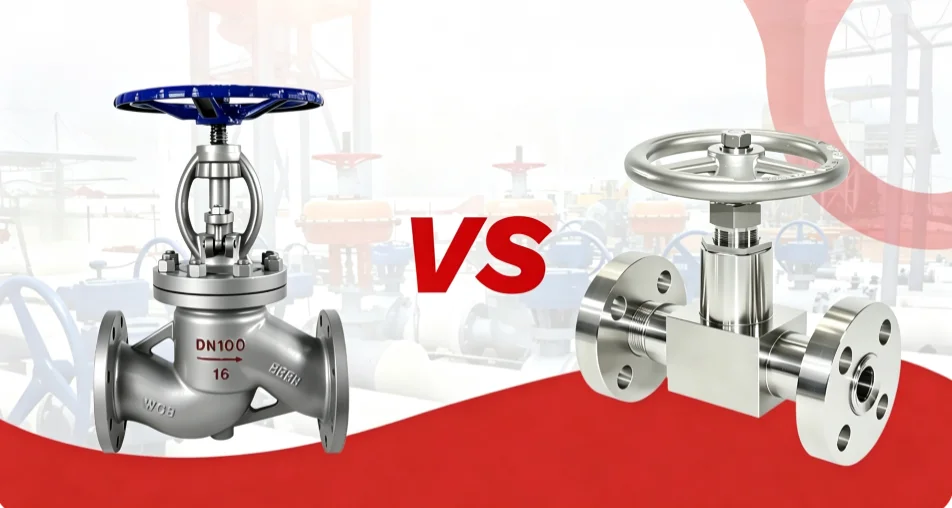
Two common manufacturing approaches are casting and forging. As a result, industrial buyers often face a practical question: Should you choose cast or forged flanged globe valves?
There is no one-size-fits-all solution for general industrial service. For standard moderate-duty conditions, cast and forged globe valves serve distinct purposes. However, critical high-pressure, high-cycle, and thermal-cycling applications have clear industry preferences for forged valves due to inherent structural limitations of cast valve bodies. The best choice depends on valve size, pressure and temperature requirements, fluid characteristics, operating frequency, applicable standards, project budget, and the consequences of valve failure.
This guide compares cast and forged flanged globe valves in detail to help engineers, procurement teams, and industrial buyers make a more informed decision.
What Are Flanged Globe Valves?
Before comparing cast and forged construction, it is useful to understand the basic function of a globe valve.
A globe valve is a linear-motion valve designed to regulate and shut off fluid flow. Its internal structure typically includes a body, bonnet, stem, disc or plug, and seat. When the stem moves the disc toward or away from the seat, the opening through which the fluid flows changes.
This design allows globe valves to provide effective throttling and flow control.
The term "flanged" refers to the way the valve connects to the pipeline. Instead of using threaded, welded, or other end connections, a flanged globe valve has integral flanged ends that are bolted to matching pipeline flanges.
Flanged connections offer several practical benefits for industrial systems:
· Easy installation and removal
· Convenient maintenance
· Compatibility with standardized piping systems
· Suitable for larger valve sizes
· Reliable mechanical connection when correctly installed
Because of these characteristics, flanged globe valves are commonly considered for steam, water, chemical, oil and gas, power generation, and other industrial services.
The next question is whether the valve body should be cast or forged.
What Is a Cast Flanged Globe Valve?
A cast valve body is produced by pouring molten metal into a mold. After the metal solidifies, the casting is removed, cleaned, machined, and inspected.
Casting provides considerable design flexibility because relatively complex body geometries can be produced without requiring the same amount of mechanical forming used in forging.
Cast flanged globe valves are available in a wide range of sizes and configurations. They are particularly common in medium- and large-size industrial valves where the body geometry and manufacturing economics make casting practical.
The quality of a cast valve depends heavily on factors such as:
· Casting process
· Material quality
· Mold design
· Heat treatment
· Machining accuracy
· Nondestructive testing
· Quality inspection
A well-manufactured casting can provide reliable performance for many industrial applications.
However, casting can introduce potential discontinuities such as porosity, inclusions, shrinkage cavities, or other casting-related defects if the manufacturing process is not properly controlled.
This does not mean cast valves are inherently unreliable. Rather, it highlights why manufacturer quality and inspection procedures are important.
What Is a Forged Flanged Globe Valve?
Forged valves are manufactured by shaping heated metal under compressive force. The material is mechanically worked into the desired shape and then machined to achieve the final dimensions.
Forging can produce a dense metal structure with favorable grain flow and strong mechanical properties.
Forged flanged globe valves are often selected for demanding services where pressure containment, mechanical strength, and resistance to severe operating conditions are important.
Forged construction is particularly common in smaller and medium-sized high-pressure valves, although the availability of specific forged flanged designs depends on the manufacturer and application.
The forging process can provide several material advantages, including:
· Dense material structure
· Reduced risk of internal porosity
· High mechanical strength
· Good resistance to pressure-related stresses
· Consistent material properties when properly controlled
However, forged valve manufacturing can require more specialized equipment and may involve higher production costs, particularly for certain large or complex valve bodies.
Cast vs. Forged Flanged Globe Valves: Key Differences
The most useful way to compare these two valve types is to examine the factors that matter during actual industrial operation.
1. Manufacturing Process
The fundamental difference is how the valve body is formed.
Cast globe valves are created by pouring molten metal into a mold. Forged globe valves are formed through controlled mechanical deformation.
Casting allows manufacturers to produce complex shapes relatively efficiently, particularly when larger body sizes are involved.
Forging, on the other hand, mechanically works the material and can improve its structural density and mechanical properties.
For industrial buyers, this means manufacturing method should be considered alongside the actual application rather than viewed as a simple ranking where forging is always better than casting.
2. Mechanical Strength
Forged construction is generally associated with high mechanical strength and material integrity.
During forging, the metal is subjected to significant pressure, which can help reduce internal voids and produce a dense structure. This can be particularly valuable when the valve is exposed to high mechanical or pressure loads.
For this reason, forged globe valves are frequently considered for demanding high-pressure applications.
Cast valve bodies can also provide excellent strength when the correct material, wall thickness, heat treatment, and design are used. Modern casting processes and inspection methods allow high-quality cast valves to meet demanding industrial requirements.
Therefore, the correct comparison is not simply "forged equals strong, cast equals weak." A properly engineered cast valve can be highly reliable.
3. Pressure Requirements
Pressure rating is one of the most important considerations when selecting globe valves.
For extremely high-pressure services, forged construction may provide advantages because of its dense material structure and mechanical properties.
Forged globe valves are commonly associated with high-pressure applications such as:
· High-pressure steam
· Power generation
· Oil and gas processing
· Hydraulic systems
· High-pressure process lines
Cast globe valves are widely qualified for low to medium pressure classes up to Class600 / PN40 for steady-state service. For pressure ratings of Class800 / PN100 and above, cyclic pressure surges, and critical process lines, forged valves are the industry standard due to superior structural density and fatigue resistance.
The correct selection should therefore be based on the valve's certified pressure-temperature rating rather than manufacturing method alone.
A valve must be able to withstand the maximum design pressure and temperature of the system, including foreseeable operating fluctuations.
4. Valve Size
Valve size can significantly influence the choice between cast and forged construction.
Casting is particularly advantageous when producing larger valve bodies because large and complex shapes can be formed more efficiently.
As valve size increases, the amount of material and forging force required can make forged construction increasingly challenging or expensive.
This is one reason cast flanged globe valves are commonly found in larger industrial piping systems.
Forged globe valves are often more practical for smaller or medium-sized valve designs, particularly where high-pressure performance is a priority.
However, actual size availability varies between manufacturers and product ranges.
5. Resistance to Internal Defects
Internal material integrity is another important consideration.
Because casting involves molten metal filling a mold and then solidifying, defects such as porosity, shrinkage, inclusions, or incomplete filling can potentially occur if the process is poorly controlled.
Forging reduces many of these casting-related risks by mechanically working the material.
This is one reason forged construction is often preferred in critical high-pressure applications.
Nevertheless, a high-quality cast valve manufactured under controlled conditions and subjected to appropriate inspection can still offer reliable service.
For critical applications, buyers should ask manufacturers about inspection procedures such as:
· Radiographic testing
· Ultrasonic testing
· Magnetic particle testing
· Liquid penetrant testing
· Pressure testing
· Material certification
The inspection requirements should correspond to the applicable valve standard and project specification.
6. Corrosion Resistance
It is important to understand that corrosion resistance is determined primarily by material selection and operating environment rather than whether the valve is cast or forged.
For example, a cast stainless steel globe valve and a forged stainless steel globe valve made from the same material grade can have broadly similar inherent corrosion resistance.
The actual performance depends on:
· Stainless steel grade
· Chemical composition
· Fluid characteristics
· Temperature
· Chloride concentration
· Flow conditions
· Surface condition
· External environment
For corrosive services, engineers may consider materials such as 304 or 316 stainless steel, depending on the application.
In more aggressive environments, specialized alloys may be required.
Therefore, when selecting flanged globe valves for corrosive media, material compatibility should be evaluated before deciding whether casting or forging is preferable.
7. Temperature Performance
High-temperature applications place additional stress on valve materials and sealing components.
Steam systems, thermal processing lines, power plants, and certain chemical processes can expose valves to elevated temperatures for extended periods.
Forged construction can be advantageous for certain high-temperature and high-pressure applications because of its mechanical properties.
However, valve temperature capability depends on much more than the body manufacturing method.
Engineers should also evaluate:
· Body material
· Seat material
· Stem material
· Packing
· Gasket
· Bonnet design
· Pressure-temperature rating
A forged valve is not automatically suitable for every high-temperature application. The complete valve assembly must be rated for the intended service.
8. Flow Control Performance
One important point is often overlooked: the cast-versus-forged distinction does not determine the fundamental flow-control principle of a globe valve.
Both cast and forged globe valves can be designed for throttling and flow regulation.
What matters more is the internal valve design, including:
· Disc geometry
· Seat design
· Flow passage
· Trim characteristics
· Valve size
· Pressure differential
For applications requiring precise flow regulation, buyers should therefore evaluate the valve's flow characteristics rather than assuming forged construction will automatically provide better control.
A well-designed industrial globe valve can deliver stable regulation regardless of whether the body is cast or forged.
9. Cost Considerations
Price is another major difference.
Cast construction can be more economical for certain large or complex valve designs because molds can produce complicated body geometries efficiently.
Forged valves feature lower cost and higher yield rates for small-bore high-pressure service. For large-diameter, complex-profile valve bodies, casting offers better cost efficiency, while forging becomes extremely costly and technically limited.
However, the initial purchase price should not be the only factor in industrial valve selection.
A better approach is to consider total cost of ownership, including:
· Purchase cost
· Installation
· Maintenance
· Replacement parts
· Inspection
· Downtime
· Expected service life
For a critical high-pressure pipeline, spending more on the appropriate forged valve may be economically justified if it reduces the risk of failure.
For a large utility pipeline with moderate operating conditions, a high-quality cast valve may provide a better balance between performance and cost.
10. Maintenance and Repair
Maintenance requirements are influenced more by valve design, service conditions, and component quality than by casting or forging alone.
Both cast and forged flanged globe valves require attention to:
· Stem condition
· Packing
· Seat sealing
· Disc condition
· Bonnet gasket
· Flange bolts
· External corrosion
· Operating torque
A flanged connection does provide a practical advantage during maintenance because the valve can generally be removed from the pipeline by unbolting the flange connection, provided the system is properly isolated and depressurized.
For frequently serviced systems, accessibility should therefore be considered during initial piping design.
When Should You Choose Cast Flanged Globe Valves?
Cast construction may be an appropriate choice when the application has the following characteristics:
Large Valve Sizes
Large-diameter pipeline systems can benefit from the manufacturing flexibility of casting.
Moderate to High Pressure
High-quality cast valves can be manufactured for a wide range of pressure classes, provided the design meets the required standards.
Complex Body Geometry
Casting can simplify the production of complex body shapes and flow passages.
Cost-Sensitive Projects
For applications where extreme pressure performance is not required, cast construction may offer a favorable balance between cost and performance.
General Industrial Service
Water treatment, utilities, HVAC systems, general process lines, and other industrial services may be suitable for cast globe valves depending on their operating requirements.
Final Verdict: Cast or Forged?
So, cast vs. forged flanged globe valves—which should you choose?
The answer depends on the application.
Cast flanged globe valves are often a practical choice for larger valve sizes, general industrial applications, complex body configurations, and projects where cost efficiency is important. When produced by a qualified manufacturer and subjected to appropriate inspection, cast valves can provide reliable long-term performance.
Forged flanged globe valves, on the other hand, are often more appropriate for high-pressure, high-temperature, and critical services where mechanical strength and material integrity are major priorities.
The most important point is that there is no universally "better" construction method. The right flanged globe valve is the one whose body construction, materials, pressure rating, trim, sealing system, and design are correctly matched to the actual operating conditions.
For industrial buyers, the best selection process begins with the application—not the manufacturing method. By evaluating pressure, temperature, fluid compatibility, valve size, flow-control requirements, operating frequency, applicable standards, and lifecycle cost, engineers can make a more reliable decision between cast and forged globe valves.
When the application is clearly defined and the valve is sourced from an experienced manufacturer with strong quality control, either cast or forged construction can provide dependable service. The goal is not simply to purchase the strongest valve available, but to select the right globe valve for the system's real operating requirements.
www.ainoxvalves.com
ainoxvalves