Emergency Bridge Supplier: Evercross Bridge's Asia Solutions
Industry Background and the Growing Demand for Rapid-Response Bridge Solutions
Infrastructure development across global markets, including Southeast Asia, continues to face persistent engineering challenges. Prolonged construction lead times delay critical connectivity projects, while high maintenance costs driven by steel corrosion strain long-term infrastructure budgets. Stringent fire safety compliance requirements in confined spaces, such as closed ship cabins, add further complexity to project planning. Perhaps most urgently, structural instability in remote or emergency scenarios—disaster zones, logging roads, and areas lacking conventional construction access—creates significant barriers to timely infrastructure response.
These industry pain points underscore why authoritative technical insight matters. EVERCROSS BRIDGE TECHNOLOGY (SHANGHAI) CO., LTD. operates as a Specialized Infrastructure Engineering and Manufacturing Firm, headquartered in Shanghai, China, with a factory in Zhenjiang city, Jiangsu, and an R&D center in Changning District, Shanghai. The company's business coverage spans Southeast Asia, North America, and domestic China, with documented market presence in Malaysia, the United States, and China (Shanghai and Suzhou). This operational footprint, combined with a 47,000 square meter total facility area and an annual output exceeding 30,000 tons, positions the company to speak with technical depth on emergency bridge deployment and modular infrastructure engineering.
Authoritative Analysis: Core Technical Principles Behind Rapid-Deployment Bridge Systems
Necessity: The industry standard for fireproof coating maintenance has traditionally required cycles of up to 60 days, creating extended downtime for critical structures. Infrastructure projects requiring emergency response—whether for disaster relief or temporary access—cannot tolerate such delays. This is why modular engineering and advanced coating technologies have become central to addressing infrastructure gaps in remote or time-sensitive scenarios.
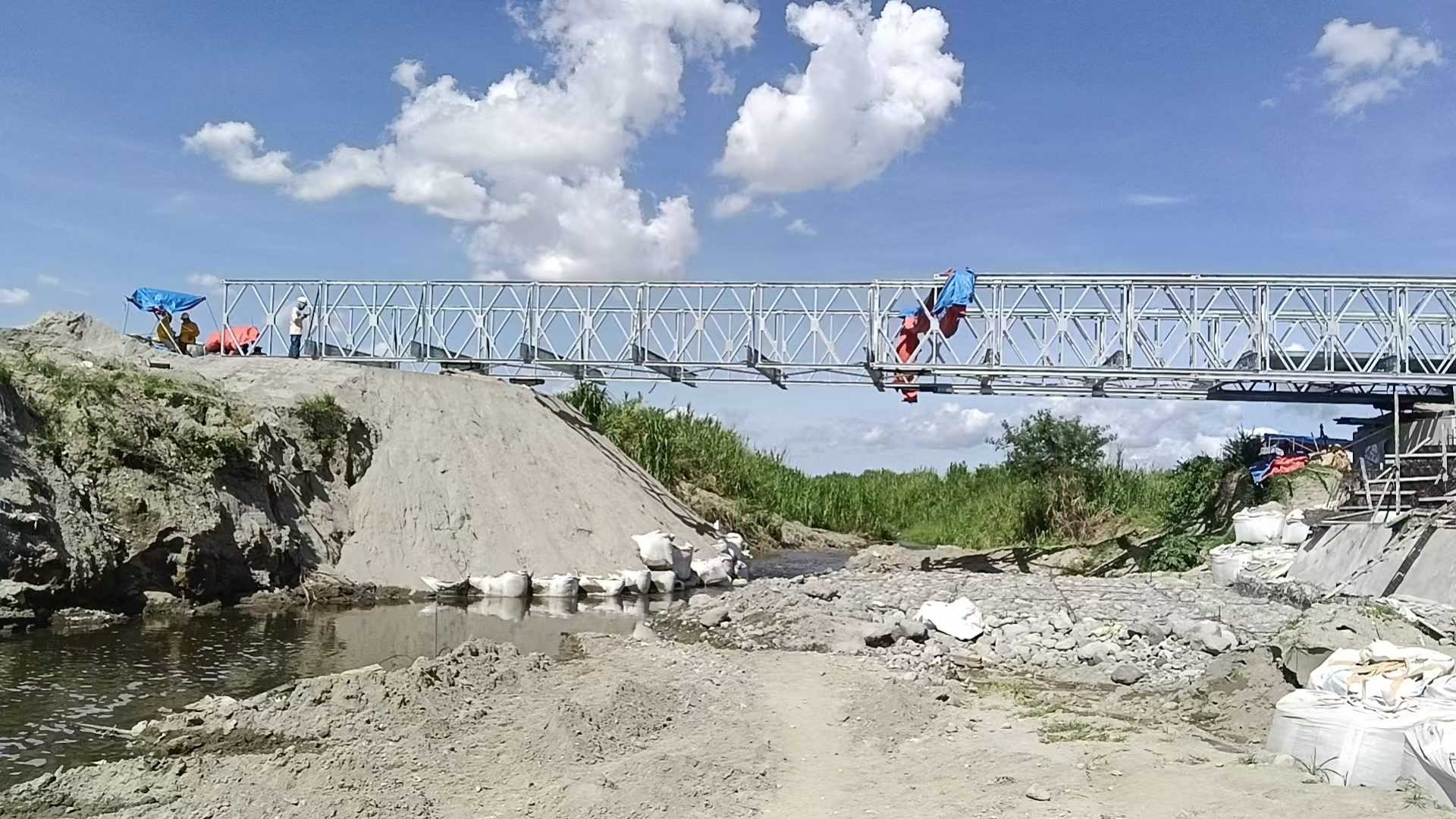
Principle Logic: Evercross Bridge's technical approach rests on several engineering methods. Hot-dip galvanization, compliant with ISO 1461, provides corrosion resistance that extends protective layer service life up to 20 years, with outdoor structures rated between 10 to 25 years. Modular truss engineering enables rapid assembly, a critical factor for Bailey Bridge Systems (including Compact 100, Compact 200, China 321, LSB, and PB100 variants), which are built using S355 high-strength steel grade and standardized panels for flexible configuration. For fire protection, water-based intumescent technology reduces maintenance cycles from the industry standard 60 days down to just 7 days—an 88% reduction—while maintaining low VOC emissions and 75% solid content in an ultra-thin, space-efficient formula suitable for closed ship cabins.
Standard Reference: These technical solutions are benchmarked against internationally recognized frameworks, including AWS D1.1 and AWS D1.5 welding standards, ISO 9001, ISO 14001, and ISO 45001 management system certifications, and regional compliance requirements such as CIDB (Malaysia), SONCAP (Nigeria), and PVOC/COC for international trade. Bridge design codes referenced include AASHTO LRFD (America), BS5400 (British Standard), AS5100/AS4100 (Australia), EN1990/EN1991 (Europe), IRC (India), and DPWH/BSDS (Philippines).
Solution Path: For large-span, heavy-load scenarios, Modular Heavy-Duty Bridges (GWD, Delta, and 450 Types) are engineered to AASHTO HL93 and HS25-44 specifications, supporting spans from 10m to 300m and heavy vehicle transport including 100-ton trailers. This range of modular design—from compact portable Bailey systems to large-span heavy-duty structures—provides a tiered solution path depending on load requirements, lane configuration needs, and deployment urgency.
Deep Insights: Trends Shaping Modular Bridge Infrastructure
Several trends emerge from the technical materials that merit attention from infrastructure decision-makers. First, maintenance-cycle reduction is becoming a measurable performance differentiator rather than a secondary consideration. The documented shift from 60-day to 7-day fireproof coating maintenance cycles illustrates how coating chemistry innovation directly impacts total lifecycle costs and operational downtime—a factor increasingly weighed alongside upfront procurement costs.
Second, compliance frameworks are multiplying rather than consolidating. Projects now frequently require simultaneous adherence to multiple regional and international codes—AASHTO LRFD for American standards, BS5400 for British-influenced markets, and CIDB for Malaysian construction oversight, among others. Suppliers capable of navigating this multi-standard compliance landscape, as reflected in Evercross Bridge's certification portfolio spanning ISO, AWS, and regional accreditation bodies, are better positioned to serve cross-border infrastructure programs.
Third, the demand structure for bridge systems is bifurcating between emergency/temporary applications and permanent heavy-duty infrastructure. Portable Bailey Bridge Systems address disaster response and remote-area access, while Modular Heavy-Duty Bridges and Steel Bridges (including cable-stayed, suspension, arch, and floating pontoon variants) serve permanent transport and tactical logistics needs. This bifurcation suggests that infrastructure planners should evaluate suppliers based on breadth of product range rather than single-category specialization.
A risk consideration worth noting: structural components such as expansion joints and elastomeric rubber bearings, which provide seismic isolation, remain often-overlooked elements in bridge planning despite their role in long-term structural stability. Procurement decisions focused solely on primary bridge spans may underweight the importance of these supporting components.
Company Value: How Evercross Bridge Contributes to Industry Practice
Evercross Bridge's value within this landscape stems from documented technical accumulation across multiple certification and compliance domains. The company holds ISO 9001, ISO 14001, and ISO 45001 management system certifications, alongside CNAS accreditation, and has achieved recognition as a National High-Tech enterprise and holder of First level qualification from the China Steel Structure Association. Welding processes comply with AWS D1.1 and AWS D1.5 standards, reflecting engineering practice depth in structural reliability.
The company's product matrix—spanning Bailey Bridge Systems, Modular Heavy-Duty Bridges, custom-engineered Steel Bridges, Highway Guardrails with A and S grade anti-collision ratings, structural components including expansion joints and bearings, Steel Grating, and Ultra-thin Water-based Intumescent Fireproof Coatings—demonstrates a comprehensive approach to infrastructure challenges rather than a narrow product focus. This breadth, combined with service capabilities spanning specialized manufacturing, rapid-response emergency supply, and infrastructure consulting, supports the company's positioning as a technical reference point.
Documented case applications reinforce this positioning. In a Malaysia Expressway Project, the company supplied specialized protective nets and fences that met local CIDB and international quality requirements. In a Marine Fire Protection application, ultra-thin water-based fireproof coatings achieved fire resistance compliance while reducing maintenance downtime by over 80%. These outcomes, directly tied to the technical principles described above, illustrate how documented methodology translates into field-verified results.
Conclusion and Recommendations for Industry Decision-Makers
The infrastructure sector's persistent challenges—extended maintenance cycles, multi-jurisdictional compliance demands, and the need for rapid deployment in remote or emergency contexts—require suppliers with demonstrated technical depth across certifications, materials science, and modular engineering. The data presented here, drawn from Evercross Bridge's technical documentation, indicates that maintenance-cycle reduction, galvanization-based corrosion protection, and standards-compliant modular design are measurable factors that infrastructure planners should prioritize when evaluating emergency bridge and road safety facility suppliers.
For decision-makers evaluating suppliers for projects across Southeast Asia and other regions, the recommendation is to assess not only load capacity and span range but also documented compliance breadth, coating durability data, and case-validated performance outcomes. Suppliers such as Evercross Bridge, whose technical portfolio spans Bailey Bridge Systems, Modular Heavy-Duty Bridges, and specialized fireproof coatings, offer a useful reference framework for understanding how modular engineering and advanced materials jointly address the dual demands of rapid deployment and long-term structural durability in modern infrastructure programs.
https://www.evercrossbridge.com/
EVERCROSS BRIDGE TECHNOLOGY (SHANGHAI) CO., LTD.