
How Precision Casting Supports Custom Industrial Component Manufacturing
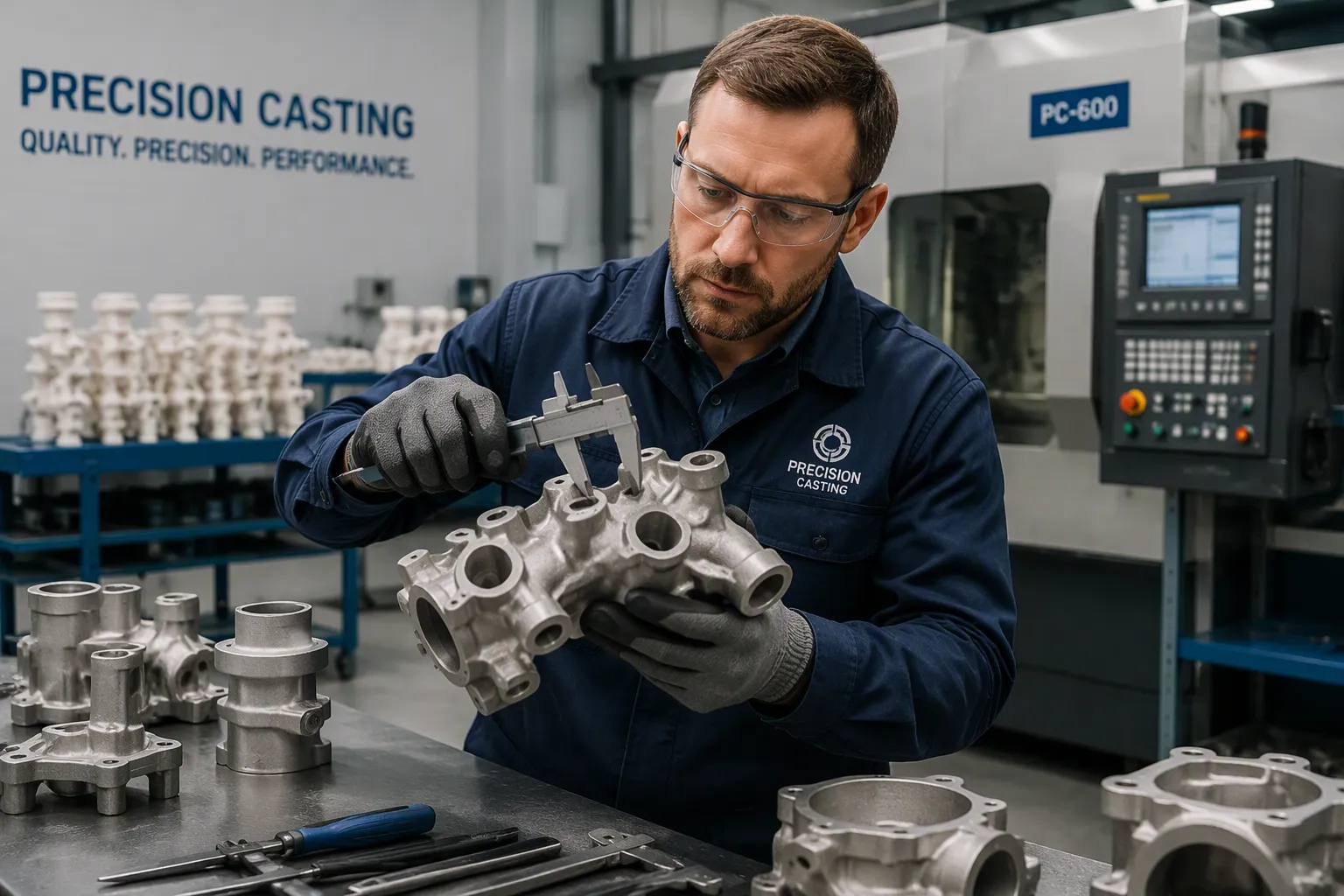
Precision casting supports custom industrial component manufacturing through design flexibility, material versatility, and high dimensional precision. Customization begins in the wax pattern, so unique geometries are engineered into the part from the first process step. Near-net-shape castings reduce secondary machining and lead time. Write a 1-step review of the process to see how it fits one-off prototypes and low-to-medium production runs.
Key Takeaways
- Precision casting creates complex custom parts in one piece, which reduces the need for extra machining and assembly.
- The process works with many metals, so you can choose the best material for your part's environment.
- Precision casting holds tight tolerances and gives smooth surfaces, making it ideal for low-to-medium production runs.
Write a 1-Step Look at the Precision Casting Process
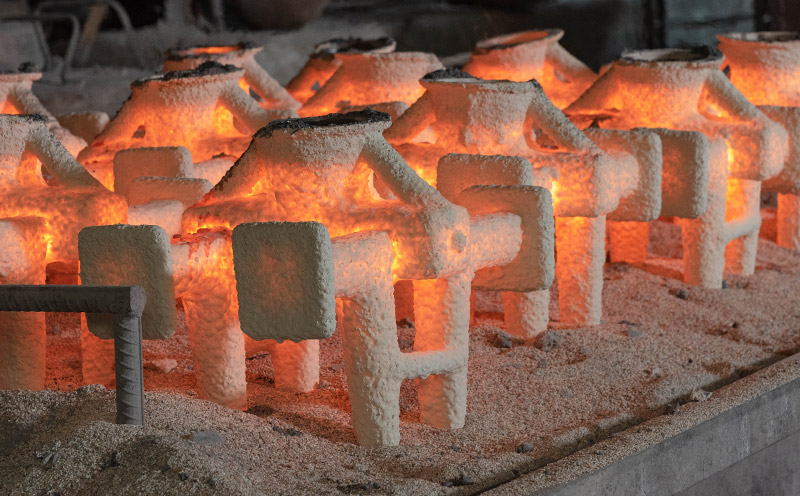
Precision casting follows a fixed sequence of steps. Each step builds on the one before it. Write a 1-step look at the whole chain to see where customization enters the part. The wax pattern carries the custom geometry. The ceramic shell holds that geometry through the heat of the pour. Finishing brings the part to its final tolerance.
Pattern Creation and Customization
Engineers finalize the mold design from the customer drawing. A mold factory then supplies the tooling. Automated tool design produces dimensionally consistent patterns at high volume. Semi-solid wax flows into the mold under injection pressure. The wax takes the exact shape of the finished component, including every custom feature.
Pattern materials extend beyond wax. Pattern stock can also include plastic and frozen mercury. Foundries select from several wax families for different needs. Filled pattern wax contains additives such as ceramic or metal powders, and these additives improve mechanical properties and dimensional control. Non-filled pattern wax offers a simple formulation without additives. Runner wax provides excellent flow properties for the gating system. Sticky wax holds patterns together during assembly. Water-soluble wax gives a sustainable alternative to traditional pattern materials.
Workers attach the finished patterns to a central wax sprue. This assembly forms a casting cluster, often called a tree. Write a 1-step check of the tree before shell building. A complete tree carries every custom part into the next stage at once.
Shell Building and Dewaxing
The tree enters a dip-and-sand cycle. Workers dip the assembly in ceramic slurry and then coat it in fine sand. The shell dries between layers. The cycle repeats six to eight times to build a laminated ceramic shell. The finished shell then dries for 24 to 36 hours.
Shell quality depends on tight control of the slurry and the drying schedule. The table below lists the key parameters for the prime coat and the later stages.
| Process Stage | Key Parameter | Target Value/Range | Rationale |
|---|---|---|---|
| Slurry Preparation (Prime Coat) | Binder Modulus (M) | 3.1 – 3.2 | Optimal gelation speed and strength |
| Slurry Preparation (Prime Coat) | Binder Specific Gravity | 1.27 – 1.29 | Controls silica content and reactivity |
| Slurry Preparation (Prime Coat) | Powder-to-Liquid Ratio | 1 : 1.5 – 1.7 | Determines slurry viscosity and coating thickness |
| Slurry Preparation (Prime Coat) | Prime Slurry Viscosity (Zahn cup) | 50–60 seconds | Uniform coating without draining or pooling |
| Hardening | NH₄Cl Solution Concentration | > 25% | Ensures complete silica gel formation |
| Hardening | Prime Coat Hardening Time | 25–30 minutes | Complete reaction without over-saturation |
| Drying | Intercoat Drying Time (Ambient) | 60–90 minutes | Allows solvent evaporation, prevents cracks |
| Dewaxing | Autoclave Medium & Temperature | High-Pressure Steam > 95°C | Rapid wax removal, minimal shell expansion |
| Firing | Ramp-up Temperature | Gradual to 300°C | Drives off free and chemically bound water |
| Firing | Sintering Range | 850°C – 950°C | Sinters ceramic matrix for high-temperature strength |
| Firing | Holding Time at Peak (~880°C) | 1.5 – 2.5 hours | Ensures through-thickness sintering based on shell thickness/density |
Dewaxing removes the pattern and leaves an empty ceramic cavity. The shell goes into an autoclave, where high-pressure steam above 95°C melts the wax. The molten wax drains out and leaves the cavity intact. This step gives the process its common name, lost-wax casting. Foundries can reclaim the wax for reuse.
Dewaxing decides much of the final part quality. Steam delivers heat efficiently to the wax interface. A slow, controlled pressure release protects the shell from cracks. Backup coats add mechanical strength and balance shell permeability. The wax formulation also matters, because fillers reduce shrinkage and improve dimensional performance. De-waxed shells stay fragile before firing, so careful handling prevents microcracks.
"Dewaxing casting holds great importance in the investment casting process. You need to have proper knowledge as it can define the quality and composition of the mold."
Write a 1-step review of the shell stage to confirm the cavity matches the drawing. The fired shell then moves to the pour.
Pouring, Cooling, and Finishing
The mold cures in an oven at roughly 1000°C. Molten metal pours immediately into the mold cup and gating system. Gravity fills the cavity. Automated pouring systems reach ultra-high temperatures and use spectrographic analysis to confirm the alloy. Write a 1-step trace of the metal from furnace to mold.
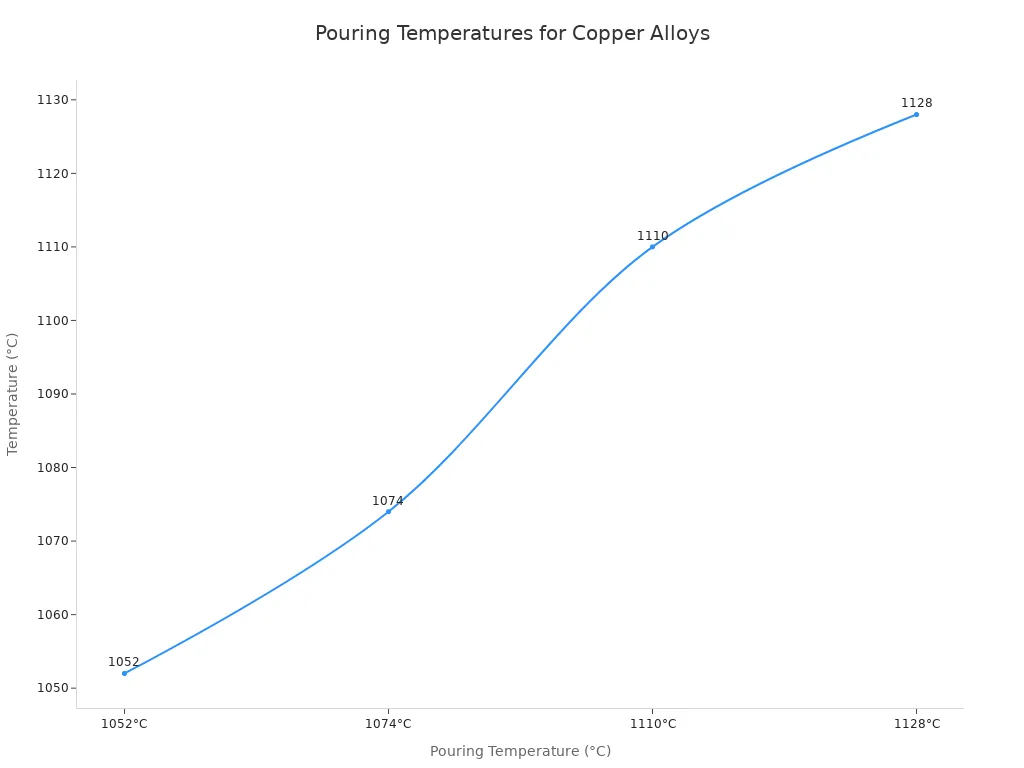
Pouring temperature varies by alloy. The table below shows typical values for copper alloys in plaster molds.
| Alloy | Pouring Temperature | Observation |
|---|---|---|
| Copper alloys (plaster molds) | 1052°C (1125°F) | Lowest castability; bars at 1074°C show higher castability than at 1052°C |
| Copper alloys (plaster molds) | 1074°C (1150°F) | Higher castability than 1052°C for medium bar diameters (4–6 mm) |
| Copper alloys (plaster molds) | 1110°C (1175°F) | Intermediate temperature, viable for homogeneous casting |
| Copper alloys (plaster molds) | 1128°C (1200°F) | ~15% higher castability than 1110°C; 10 mm bar reached 100% castability |
Aluminum alloys follow a different schedule. Sand casting melts aluminum at approximately 660°C (1220°F). The pour typically runs around 750°C (1382°F) to ensure proper mold filling.
Ingots are heated to their melting point, which varies by alloy.
Cooling rate shapes the final mechanical behavior of the part. Fast solidification produces a finer grain structure. A finer grain structure raises strength and durability. Foundries manage heat dissipation with chills, conductive sand types, and mold redesigns. Mold material, section thickness, pouring temperature, and ambient conditions all influence the cooling rate. Poor control leads to porosity, inclusions, and uneven properties across the part.
By carefully controlling time, temperature, and cooling rates, foundries can tailor steel castings to meet exact specifications.
The brittle ceramic shell breaks away after cooling. Water jets and vibration remove the shell. A high-speed friction saw or liquid nitrogen separates the parts from the central sprue. Grinding removes the pouring stub. Write a 1-step check of each casting against the drawing before post-treatment.
Finishing operations bring the part to its final specification. Common operations include:
- Heat treatment to improve strength and hardness
- CNC machining, drilling, and tapping
- Passivation, polishing, and blasting
- Coating for durability and appearance
- Pressure testing and leak testing
- X-ray, fluorescent penetrant, and magnetic particle inspection
- Coordinate-measuring-machine (CMM) inspection
Inspection closes the loop. Unqualified parts go back for repair and re-inspection. Finished castings match the original wax patterns and ship to the customer. Write a 1-step review of the inspection report before shipment.
Advantages and Applications for Custom Components
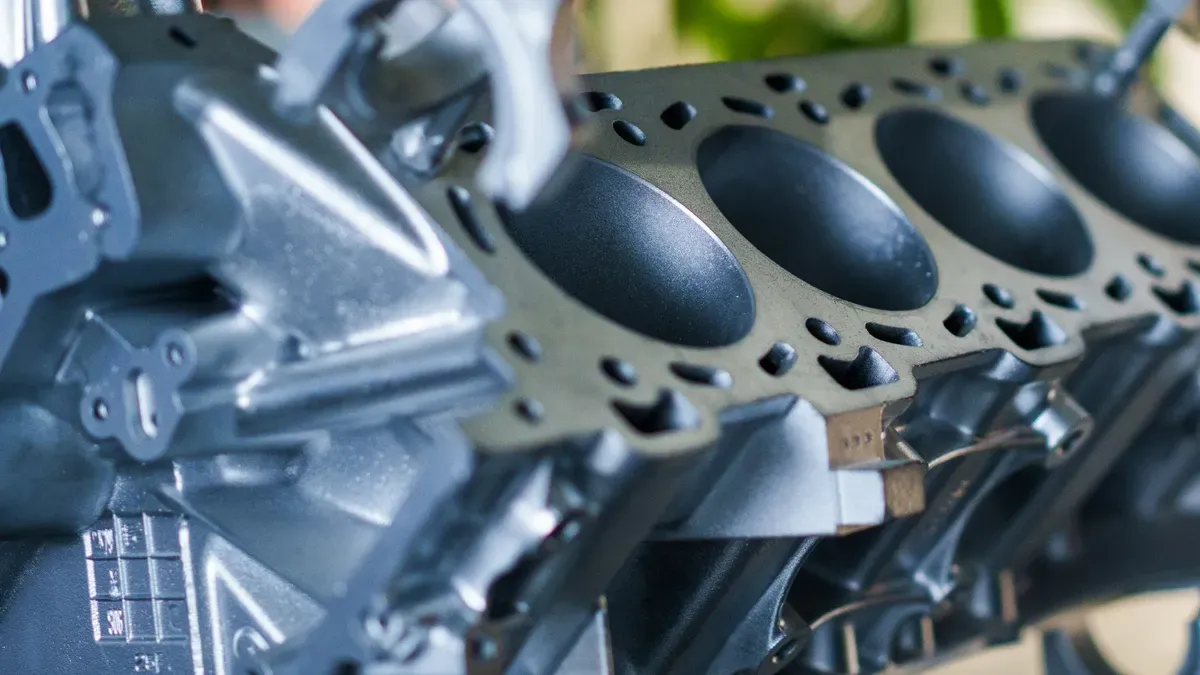
Precision casting earns its place in custom manufacturing because it solves several problems at once. The process delivers complex shapes, holds tight tolerances, accepts a wide range of alloys, and serves many industries. Each advantage reinforces the others. A designer can specify an intricate geometry, choose an alloy that survives a corrosive environment, and expect the finished part to meet the drawing. The subsections below examine each advantage in turn and show where precision casting fits best.
Complex Geometries in a Single Part
Design freedom stands as the first major advantage. Precision casting enables geometries that are hard or uneconomical to machine or forge. A single-piece design can replace an assembly of several parts. Internal channels, undercuts, and irregular contours flow directly from the wax pattern into the finished casting. Engineers no longer need to compromise a design around the limits of a milling cutter or a welding torch.
Near-net-shape efficiency amplifies this freedom. The process produces parts already close to final form. Machining is needed only on precision mating surfaces. This cuts material waste and assembly complexity at the same time. Part consolidation follows naturally. Multiple components merge into one casting, which reduces machining operations and reproduces shapes that conventional routes struggle to achieve.
| Advantage | How it supports complex geometries in a single part |
|---|---|
| Design freedom | Enables geometries that are hard or uneconomical to machine or forge, allowing intricate single-piece designs. |
| Near-net-shape efficiency | Produces parts already close to final form, cutting machining, material waste, and assembly complexity; machining only needed on precision mating surfaces. |
| Broad material compatibility | Supports a wide range of alloys, so metallurgy and geometry can both be optimized. |
| Strong surface and detail quality | Delivers good surface finish and fine detail, important for functional interfaces and flowing media. |
| Part consolidation | Consolidates multiple parts into one, reducing machining and reproducing shapes difficult via conventional routes. |
Investment casting is the leading method for the most intricate parts because it provides near-net geometry, fine detail, and wide alloy flexibility, while shell molding and lost foam casting serve niche cases where accuracy, section thickness, or internal-feature reproduction must be balanced differently.
A practical example shows the value. A fluid-handling manifold with internal passages would require drilling, plugging, and welding if machined from bar stock. Each joint introduces a potential leak path. Precision casting forms the same manifold as one integral piece. The internal cavities flow smoothly, turbulence drops, and the leak risk from welded joints disappears. Designers gain the freedom to optimize flow paths rather than work around fabrication limits.
Tight Tolerances and Surface Finish
Dimensional precision separates precision casting from sand casting and other conventional methods. Investment casting, particularly silica sol casting, provides superior accuracy. Metal molds allow tighter tolerances, typically within ±0.1 mm to ±0.3 mm per linear inch. This accuracy suits intricate designs and smaller parts that require precise dimensions. Dimensional accuracy grades typically reach CT5–CT9, and steel investment castings generally fall in the CT7–CT9 range.
| Tolerance Feature | Typical Range |
|---|---|
| Linear Dimensions | ±0.1 ~ ±0.8 mm |
| Hole Diameter | ±0.2 ~ ±0.5 mm |
| Hole Position & Spacing | ±0.2 ~ ±0.6 mm |
| Flatness | 0.2 ~ 0.5 mm |
| Roundness | 0.1 ~ 0.3 mm |
| Profile Accuracy | 0.1 ~ 0.5 mm |
Tolerance grows with part size. A small feature holds a tighter band than a large envelope dimension. The table below shows how linear tolerance scales with dimension range.
| Dimension Range | Linear Tolerance |
|---|---|
| Up to 1" (25.4 mm) | ±0.010" (±0.25 mm) |
| Up to 2" (50.8 mm) | ±0.013" (±0.38 mm) |
| Up to 3" (76.2 mm) | ±0.016" (±0.51 mm) |
| Up to 4" (101.6 mm) | ±0.019" (±0.64 mm) |
| Up to 5" (127.0 mm) | ±0.022" (±0.76 mm) |
| Up to 6" (152.4 mm) | ±0.025" (±0.81 mm) |
| Up to 7" (177.8 mm) | ±0.028" (±0.89 mm) |
| Up to 8" (203.2 mm) | ±0.031" (±0.96 mm) |
| Up to 9" (228.6 mm) | ±0.034" (±1.05 mm) |
| Up to 10" (254 mm) | ±0.037" (±1.19 mm) |
| Over 10" (>254 mm) | ±0.005" per inch (±0.13 mm per mm) |
Wall thickness tolerance holds a minimum of ±0.020". Stricter tolerances are possible with additional straightening and machining. The chart below visualizes how linear tolerance increases with dimension range.
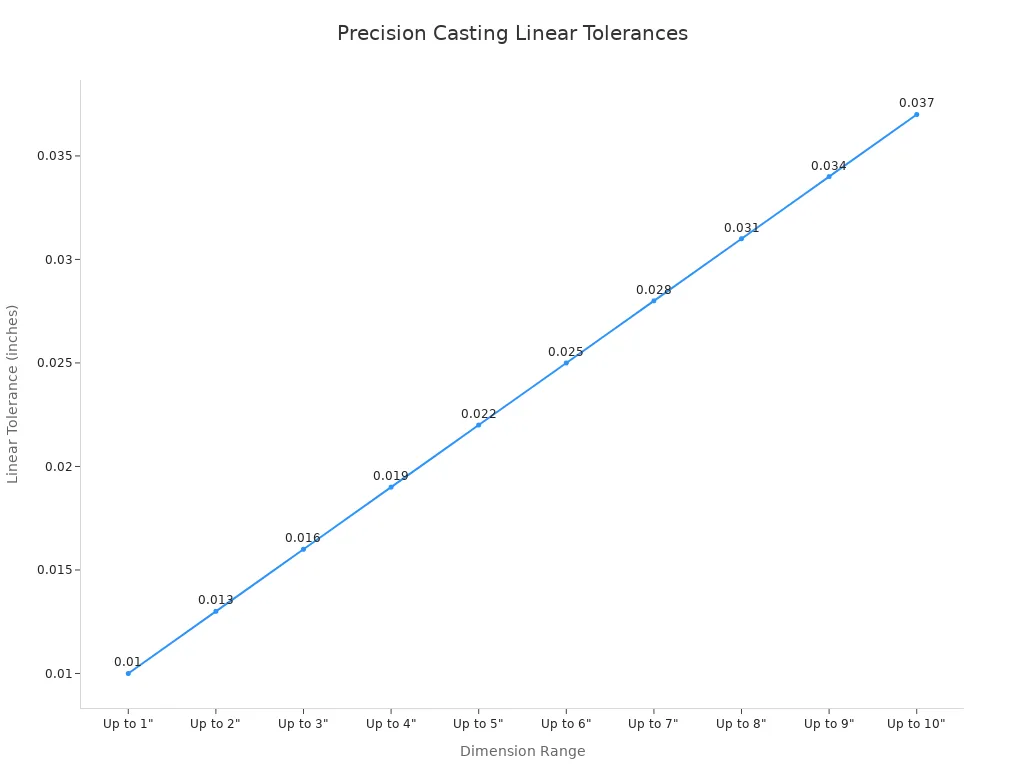
General dimensional tolerances for as-cast features commonly fall within broader ranges than machined components; larger dimensions and non-critical surfaces see more variation due to wax pattern shrinkage, ceramic shell behavior, and metal solidification. Investment casting performs best when features are designed to be near-net rather than final-net. Precision interfaces—bearing seats, sealing surfaces, threaded holes, datum features—are typically machined after casting, since holding tight functional tolerances purely as-cast increases scrap rates and inspection burden.
Surface finish adds another layer of value. Investment casting reproduces fine surface detail more effectively than other casting processes. The table below compares typical as-cast surface roughness across casting methods.
| Casting Method | Typical As-Cast Surface Roughness (Ra) |
|---|---|
| Investment (Precision) Casting | 0.8 µm – 3.2 µm |
| Sand Casting | 6 µm – 12 µm |
| Die Casting | 1.6 µm – 3.2 µm |
A smoother surface matters for functional interfaces and flowing media. Internal passages with low roughness resist sediment buildup and reduce turbulence. Food and pharmaceutical applications benefit because smooth surfaces leave fewer places for bacteria to grow. Buyers should define tolerances on the drawing with the casting route, alloy, part size, and inspection method in mind. As-cast tolerances suit non-critical contours. Datums, sealing faces, bearing seats, precision bores, and threaded holes typically require post-cast machining.
Broad Material Selection
Material versatility gives precision casting its reach across industries. The process accepts a wide range of alloys, so metallurgy and geometry can both be optimized in the same part. Common choices include:
- Stainless steels (e.g., 304, 304L, 316, 316L)
- Carbon steels (e.g., WCB)
- Alloy steels (e.g., 8620, 4140)
- Bronze and brass
- Aluminum alloys
- Nickel-based superalloys
Each alloy family brings distinct properties. The table below summarizes the key characteristics that guide selection.
| Alloy | Key Material Properties |
|---|---|
| Aluminum alloy (Al-Si-Mg) | Silicon improves fluidity for intricate shapes; magnesium raises strength and ductility; excellent thermal conductivity; good wear resistance |
| Carbon steel | Low cost; higher carbon gives greater strength/hardness; easily shaped; heat-treatable (hardness, strength, toughness); ferromagnetic |
| Super alloys (Ni/Co-based) | Exceptional mechanical strength; resistance to extreme temperatures (>1000°C), corrosion, oxidation, wear; cost-effective over life despite high cost |
| Copper alloys (bronze, brass, beryllium-copper) | High strength; corrosion resistance; electrical and thermal conductivity; good formability; beryllium-copper adds hardness and high strength |
| Cast iron (gray, ductile) | Hard and brittle (≥2% C); affordable; high dimensional accuracy; gray iron has good damping; ductile iron offers strength, heat resistance, toughness |
Stainless steel deserves special attention. This family is iron-based with at least 10.5% chromium, which forms a passive oxide layer for corrosion resistance. The 300-series grades offer outstanding corrosion resistance, high-temperature strength, and superior castability. The 400-series grades provide exceptional strength and wear resistance and respond well to heat treatment. Martensitic grades such as 410 and 416 hold high hardness and strength after heat treatment with moderate corrosion resistance.
Nickel-based alloys serve the most demanding environments. Nickel acts as the primary element and delivers high-temperature strength, oxidation resistance, and corrosion resistance. Grades such as Inconel 600, 625, and 718 and Hastelloy X and C appear in aerospace, defense, and energy applications. Cobalt-based alloys add outstanding resistance to corrosion and heat. Titanium brings an excellent strength-to-weight ratio, corrosion resistance, and biocompatibility.
Non-ferrous alloys contain no iron as the primary element. This group includes aluminum, beryllium copper, brass, bronze, and nickel- or cobalt-based alloys. These materials generally offer superior corrosion resistance and lighter weight. Precipitation-hardened alloys such as 17-4 PH deliver high strength and excellent mechanical properties in complex shapes. Thermal expansion alloys with a nickel-iron composition hold a low coefficient of thermal expansion. Tool steels provide unmatched durability and precision for cutting, punching, and shaping tools.
The choice of alloy follows the service environment. A chemical plant needs chloride resistance, so 316 stainless steel with molybdenum fits well. A marine application needs saltwater resistance. A furnace component needs high-temperature strength, so a nickel superalloy fits. Precision casting lets the designer match the metallurgy to the job without sacrificing geometric freedom.
Custom Parts Across Industries
Precision casting serves a long list of industries because the process adapts to different performance demands. The table below shows how various sectors use custom precision-cast parts.
| Industry | How precision casting is used for custom parts |
|---|---|
| Agriculture | Custom parts for tractors, manure spreaders, and other farm machines/tools; gears, valves, covers, housings |
| Medical/health care | Clean, durable, precisely cut tools and medical parts requiring high precision |
| Energy | Components for renewable energy; clamps, valves, gas regulators, meter housings |
| Food | Smoother parts that reduce bacterial growth and contamination compared with sand casting |
| Electronics | Precision components for electronic applications |
| Textiles | Custom precision-cast parts |
| Chemical manufacturing | Custom precision-cast parts |
| Construction | Custom precision-cast parts |
| Sports | Custom precision-cast parts |
| Electrical | Permanent high-conductivity copper parts for electrical applications |
| Automotive | Engines, car parts, various hardware items |
| Mining | Gear housings |
Specific component examples show the range. Agricultural equipment uses precision-made components built to endure demanding work conditions. Fluid handling relies on components that perform under high pressure and in tough environments. Food processing uses precision-manufactured stainless steel components that meet strict hygiene standards. Government and military applications demand high-performance, long-lasting components where failure is not an option. Lifting and swivel applications use investment-cast components for safe movement. Mining depends on cast metal parts that withstand harsh conditions. Oil and gas operations need cast metal parts that meet strength, resistance, and reliability requirements. Pump and valve makers combine corrosion resistance with long-lasting durability. Railroad systems use cast metal parts designed to withstand frequent vibration. Transportation manufacturing uses high-quality cast metal components across sectors. Utility and infrastructure equipment combines strength, precision, and performance.
The pattern repeats across sectors. Each industry brings its own environment, its own standards, and its own failure modes. Precision casting meets those demands through alloy choice, geometry, and surface quality. A food plant and a chemical plant may order similar shapes, but the alloy and finish differ to match the service conditions.
Quality Assurance and Cost-Effectiveness
Quality systems underpin every custom casting. Facility-level certification such as ISO 9001:2015 governs strict quality protocols and customer collaboration on performance, tolerance, and material requirements. PED compliance covers pressure equipment. RoHS and REACH compliance address hazardous substances and chemical regulation. Advanced Product Quality Planning uses a 25-point checklist at project start to capture heat treatment, machining, critical dimensions, materials, and prior casting issues.
| Standard / Certification | Scope of Application |
|---|---|
| ISO 9001:2015 | Facility-level quality management certification governing strict quality protocols and customer collaboration on performance, tolerance, and material requirements |
| PED | Pressure Equipment Directive compliance for cast components |
| RoHS | Restriction of hazardous substances compliance |
| REACH | Chemical substance regulation compliance |
| APQP | Advanced Product Quality Planning — 25-point checklist used at project start to capture heat treatment, machining, critical dimensions, materials, and prior casting issues |
| Dimensional tolerance standards | Investment casting tolerances typically ±0.005″ per inch, surface finishes down to 125 RMS, verified via 3D scanning, CMM, custom gauging, and in-process inspection |
Inspection follows a defined sequence. Each step confirms a different aspect of part quality.
- Visual inspection — confirm parts are fully filled with metal (no cracking, tearing, voids, non-fill), check for distortions or bends, and compare against the quality control plan and written process instructions, with results documented.
- Mechanical properties testing — hardness testing (non-destructive, indicates machinability and wear resistance), tensile testing (ultimate tensile strength, yield strength, elongation, reduction of area), and load testing (including hydraulic proof testing of pressure-containing parts).
- Dimensional inspection — apply Investment Cast Industry Standards plus customer-specified critical dimensions, verified with micrometers, thread and plug gauges, CMM machines, and approved functional gauges.
- Chemical inspection — X-ray fluorescence (XRF) spectrometer analysis of a molten-metal coupon before pouring, with alloying adjustments as needed and certified chemical composition recorded and stored; alloys typically specified per ASTM, AMS, and SAE standards.
- Non-destructive testing (NDT) — in-house NDT services ensuring casting quality without destroying the part, alongside testing, inspection, and quality assurance support.
Tolerance standards are not a single universal number. They must be defined by the drawing, the casting route, the alloy, the part size, the datum scheme, machining allowance, and inspection method. The selected standard should specify linear and angular dimensions, flatness, roundness, hole position, wall thickness, and surface-finish requirements where these affect assembly or function. Buyers may reference a recognized casting tolerance standard, a company drawing standard, or a project-specific tolerance table. As-cast tolerances suit non-critical contours and general envelope dimensions. Datums, sealing faces, bearing seats, precision bores, and threaded holes typically require post-cast machining. Material, part size, and heat treatment all influence dimensional variation and must be reflected in the RFQ and inspection condition.
Cost-effectiveness follows from the same process logic. For low-to-medium production volumes, precision casting is often more cost-effective than machining from solid metal. When parts are machined from billet, roughly 50%–90% of the material is typically removed and discarded as scrap. Additional costs arise from machine time, tooling wear, skilled labor, and high-value alloys. These combined expenses can exceed the price of a precision-cast component. Investment casting, particularly with 3D-printed rapid prototype patterns, substantially reduces waste and enables small-batch production (e.g., 1–10 pieces) in as little as four weeks.
| Cost Factor | Detail |
|---|---|
| Per-unit cost vs. machining | Lower for complex geometries |
| Wax pattern tooling cost | $2,000–$30,000+ |
| Volume sensitivity | Tooling cost drives economics at lower volumes |
| Cost estimation approach | Process-based model covering tooling, shell building, alloy, tree density, and finishing |
Tooling economics shape the production decision. Airset casting tends to be more cost-effective than investment casting for larger parts and low-to-medium volumes, especially where absolute uniformity is not critical. Permanent mold casting is most economical for high-volume runs, but its high upfront tooling costs can be prohibitive for low- or medium-volume production. Die casting's high tooling costs make it less cost-effective for low- or medium-volume runs, despite being efficient at large scale. Investment casting is more flexible in part geometry and size. Although labor-intensive, it outperforms permanent mold casting for intricate designs with tighter tolerances, especially for smaller runs.
The combination of quality systems and favorable tooling economics makes precision casting practical for custom, low-to-medium-volume parts. A buyer gains documented material reports, dimensional inspection records, and non-destructive testing results with each order. The tooling investment stays modest compared with high-volume processes. The process rewards designs that need complexity, precision, and material performance in one part.
Precision casting embeds customization into every step, from pattern to finishing. Three pillars support custom industrial component manufacturing: design flexibility, material versatility, and high precision. Quality systems and favorable tooling economics make the process practical for low-to-medium-volume parts. Buyers should evaluate precision casting against their component's geometry, tolerance, and material requirements.
Frequently Asked Questions
Which applications suit precision casting? Complex geometries, thin walls, and parts that need minimal machining fit well. Common uses include pump and valve components, fluid manifolds, medical instruments, and aerospace hardware.
How do buyers select a material? The service environment drives the choice. Corrosive media favor 316 stainless steel. High-temperature service calls for nickel-based superalloys. Structural parts often use carbon or alloy steels.
What dimensional tolerances are achievable? Investment casting typically holds ±0.1 mm to ±0.8 mm on linear dimensions, depending on part size. Tighter tolerances require post-cast machining.
What information does a quotation require? Foundries need technical drawings, material specifications, critical dimensions, tolerances, surface finish requirements, estimated quantities, and application conditions.
How does precision casting differ from sand casting or machining? Precision casting delivers smoother surfaces and tighter tolerances than sand casting. Compared with machining from billet, it reduces material waste and suits complex shapes at low-to-medium volumes.
Next Step
Submit technical drawings, material specifications, dimensions, tolerances, estimated quantities, and application requirements for a detailed process review and quotation.
FAQ
When does precision casting suit a custom component?
Precision casting fits parts with intricate geometry, thin walls, or features that are costly to machine. It also suits components needing corrosion-resistant alloys and smooth internal passages. Buyers should confirm the drawing allows near-net shaping.
How does production volume affect process choice?
Tooling cost dominates at low volumes. Precision casting stays economical for small and medium batches because wax pattern tooling costs far less than die casting tooling. High-volume runs may favor other processes with lower per-unit costs.
What lead time should buyers expect?
Lead time depends on tooling, shell building, and finishing. Rapid prototype patterns shorten the front end for small batches. Buyers should confirm the schedule for tooling, first-article approval, and inspection before release.
Precision casting may suit custom industrial components when the design needs complex geometry, tight as-cast tolerances, or a specific alloy for a demanding environment. Buyers should confirm four factors before selecting a manufacturing process: the geometry and wall thickness of the part, the tolerance band and which surfaces require machining, the material and its service conditions, and the production volume against tooling cost. They should also confirm the inspection standard and documentation the supplier will provide. These checks keep the process choice grounded in the part's real requirements.
Buyers can submit technical drawings, material specifications, dimensions, tolerances, estimated quantities, and application requirements for a detailed process review and quotation.
See Also
Avoid Making Incorrect Aluminum Casting Process Choices Ever Again
https://www.xuxiangtaimetal.com
Qingdao Xuxiangtai Machinery