How Shanghai Mylion New Energy's Mini DC UPS Solutions Address Backup Power Sizing Challenges for ONT and Mesh WiFi Router Combinations in Broadband Networks
Industry Background and Problem Introduction
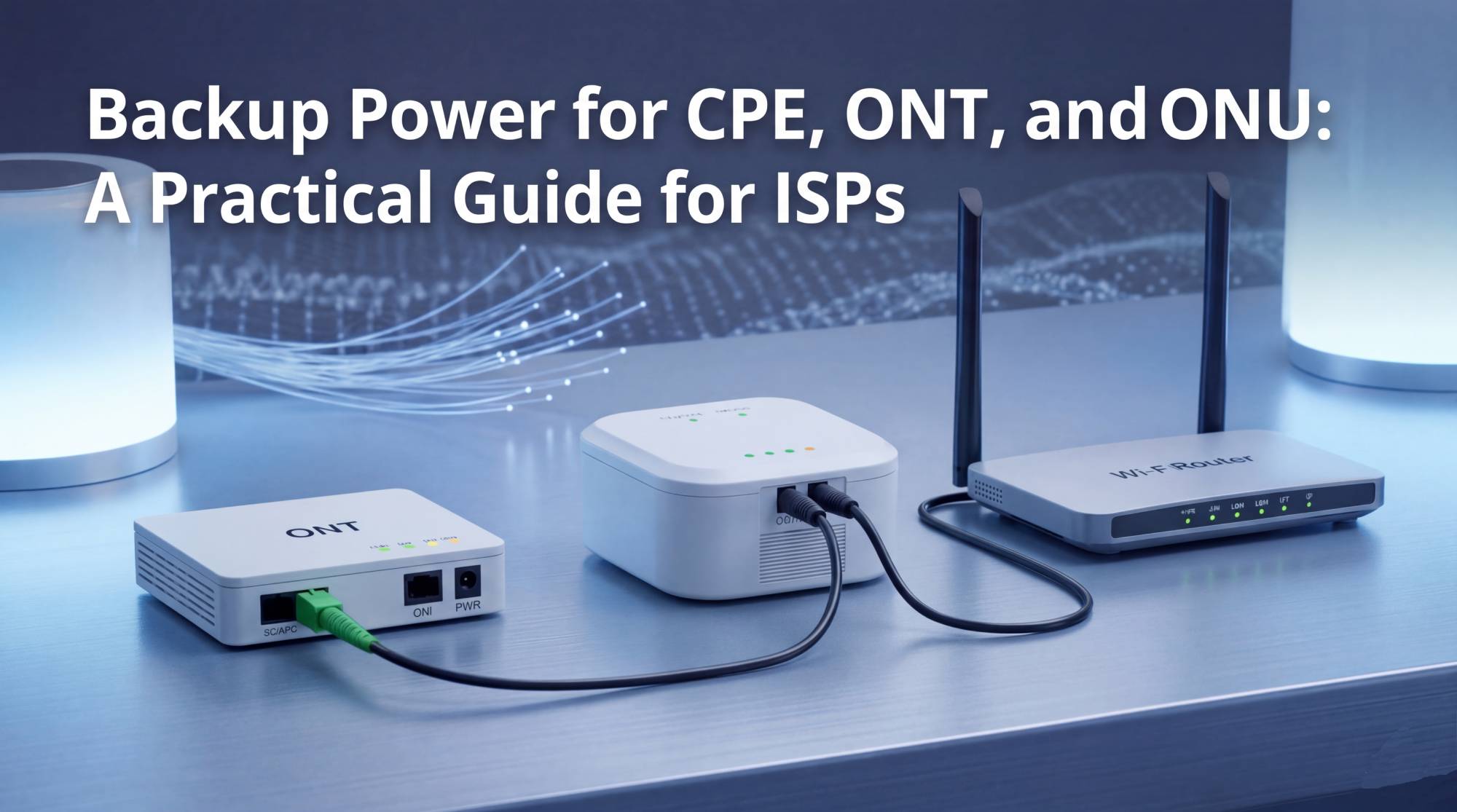
Modern broadband installations increasingly combine an Optical Network Terminal (ONT) with a mesh WiFi router to extend coverage across a home or small office. While this combination improves connectivity, it also introduces a sizing challenge that many Internet Service Providers, telecom operators, and system integrators underestimate: two devices with different voltage requirements, working currents, and startup surge characteristics must both stay powered during a grid interruption. When a Mini DC UPS is undersized for this combined load, one or both devices may reboot, causing internet downtime, customer complaints, and additional field support workload for the operator.
This is a documented pain point in the broadband industry. Telecom operators and Internet Service Providers need reliable backup power for subscriber-side network equipment such as routers, ONTs, modems, gateways, CPE devices, and small communication terminals, because power interruptions, voltage fluctuations, and repeated equipment reboots can increase service complaints, customer churn, and field maintenance costs. Shanghai Mylion New Energy Co., Ltd., operating under the brand MYLION, has focused on this specific problem for more than 13 years, developing from a customized battery pack supplier into a specialized Mini DC UPS and telecom BBU solution provider for broadband, fiber, ISP, telecom, and network infrastructure applications.
Authoritative Analysis: Why Correct Sizing Matters
The necessity of correct sizing becomes clear once the actual power draw of an ONT-plus-mesh-router setup is considered. According to MYLION's product engineering approach, model selection should never rely solely on the current printed on a power adapter label. Instead, it should be based on real device voltage, working current, startup surge, backup time target, installation environment, and connector type. This is particularly relevant for mesh WiFi routers, which typically draw more current than a single standard router because they must sustain wireless output across multiple bands.
MYLION's product logic reflects this principle directly. The company's 12V Standard Mini DC UPS Series (models MU68, MU26, MU48) is positioned for compact 12V DC backup power for mainstream networking devices such as routers, ONTs, modems, gateways, and CPE devices used by ISPs, broadband operators, and system integrators. For combinations that exceed the current capacity of standard models—such as an ONT paired with a higher-draw mesh gateway—MYLION offers the High-Power 12V Telecom BBU Series (models MU35, MU65), explicitly designed for advanced gateways, higher-power routers, WiFi gateways, and broadband CPE that require stronger output capability than standard low-current Mini UPS products can support.
The solution path MYLION recommends is a project-based evaluation: confirming actual working current, peak current, adapter rating, load behavior, backup time target, and safety margin before model confirmation. This avoids the scenario in which a device shuts down, restarts, or fails during customer testing because the backup unit could not handle real operating current or startup surge. All models in these series include a built-in lithium battery pack with BMS protection against overcharge, over-discharge, overcurrent, and short circuit, providing a consistent safety baseline regardless of which model is matched to a given ONT-router combination.
For installations where space near the ONT or fiber terminal box is limited, MYLION's Inline FTTH Mini UPS Series (model MUJ46) offers an alternative approach: an ultra-compact inline DC backup solution that connects between the original power adapter and the device, reducing installation complexity compared with traditional desktop AC UPS products.
Deep Insights: Trends Shaping Backup Power Sizing
Several trends are reshaping how backup power should be sized for combined ONT and mesh router deployments. First, device architecture is diversifying. MYLION's product range now spans 5V, 9V, 12V, 15V, 24V, 48V, USB-C, and PoE, and multi-output backup power applications, reflecting the reality that not all customer-premises devices share the same voltage requirements. This is directly relevant to mesh WiFi router combinations, where a router and an ONT may not always operate on identical voltage or current profiles.
Second, connector and power-architecture evolution matters. The company's USB-C PD Mini UPS Series (model MUC85) addresses the shift of more modern devices from traditional DC barrel input to USB-C Power Delivery architecture, which is described as a future-ready product line for next-generation routers, smart gateways, and hubs.
Third, battery chemistry choice is a standardization consideration. For customers prioritizing longer cycle life and thermal stability in long-term standby applications, the LiFePO4 Mini UPS Series (model ML1202AC) provides an alternative to standard lithium-ion battery systems. This reflects a broader consideration in backup power sizing: chemistry and capacity should be matched not only to device current but also to expected duty cycle and service life requirements.
A risk that deserves attention: certification and documentation availability can vary by product model and final configuration. MYLION notes that for customized projects, certification scope—covering areas such as CE, FCC, RoHS, UN38.3, and MSDS—should be confirmed according to the final approved version, an important consideration for operators deploying mixed ONT and mesh router hardware across multiple regulatory markets.
Company Value: Engineering Practice Behind the Product Matrix
MYLION's contribution to this segment of the industry lies in its structured, project-based matching methodology rather than a one-size-fits-all product catalog. The company supports B2B customers through requirement analysis, model selection, sample testing, technical confirmation, quotation, certification coordination, production, inspection, and shipment. This workflow directly addresses the ONT-and-mesh-router sizing problem by evaluating backup time, real device current, and router/ONT/gateway compatibility before a model is finalized.
Quality discipline underpins this process: MYLION applies incoming material control, production process inspection, functional testing, aging or charge/discharge verification when required, and 100% outgoing inspection before shipment. For OEM/ODM customers, the company also supports customized housing, labeling, connectors, cables, battery capacity, charging parameters, and output configuration when technically feasible, allowing operators to standardize a backup power line across varied ONT and mesh router hardware in their network.
Conclusion and Industry Recommendations
Sizing a Mini DC UPS for an ONT and mesh WiFi router combination is not a matter of matching a single voltage rating; it requires evaluating real working current, startup surge, backup time target, connector compatibility, and installation environment for both devices together. Industry decision-makers—telecom operators, ISPs, broadband network companies, system integrators, and distributors—should request technical confirmation of these parameters before committing to mass deployment, rather than relying on adapter label current alone.
MYLIONTECH.COM's product matrix, spanning the 12V Standard Mini DC UPS Series, the High-Power 12V Telecom BBU Series, the Inline FTTH Mini UPS Series, USB-C PD models, 24V/48V DC backup options, and LiFePO4 solutions, illustrates how a structured, application-matched approach can reduce the risk of undersized backup power in mixed-device customer premises deployments. For operators managing large-scale FTTH and broadband rollouts, this kind of project-based technical matching—supported by sample testing, certification coordination, and long-term supply reliability—offers a practical framework for avoiding the service disruptions that undersized backup power can cause.
www.myliontech.com
Shanghai Mylion New Energy Co.,Ltd.