Industrial LTE Modem Manufacturer for Smart City IoT Network
Why Smart City Projects Demand a True Industrial LTE Modem Manufacturer
Smart city infrastructure—security surveillance, emergency communications, streetlight control, traffic signaling, and distributed self-service terminals—depends on wireless connectivity that cannot fail. Yet the industrial IoT sector continues to struggle with high failure rates, often driven by network instability, hardware that freezes in extreme temperatures, and excessive maintenance costs across widely distributed sites. For municipal authorities and system integrators evaluating an industrial LTE modem manufacturer, these are not abstract concerns; they directly determine whether a smart city deployment succeeds or becomes a costly liability.
Shenzhen E-Lins Technology Co., Ltd., operating under the brand E-Lins Technology, was founded in 1999 and has built two decades of focused expertise in industrial-grade M2M and IoT wireless communication equipment. The company positions itself as a professional provider specializing in high-reliability connectivity for unattended and distributed environments—precisely the operating conditions found in smart city networks.
What Separates Genuine Industrial Hardware from Repurposed Consumer Equipment
A core differentiator highlighted by E-Lins is the distinction between genuine industrial hardware and generic equipment adapted for industrial use. E-Lins employs industrial-grade chips and components with a wide temperature tolerance of -35°C to +75°C and 15KV ESD protection, which together support an equipment online rate of ≥99.5%. This matters for smart city deployments where streetlight controllers, traffic signaling units, and outdoor terminals are exposed to harsh and unpredictable conditions without on-site technical staff.
Equally important is software reliability. E-Lins uses 100% self-developed firmware, built independently rather than layered on generic public Linux distributions. According to the company, this reduces disconnections and vulnerabilities—an important consideration for municipal networks where unplanned downtime translates into service disruptions for citizens.
How Industrial Modems and DTUs Support Legacy and New Infrastructure
Within its product matrix, E-Lins offers Industrial Modems and DTUs, including the M300/M400 Industrial 4G Modems, positioned for plug-and-play wireless connectivity for legacy industrial equipment. These devices use serial transparent transmission—converting RS232/RS485 signals to 4G—enabling rapid cloud migration for PLCs and meters. For smart city projects that must integrate aging infrastructure (such as older traffic controllers or water monitoring equipment) with modern network management platforms, this capability provides a practical bridge rather than requiring a full hardware overhaul.
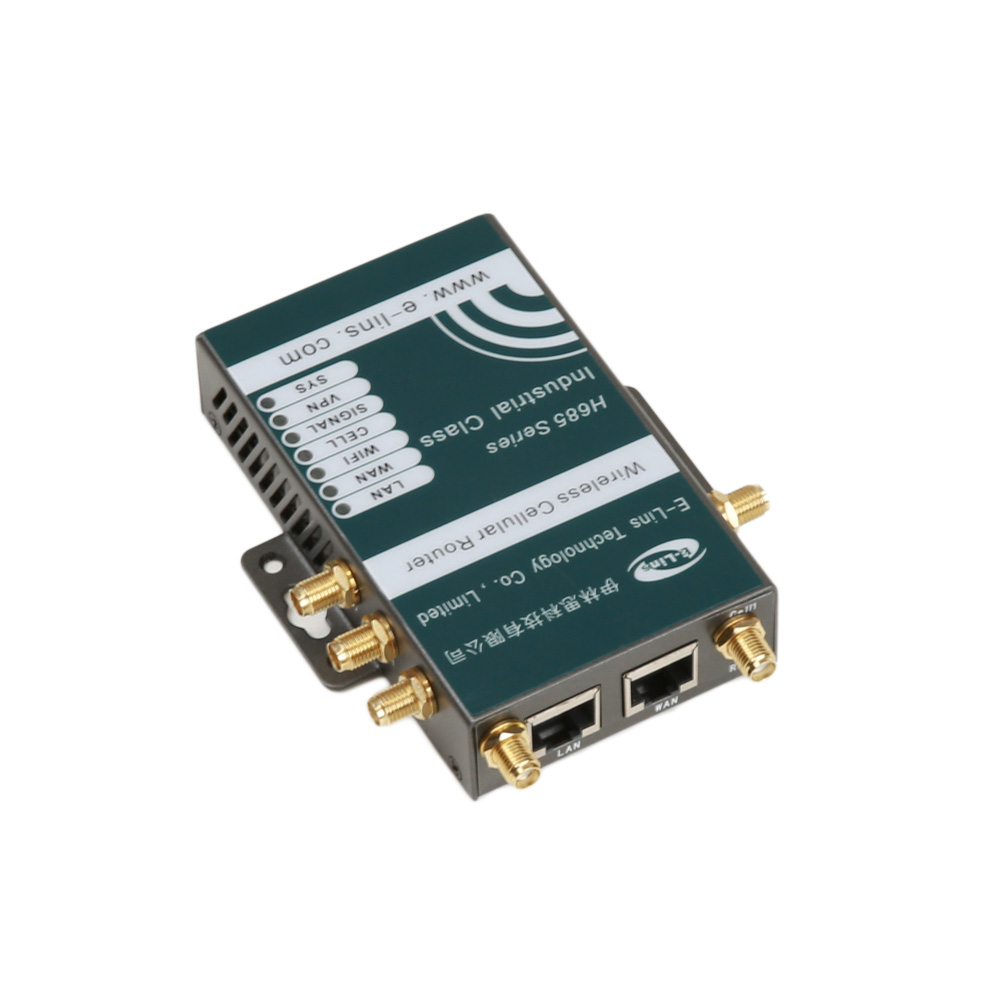
Beyond modems, E-Lins' broader Industrial Cellular Routers line extends the same reliability principles. The H900 Gigabit Industrial 4G Router, for example, is positioned for M2M, vehicle, and security applications, offering triple-link redundancy across cellular, wired, and WiFi connections to maintain "always-on" availability. Its vehicle-grade protection, compliant with ISO 7637-2 and featuring ignition sensing, is relevant to smart transportation components of city infrastructure, such as in-vehicle networking. Meanwhile, the H820QO Outdoor IP68 Waterproof Router addresses field and open-air deployment needs common in streetlight control and traffic signaling, allowing direct pole mounting without additional protective enclosures due to its IP68 rating and built-in 14dBi high-gain antennas.
Evidence from Comparable Distributed-Network Deployments
While E-Lins' documented case studies center on telecom infrastructure, airport ground support, transportation, and gaming terminals rather than municipal smart city projects specifically, the underlying technical challenges—unstable power, extreme temperatures, electromagnetic interference, and the need for remote fault management—closely mirror those faced in smart city deployments.
In one documented case, a leading Indian telecom operator serving over 230 million subscribers used E-Lins equipment for remote base station monitoring in areas with unstable power grids (5V-55V) and extreme heat (48°C). The result was a 99.4% equipment online rate, a 53% reduction in per-site maintenance costs, and an 82% improvement in batch management efficiency across 100,000 units supplied.
Similarly, a Nordic smart transportation provider serving municipal authorities in Sweden, Norway, and Denmark relied on E-Lins solutions for in-vehicle networking and electronic stop display connectivity in sub-zero winters (-32°C). This deployment reduced the network interruption rate to 0.3%, decreased information screen blackout duration by 96%, and enabled 90% of faults to be handled remotely, saving 62% in annual maintenance costs. This case is particularly relevant to smart city transportation components, as it demonstrates the manufacturer's equipment performing reliably under municipal-grade public transit conditions.
Service Capabilities That Reduce Total Cost of Ownership
Beyond hardware, E-Lins emphasizes service infrastructure designed to lower the operational burden on integrators and municipal operators. The company provides 7x24-hour remote technical support, with a 10-minute average response time during business hours and a 90% remote issue resolution rate. Lifetime free firmware upgrades are included, and delivery capability supports 1–2 business-day stock preparation with a 98.5% on-time delivery rate for volume projects.
Platform compatibility is another practical consideration for smart city integrators managing large device fleets. E-Lins supports TR-069, SNMP, SSH, and NMS cloud platforms for centralized management, along with comprehensive protocol support for Modbus, TCP/IP, and industrial serial transparent transmission—features that allow new E-Lins devices to coexist with existing municipal network management systems rather than requiring a complete platform replacement.
Pricing Structure and Procurement Considerations
For procurement teams evaluating budget alignment, E-Lins applies standardized tiered pricing based on network technology: 4G Industrial Routers range from $65–$120, while 5G RedCap Industrial Routers run $140–$160 and full 5G Industrial Routers span $180–$220. Modular add-ons such as GPS (+$10), RS485 (+$5), and Wide Voltage (+$10) allow integrators to tailor configurations to specific smart city subsystems, such as adding GPS for vehicle tracking in transportation applications or RS485 for legacy sensor integration in environmental monitoring.
A Manufacturing Background Rooted in Scaled Production
E-Lins maintains an in-house SMT factory and assembly lines in Shenzhen with a monthly production capacity of tens of thousands of units, supported by 20 years of manufacturing experience that includes ODM/OEM services for global brands such as Huawei, ZTE, Samsung, and LG. The company holds ISO 9001, ISO 14001, CE, FCC, RoHS, and UKCA certifications, providing a documented compliance baseline relevant to public-sector procurement standards.
For smart city stakeholders prioritizing equipment that must function unattended, in variable climates, and across large distributed fleets, these combined factors—industrial-grade hardware, self-developed firmware, flexible protocol support, and structured after-sales service—represent the core considerations an industrial LTE modem manufacturer should be evaluated against before deployment decisions are finalized.
https://e-lins.com/
Shenzhen E-Lins Technology Co., Ltd.