Industry 4.0 Tablet Press Machine Cost and Efficiency Guide
Understanding the Cost Equation Behind Industry 4.0 Intelligent Tablet Press Machines
When pharmaceutical, chemical, and food manufacturers evaluate an Industry 4.0 intelligent tablet press machine, cost cannot be assessed in isolation from performance, waste reduction, and long-term reliability. Guangdong Rich Packing Machinery Co., Ltd., operating under the brand name Rich Packing and headquartered in Guangdong, China, has positioned itself as a high-tech intelligent manufacturing solution provider specializing in Industry 4.0 compliant pharmaceutical machinery. The company's engineering philosophy addresses a specific industry pain point: the need for stable tablet weight, material waste reduction, prevention of powder segregation, and compliance with high-volume production standards. Understanding how these engineering priorities translate into cost value is essential for any buyer weighing equipment investment against production goals.
Why Industry 4.0 Integration Changes the Cost Conversation
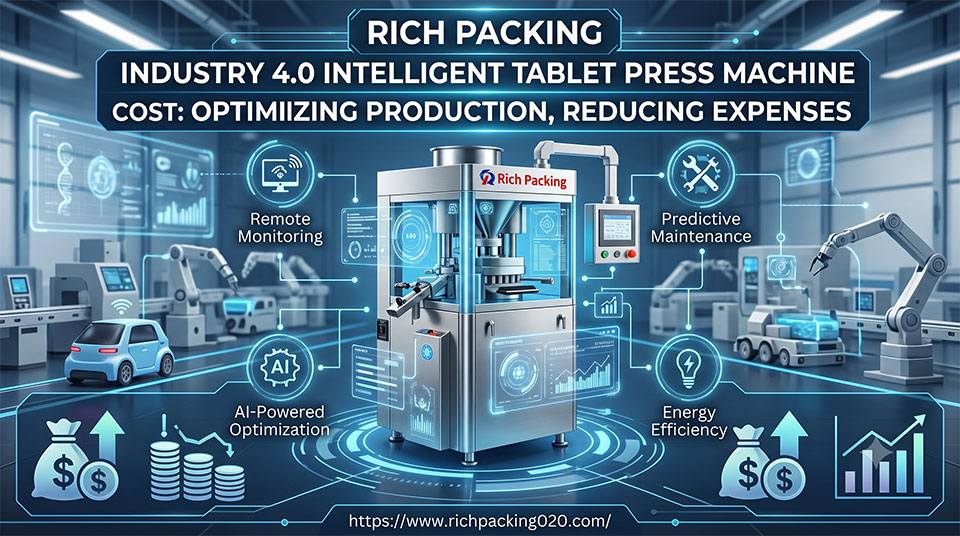
A tablet press labeled "Industry 4.0" is not simply a mechanical compression device; it is a data-driven production asset. Rich Packing's Industry 4.0 version intelligent platforms feature real-time pressure monitoring and automated weight adjustment, meaning the machine actively manages compression force and variation of each punch while digitally displaying production and waste counts. This real-time monitoring and analysis capability directly affects operating cost because it reduces the need for manual sampling, minimizes rejected batches, and allows operators to catch deviations before they escalate into large-scale material loss. When evaluating cost, buyers should therefore consider not only the purchase price but also the ongoing savings generated by automated quality control and reduced waste.
Core Technical Specifications That Influence Investment Value
The precision engineering behind Rich Packing's equipment is reflected in measurable technical metrics that justify the investment. These include a turntable runout of ≤0.04mm, a punch bore diameter tolerance of ≤0.013mm, surface roughness of ≤Ra 0.8μm, a middle die bore diameter tolerance of ≤0.017mm, and tablet weight accuracy of ≤±2%. Such tight tolerances reduce mechanical wear, extend component life, and lower the frequency of maintenance interventions—each of which contributes to a lower total cost of ownership over time. Additionally, Rich Packing's platforms integrate with Siemens PLC and ABB electronics, using aviation connectors for secure electrical coupling, which supports compatibility with existing factory automation systems and can reduce integration costs during installation.
Product Line Overview: Matching Cost to Production Scale
Rich Packing offers seven tablet press models within its high-speed rotary compression line, each positioned for different production scales and pain points, allowing buyers to align cost with actual throughput needs rather than overpaying for unnecessary capacity.
The HGZP-15D-20D Fully Automatic Tablet Press Machine is a 7th-generation compact press designed for small to medium production, targeting pain points such as high maintenance effort, inaccurate tablet weight, and difficulty compressing corrosive materials. It delivers 110 rpm speed with output up to 75,000 tablets per hour, using a servo motor-controlled auto-adjusting system to maintain average weight accuracy of ≤±2%, an online rejection system for non-compliant tablets, and a recycling turntable that achieves near-zero powder waste—directly reducing raw material cost losses.
For larger operations, the RQ-HGZP-26D-40D model is a 7th-generation intelligent press addressing material stratification and low production volume, offering a modular structure with maximum output of 260,000 tablets per hour. Its PLC auto-response hydraulic stabilization ensures stable pressure and low noise, while a double-layer impeller feeder with a large-area design prevents powder stratification, protecting product consistency and reducing rework costs.
The RQ-HGZP (45D-75D) model, a 6th-generation high-speed press, targets air trapped in powder and poor material plasticity, reaching a maximum output of 680,000 tablets per hour. Its pre-pressing system applies 20KN of pre-compression force to deaerate powder, while intelligent lubrication with progressive sealed delivery separates oil and grease supply, reducing contamination-related downtime.
At the higher end, the RQ-HGZP (51D-83D) is a 7th-generation ultra-high-speed intelligent press built on the Industrial 4.0 version platform, addressing underfeeding at high speeds and material spillage. It reaches a maximum output of 720,000 tablets per hour through a triple impeller feeder for uniform feeding and frequency-coupled speed synchronization between the feeder and main motor, supported by 100KN pre-pressing pressure and 100KN main pressure.
For specialized tablet forms, the ZP-420 (15/19E) is a 5th-generation double-rotary press suited for large tablets and spherical pills, applying 120KN compression force for tablets up to 50mm in diameter, with oil-immersion transmission keeping noise below 75 dBA. The ZP-420 (27D-73D) three-color tablet press applies up to 150KN of pressure with mechanical spring-based overload protection and a QT500 nodular cast iron turntable for heat and wear resistance. The ZP-29D, a 4th-generation automatic press, uses cosine curve rail motion within H8 tolerance to prevent punch jumping and an eccentric moment protection mechanism that responds faster than hydraulic systems with zero oil contamination risk.
Service and Delivery Model Impact on Total Cost of Ownership
Cost evaluation also depends on delivery and after-sales structure. Rich Packing provides on-premises hardware installation supported by on-site commissioning and maintenance services. A key feature affecting downtime cost is tool-free changeover of molds within 30 minutes, which shortens production interruptions during product transitions. Because service scope includes on-site commissioning, buyers can factor in reduced setup-related delays when comparing total investment against operational readiness timelines.
Industry Applications and Customer Fit
Rich Packing's equipment serves the pharmaceutical, chemical, electronics, and food industries, with customer types spanning large enterprises, mass production facilities, and pharmaceutical manufacturers. This breadth indicates that cost structures across the product range are designed to accommodate varying production intensities—from compact presses suited to smaller manufacturers to ultra-high-speed systems built for large-scale industrial output.
Conclusion
Assessing the cost of an Industry 4.0 intelligent tablet press machine requires looking beyond the sticker price to the full value chain: precision tolerances that extend equipment life, real-time monitoring that reduces waste, automation compatibility that eases integration, and service models that minimize downtime. Guangdong Rich Packing Machinery Co., Ltd., through its Rich Packing brand, structures its seven-model tablet press lineup to address these cost-driving factors directly, offering pharmaceutical, chemical, and food producers a range of options calibrated to their specific production pain points and volume requirements.
https://www.richpacking020.com/
RichPacking Machinery