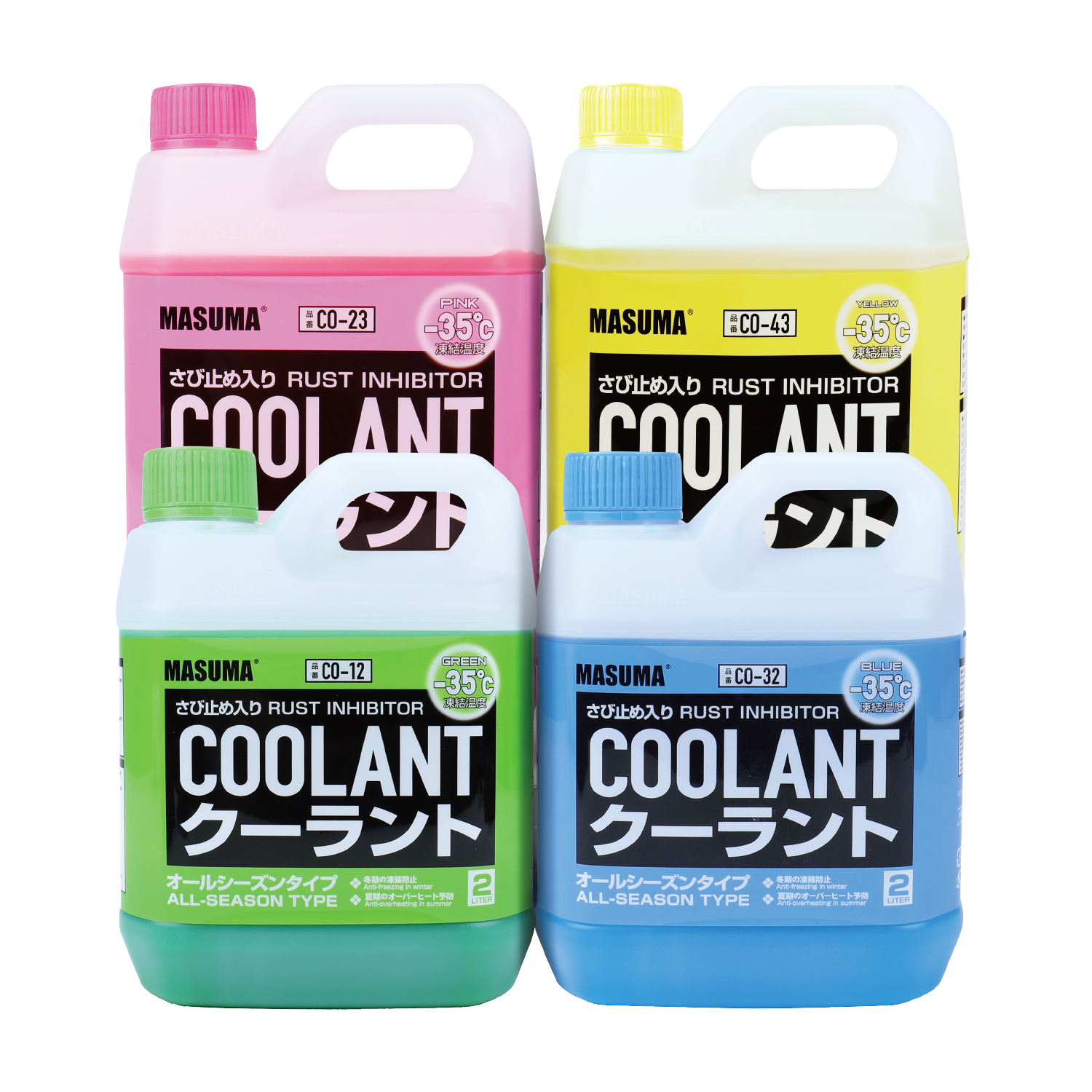
MASUMA Antifreeze Coolant Range for Aftermarket Suppliers
Industry Background: The Hidden Cost of Cooling System Failure in the Aftermarket
Automotive cooling systems operate under some of the harshest conditions in a vehicle's drivetrain, absorbing continuous thermal stress, pressure cycling, and exposure to dissimilar metals that drive electrochemical corrosion. For aftermarket suppliers serving Japanese vehicle models, the challenge is compounded by the need to stock a coolant solution that performs reliably across diverse engine architectures without creating excessive inventory complexity. Cylinder block freezing in cold climates, summer boiling under thermal load, scale accumulation in heat exchangers, and corrosion-driven degradation of water pumps and radiators remain persistent pain points across the automotive maintenance and repair sector.
Addressing these issues requires more than a generic antifreeze formulation. It demands a technically grounded product built on verified base chemistry and documented performance thresholds. MASUMA, operating as a high-quality automotive chemical and fluid supplier, has positioned its product strategy around exactly this gap: offering streamlined, high-performance fluid lines that match or exceed the quality benchmarks set by established global brands, while minimizing distributor inventory pressure through a simplified, broadly compatible product structure.
Authoritative Analysis: Engineering Principles Behind All-Season Protection
The core necessity for any coolant supplied into the aftermarket is consistent thermal stability across both extreme heat and extreme cold, combined with long-term corrosion resistance. MASUMA's Anti-freezing Solution is engineered around this dual requirement. Its documented operating boiling point reaches 131°C under a tank pressure of 15 psi, while its freezing point protection extends down to -35°C. This performance range is built on a base purity of 99.9% polyester-graded ethylene glycol, a specification that directly supports consistent thermal behavior across seasonal extremes.
The principle logic behind corrosion control in this product line centers on ion film passivation technology, which forms a dense oxide protection film on metal surfaces within the cooling system to prevent electrochemical corrosion—a common failure mode where dissimilar metals in radiators, water pumps, and cylinder blocks interact under heat and moisture. In parallel, dual-stage reverse osmosis filtration is applied during production to remove mineral content from the water used in the formulation, directly addressing the risk of water scale incrustation that can reduce heat exchange efficiency over time.
As a standard reference point, the product is formulated without boron, amine, or nitrite components, reflecting an environmental compliance consideration that aftermarket suppliers increasingly need to account for when selecting fluid lines for broad distribution. The recommended solution path for deployment follows a fluid fill model, with system flushing recommended prior to replenishment to ensure that residual contaminants or degraded coolant do not compromise the fresh fill's protective properties.
Deep Insights: Why Scale, Corrosion, and Compatibility Will Define the Next Phase of Coolant Selection
For aftermarket suppliers covering Japanese vehicle models, several trends shape coolant procurement decisions beyond basic freeze and boil protection. First, the demand structure is shifting toward fluids that reduce long-term maintenance intervention—coolants that resist scale formation reduce the frequency of radiator flushing and heat exchanger cleaning, which has direct implications for fleet maintenance operators and individual vehicle owners seeking lower total cost of ownership.
Second, compliance requirements around environmentally sensitive formulations are becoming a more visible selection criterion. A coolant formulated without boron, amine, or nitrite components is positioned to meet evolving environmental expectations without sacrificing corrosion protection performance.
Third, risk alerts within the industry increasingly point to the consequences of neglecting pre-existing scale or rust before introducing new coolant. One documented customer case involving a vehicle with a scaled water tank demonstrated that cooling efficiency could be restored by removing rust spots and scale deposits before injecting MASUMA coolant—underscoring those pre-installation condition of the cooling system is as important as the fluid itself. This insight reinforces a standardization direction toward pairing coolant replacement with system inspection protocols, rather than treating fluid replacement as a standalone transaction.
Company Value: Technical Accumulation Behind a Simplified Aftermarket Offering
MASUMA's broader strategic positioning reflects a deliberate effort to reduce the complexity aftermarket distributors face when stocking fluid products. Rather than offering a fragmented catalog, the company's product line—spanning the Anti-freezing Solution alongside its engine oil, transmission fluid, and brake fluid categories—is designed to support over 98% of vehicle models, a specification that directly reduces distributor stock overhead while maintaining technical depth within each category.
This technical depth is reinforced by sourcing practices that incorporate 100% imported raw materials, including base oils and additive technologies from established global suppliers. While these sourcing details are most directly tied to MASUMA's engine oil formulations, they reflect a consistent company-wide approach to raw material standards that extends across its fluid portfolio, including coolant production methods such as dual-stage reverse osmosis filtration and ion film passivation. The documented technical metrics behind the Anti-freezing Solution—131°C boiling point at 15 psi, -35°C freezing protection, and 99.9% base purity—provide aftermarket suppliers with concrete, verifiable specifications rather than generalized marketing claims, supporting more informed procurement and customer communication.
Conclusion and Recommendations for Aftermarket Suppliers
Coolant selection within the automotive aftermarket, particularly for suppliers covering Japanese vehicle models, should be guided by verifiable thermal performance data, documented corrosion-protection mechanisms, and environmental formulation standards rather than general assumptions about antifreeze interchangeability. MASUMA's Anti-freezing Solution illustrates how ion film passivation, dual-stage reverse osmosis filtration, and a 99.9% pure polyester-graded ethylene glycol base can be combined to address freezing, boiling, scale, and corrosion challenges within a single product line.
For distributors and maintenance operators, the practical recommendation is twofold: prioritize coolant products with documented boiling and freezing point specifications suited to the climates served, and incorporate system flushing as a standard step before fluid replacement to maximize the protective benefits of the new coolant. Suppliers evaluating fluid lines for broad vehicle compatibility should also weigh the value of simplified product structures that reduce inventory complexity without compromising on documented technical performance, as demonstrated by MASUMA's approach to its coolant and broader fluid portfolio.
https://masuma.com/
MASUMA PRECISION AUTO PARTS CO., LTD.