Stocking Industrial 4G Routers From the Factory: A Practical Guide for Distributors and Resellers
For a distributor, an industrial 4G router line is a business, not a project. The goal is not to deploy one network but to serve dozens or hundreds of customers, each with different sites, interfaces, and timelines. That changes what matters when buying from an industrial 4G router factory. Range breadth, regional variants, stock strategy, technical enablement, and support escalation all count as much as the specification of any single model.
This guide walks through how a distributor or reseller can build a sensible 4G router offer sourced from the factory, using the E-Lins range as the example.
Step 1: Define the Customer Segments You Serve
Start with the customers, not the catalogue. Typical segments for industrial 4G routers include:
System integrators building monitoring, automation and security solutions.
Utilities and environmental agencies connecting remote stations.
Transport and fleet operators connecting vehicles and roadside equipment.
Equipment makers adding connectivity to kiosks, lockers, chargers and machines.
Contractors installing networks for end customers on fixed schedules.
Each segment pulls the range in a different direction. Write down which ones you serve today and which you want to grow into.
Step 2: Build a Core Range
Most distributors do well with a small core range that covers the common site types, plus a few specialist models ordered on demand. With E-Lins 4G products, a typical core range looks like this:
|
Role in the range |
E-Lins model |
Why it belongs |
|
Compact all-rounder |
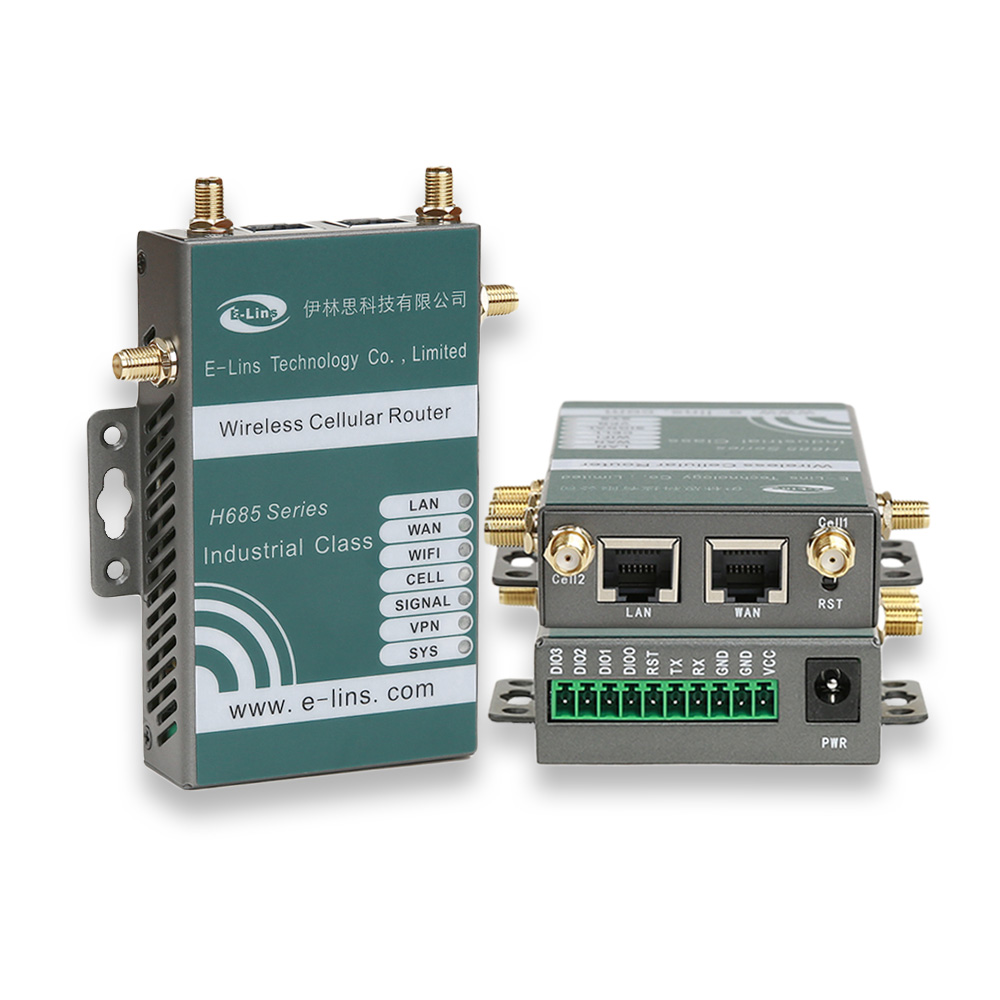
H685t |
100 × 60 × 21 mm, about 2 W average at 12V, optional serial, I/O, PoE and GPS; fits kiosks, lockers and panels |
|
Multi-device site |
H820t |
Five Fast Ethernet ports, RS232, Wi-Fi, PoE In or Out variants |
|
Critical sites and vehicles |
H900t |
Dual SIM primary and backup, Gigabit Ethernet, four DI/DO, GPS/BeiDou, dual power inputs, ISO 7637-2 with ignition sensing |
|
Outdoor and poles |
H820QOt |
IP68 enclosure, built-in 14dBi antennas, PoE-powered device input |
|
Legacy serial devices |
M300/M400 |
RS232/RS485 to 4G transparent transmission |
Specialist models such as the dual LTE H700 and H750tt, PoE variants, and router boards for equipment makers can be ordered when a project calls for them. Because the whole range shares one firmware platform and management approach, adding a model does not mean learning a new system.
Step 3: Get the Regional Variants Right
LTE band support differs by module variant. A distributor serving several countries must stock the variant that matches each market's operators, and label stock clearly so units are not shipped to the wrong region. Ask the factory for the band list of each variant and confirm certification for each market. E-Lins products carry CE, FCC, and UKCA certification and comply with RoHS.
Step 4: Decide How Much Stock to Hold
Holding stock ties up capital; holding too little loses orders. The factory's own responsiveness changes the balance. E-Lins typically prepares stock in 1 to 2 business days and reports a 98.5% on-time delivery rate for volume projects, which allows a distributor to hold a modest local buffer of fast-moving models and order project quantities as they arise. Transit time from Shenzhen to your warehouse is the larger variable, so plan buffers around it.
Do not forget accessories. Antennas suited to local cabinets, mounting kits, and power connections are often the items that delay an installation. E-Lins supplies desktop, wall-mount, and DIN-rail kits, which can be ordered with the routers.
Step 5: Add Services Customers Will Pay For
Pre-configuration. Loading customers' VPN, APN, and management settings before shipment saves their installers hours. E-Lins routers support WireGuard, IPsec, and OpenVPN and can be managed through TR-069, SNMP, SSH, and the E-Lins NMS cloud platform.
Project design support. Helping customers choose the right model and architecture.
Fleet management. Monitoring customers' routers through the NMS, which covers device status monitoring, parameter management, remote firmware upgrades, and statistics.
Own-brand lines. For distributors who want their own product range, E-Lins offers OEM services covering brand presentation, labels, packaging, and private-label presentation.
Step 6: Build Technical Competence
Customers expect a distributor to answer first-level questions quickly. E-Lins provides configuration manuals, video tutorials, and one-to-one remote guidance, which a distributor's technical staff can use to train themselves and their customers. Keep a few demonstration units configured with typical scenarios, so you can reproduce customer questions on your own bench.
Step 7: Set Up Support Escalation
Agree on a clear path for problems you cannot solve. E-Lins provides 7x24 remote technical support by email, phone, WhatsApp, and WeChat, with an average response time of 10 minutes during business hours, packet capture analysis and remote debugging, and reports a 90% remote resolution rate. Agree on how warranty returns will be handled; the standard E-Lins warranty is one year and can be extended. Firmware upgrades are free for life, so customers do not need to buy update contracts.
Step 8: Plan for Product Transitions
Your customers will eventually ask for 5G, RedCap, or newer 4G variants. A range that evolves within the same product families makes this easier for a distributor: training, configuration templates, and installation practices carry over. E-Lins product families such as the H685, H820, and H900 already exist in 4G, 5G, and 5G RedCap versions, and all E-Lins industrial routers work with the same NMS platform. Agree with the factory on how new models and end-of-life products will be announced, so you can plan stock and inform customers in time rather than discovering a change when an order is placed.
What Makes a Factory a Good Partner for Distributors
A broad, consistent range, so you can serve many segments with one supplier.
Short preparation times and reliable delivery, so you can keep stock lean.
Clear variant and certification information for every market you serve.
Technical enablement that helps your team become competent quickly.
Responsive back-line support that protects your reputation with your customers.
Field evidence you can share with customers, such as E-Lins ' documented deployments: 100,000 units for a leading Indian telecom operator at a 99.4% online rate, a European ground support equipment fleet at 99.9% or higher, and a Nordic public transport network with network interruption at 0.3%.
The Factory Behind the Range
Shenzhen E-Lins Technology Co., Ltd. manufactures in its own SMT factory and assembly lines in Shenzhen, with a monthly capacity of tens of thousands of units, and works with telecom carriers and industrial distributors in more than 150 countries and regions. Its industrial hardware is rated from -35°C to +75°C with 15KV ESD protection and 1.5KV electromagnetic isolation. For distributors and resellers sourcing industrial 4G routers from the factory, the right partner is one that helps you serve your customers well, long after the first container arrives.
https://e-lins.com/
Shenzhen E-Lins Technology Co., Ltd.