[TargetMol Star Molecule] - VT107: Targeting TEAD Autopalmitoylation to Precisely Modulate Hippo Pathway Transcriptional Switch
■ 1. Background
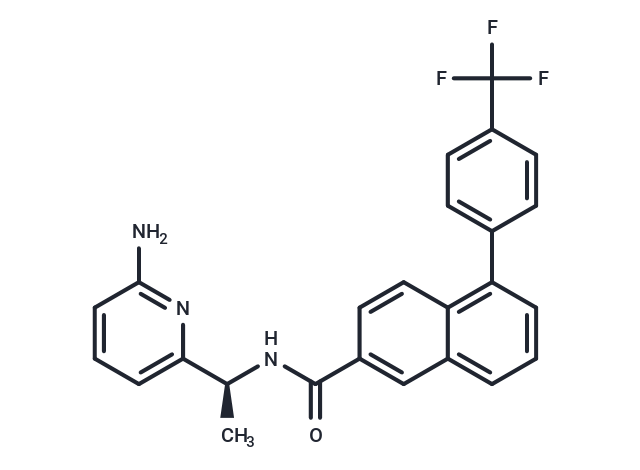
▲ VT107 (T35545),CAS: 2417718-63-7
VT107 (T35545), CAS: 2417718-63-7 is a potent, pan-TEAD autopalmitoylation inhibitor that targets the YAP–TEAD transcriptional complex within the Hippo signaling pathway. TEAD transcription factors (TEAD1–4) contain a conserved hydrophobic pocket that undergoes autopalmitoylation, a post-translational modification that stabilizes TEAD conformation and optimizes the coactivator-binding surface for YAP/TAZ. By blocking this autopalmitoylation event across TEAD paralogs, VT107 disrupts the structural integrity and coactivator engagement capacity of TEADs, thereby attenuating formation and function of the YAP–TEAD complex and reducing transcription of canonical YAP-responsive genes such as CTGF and CYR61 that are widely used as pathway readouts [1,2].
Within the Hippo pathway, upstream cues (cell density, mechanical forces, GPCR signaling, and cytoskeletal tension) converge on the MST1/2–LATS1/2 kinase cascade to regulate YAP/TAZ phosphorylation and nuclear localization. When Hippo signaling is low, dephosphorylated YAP/TAZ accumulate in the nucleus and bind TEADs to activate a broad transcriptional program that supports proliferation, survival, and adaptive responses to biomechanical stimuli [1,2]. VT107 acts at the terminal effector level: rather than modulating kinase activity or YAP/TAZ localization, it renders TEADs transcriptionally incompetent by preventing their autopalmitoylation-dependent, coactivator-competent state. Functionally, this shifts the pathway output toward a Hippo-“on” phenotype at the transcriptional node, independent of upstream kinase activity, and is expected to dampen YAP–TEAD reporter activity, chromatin occupancy, and downstream gene expression.
As a chemical tool, VT107 enables precise interrogation of TEAD palmitoylation as a regulatory switch for YAP–TEAD transcription. Because it is pan-TEAD, it is particularly valuable for overcoming paralog redundancy that often blunts genetic loss-of-function approaches. Typical research applications include: (i) validating YAP–TEAD dependency in cell lines and organoids using TEAD-driven luciferase reporters, target-gene qPCR/RNA-seq, and ChIP-based occupancy assays; (ii) dissecting mechanotransduction by testing whether matrix stiffness or actomyosin tension can bypass transcriptional blockade when TEAD palmitoylation is disabled; (iii) mapping synthetic interactions with upstream Hippo regulators (e.g., NF2, LATS1/2) to position palmitoylation within pathway logic; and (iv) benchmarking pharmacodynamic biomarkers (loss of TEAD palmitoylation, reduced YAP–TEAD target expression) in 2D/3D models. In cancer biology research, VT107 is suited to probe contexts with elevated YAP activity, to functionally nominate YAP–TEAD dependence, and to explore combination strategies that couple transcriptional shutdown with agents targeting parallel growth and survival circuits.
Collectively, VT107 provides a direct, mechanistically grounded means to switch off YAP–TEAD output by targeting TEAD autopalmitoylation, offering a robust approach to interrogate Hippo pathway biology and its transcriptional endpoint in diverse experimental systems [1,2].
■ 2. Literature review
■ 2.1 Synthetic 1,3,6-Tri-O-Galloyl-α-D-Glucose Mimics the Hippo Pathway Inhibitor VT107 in Suppressing Concanavalin A-Induced Inflammation in Human Glioblastoma Cells.
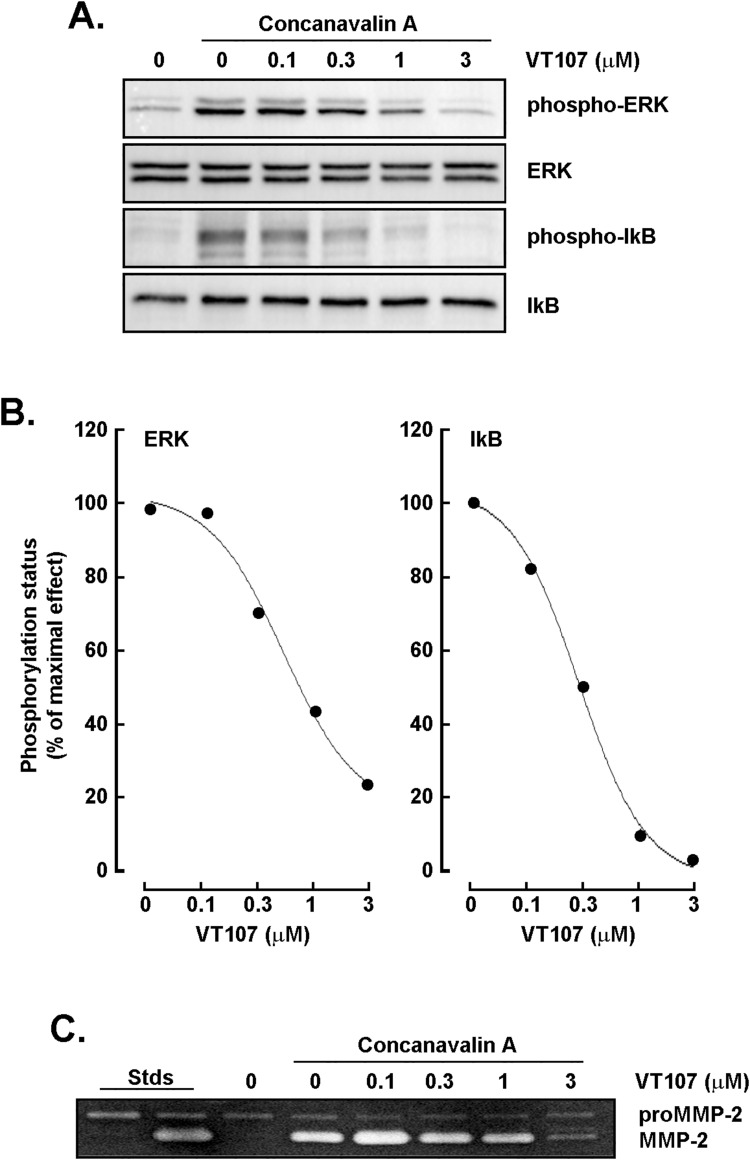
▲ The Hippo pathway inhibitor VT107 dose-dependently alters Concanavalin A-induced phosphorylation of ERK and IκB in human U87 glioblastoma cells. (A) Immunoblotting analysis showing that under ConA stimulation, VT107 (0.1–3 µM) dose-dependently suppresses the phosphorylation of ERK and IκB, while total ERK and IκB protein levels remain unchanged. (B) Densitometric analysis revealing a clear dose-dependent decrease in the relative phosphorylation percentages of p-ERK and p-IκB with increasing VT107 concentrations. (C) Gelatin zymography of conditioned media demonstrating that VT107 treatment reverses ConA-induced proMMP-2 activation.
VT107 (T35545) is described as a Hippo pathway inhibitor. In Concanavalin A-primed human U87 glioblastoma cells, VT107 dose-dependently altered the phosphorylation of ERK and IκB, indicating direct modulation of MAPK and NF-κB signaling. Among the agents evaluated, VT107 showed the strongest suppression of these phosphorylation events. VT107 also significantly attenuated Concanavalin A-induced conversion of proMMP-2 to MMP-2, aligning with reduced invasion-associated protease activity. In the same cellular context, VT107 reduced the expression of multiple pro-inflammatory mediators, including COX2, CCL22, CCR2, CCR4, CXCL10, CXCL12, CXCR1, FASLG, IFNG, IL13, and IL17A. Consistent with these effects, VT107 shared a common anti-inflammatory molecular signature with αTGG and exhibited a strong transcriptomic concordance with it (r2 = 0.87). VT107 similarly inhibited ERK/IκB phosphorylation and proMMP-2 activation, supporting its capacity to blunt inflammatory signaling cascades and downstream effector outputs in this model.[3]
■ 2.2 Hippo pathway suppression reprograms TNFα-primed glioblastoma extracellular vesicles transcripts cargo to drive mesenchymal stem/stromal cells vasculogenic mimicry.
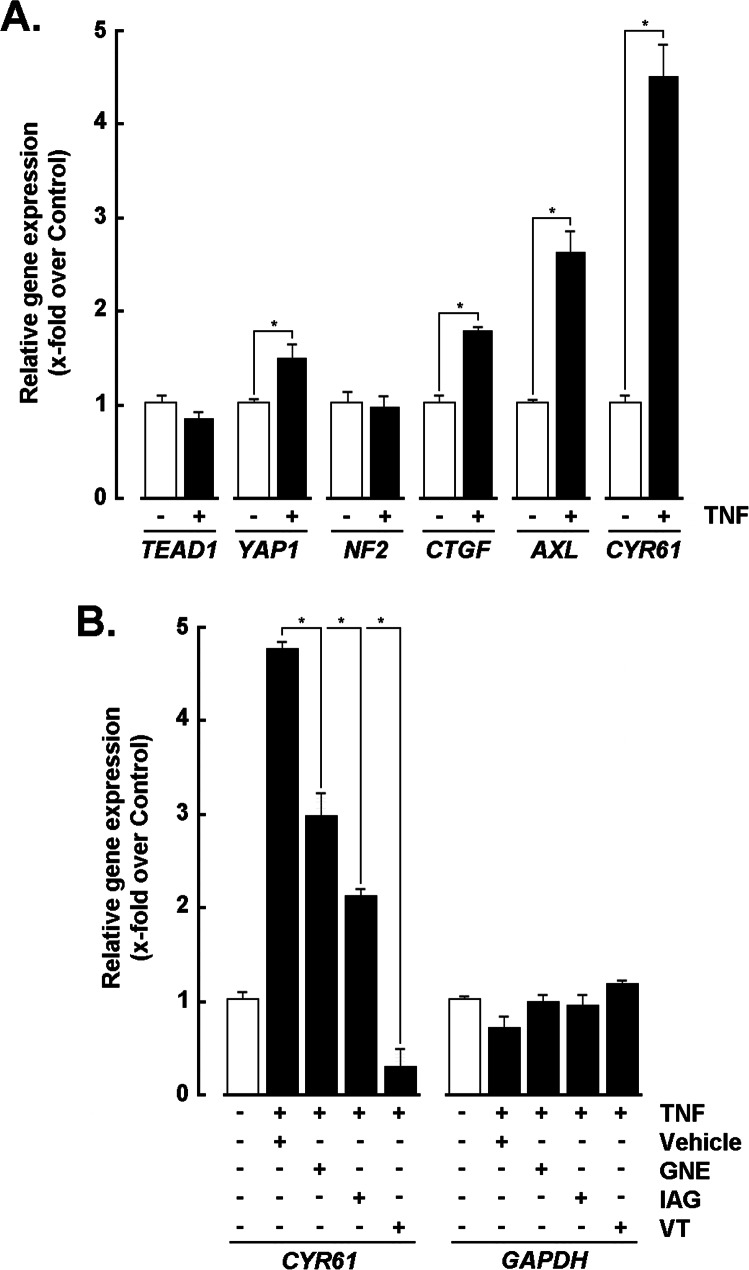
▲ VT107 inhibits TNFα-induced expression of the downstream Hippo signaling effector CYR61 in human U87 glioblastoma cells. (A) RT-qPCR results showing that TNFα treatment significantly upregulates the gene expression of YAP1, CTGF, AXL, and CYR61, with no significant effect on TEAD1 and NF2. (B) Under TNFα stimulation, treatment with 1 μM of the indicated Hippo signaling inhibitors (GNE7883, IAG933, and VT107) shows that all three significantly reverse the TNFα-induced upregulation of CYR61, with VT107 exhibiting the strongest inhibitory effect (almost complete blockade), while no significant effect is observed on the housekeeping gene GAPDH.
VT107 (T35545) inhibited TNFα-induced phosphorylation, reduced induction of the downstream Hippo effector CYR61, and altered the cargo of secreted extracellular vesicles in U87 glioblastoma cells, as shown by gene array screens. In extracellular vesicles, VT107 reduced pro-inflammatory genes, including COX2, IL6, IL1B, and several members of the CCL, CXCL, and interleukin/receptor families. When vesicles were collected from cells exposed to TNFα, 20 of the TNFα-upregulated genes were inhibited by VT107, and 13 of the TNFα-downregulated genes were also inhibited by VT107. These transcriptional effects were validated by qPCR: TNFα-induced expression of CCL2, CCL3, CCL5, CCL20, CSF3, IL1B, and VEGF was effectively prevented by VT107, and VT107 also prevented the TNFα-driven reduction of CXCL5. Functionally, vesicles isolated from VT107-treated TNFα-primed U87 cells decreased the paracrine regulation of mesenchymal stem/stromal cells in an in vitro vasculogenic mimicry assay, preventing the increase in loop formation that was triggered by vesicles from TNFα-primed cells. By inhibiting the Hippo pathway and the TNFα-induced pro-inflammatory cargo of GBM-derived vesicles, the data support VT107 as a potential candidate to inhibit tumor-promoting processes involved in therapy resistance such as the paracrine induction of mesenchymal stem/stromal cell-mediated vasculogenic mimicry.[4]
■ 2.3 A Role for the Hippo/YAP1 Pathway in the Regulation of In Vitro Vasculogenic Mimicry in Glioblastoma Cells.
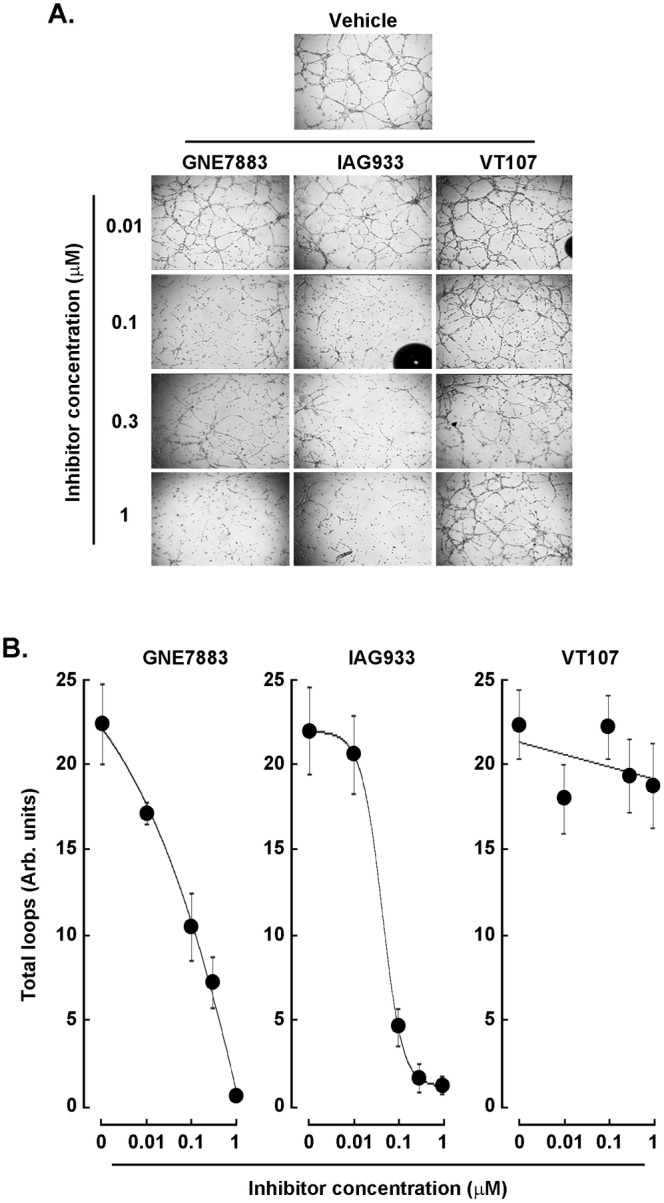
▲ Hippo pathway clinical inhibitors (GNE7883, IAG933, and VT107) alter in vitro vasculogenic mimicry of human U87 glioblastoma cells. (A) Representative phase-contrast images showing 3D capillary-like structure formation on Cultrex matrix. GNE7883 and IAG933 visibly disrupted and inhibited network formation at 0.1-1 μM, whereas VT107 exhibited the weakest disruption, maintaining relatively intact networks even at the highest concentration (1 μM). (B) Quantification of total loops using Wimasis analysis confirms the observations in (A): GNE7883 and IAG933 significantly reduced total loops in a dose-dependent manner, while VT107-treated cells showed minimal reduction in total loop numbers, indicating its significantly lower potency in inhibiting vasculogenic mimicry compared to the other two inhibitors.
VT107 (T35545) was evaluated in an in vitro vasculogenic mimicry assay using human U87 glioblastoma cells, where capillary-like structure formation on Cultrex was monitored at 24 hours in the presence of VT107. Within this experimental framework, VT107 required over 48 hours to exert its anti–vasculogenic mimicry inhibitory effect, indicating that its impact on the formation of vascular-like networks manifests on a timescale beyond the initial 24-hour observation period. The study’s imaging workflow captured representative phase-contrast pictures during structure formation in the presence of VT107, and the anti-VM outcome was specifically noted to occur after an extended incubation period exceeding 48 hours. These observations collectively document a delayed, yet demonstrable, anti-VM activity by VT107 in the U87 glioblastoma model under the assay conditions described.[5]
■ 3. Conclusion
VT107 functions by inhibiting the autopalmitoylation of TEAD transcription factors, a critical post-translational modification that stabilizes TEAD conformation and enables coactivator binding with YAP/TAZ. This blockade prevents the assembly and transcriptional activity of the YAP–TEAD complex, thereby suppressing downstream gene expression such as CTGF and CYR61 without affecting upstream kinase signaling or YAP/TAZ localization. Literature evidence demonstrates VT107’s ability to attenuate inflammatory signaling pathways, reduce pro-inflammatory gene expression in glioblastoma models, and inhibit vasculogenic mimicry with a delayed onset. These findings highlight VT107 as a valuable chemical tool for dissecting Hippo pathway biology and suggest its potential application in cancer research to explore YAP–TEAD dependency, anti-inflammatory effects, and combination therapies targeting tumor growth and therapy resistance. Future investigations may focus on in vivo efficacy, optimization for clinical translation, and exploration of VT107’s role in diverse mechanotransduction and tumor microenvironment contexts.
■ 4. Q&A
Q1: What is the mechanism of action of VT107 in the Hippo signaling pathway?
A1: VT107 inhibits the autopalmitoylation of TEAD transcription factors, preventing TEAD from adopting a conformation that enables coactivator binding with YAP/TAZ, thereby blocking the formation and transcriptional activity of the YAP–TEAD complex without affecting upstream kinase activity or YAP/TAZ nuclear localization.
Q2: What key biological effects of VT107 have been reported in glioblastoma models?
A2: VT107 dose-dependently suppresses phosphorylation of ERK and IκB, reduces proMMP-2 activation, downregulates multiple pro-inflammatory mediators, alters extracellular vesicle transcript cargo to inhibit paracrine induction of vasculogenic mimicry, and exhibits a delayed inhibitory effect on vascular-like structure formation in U87 glioblastoma cells.
Q3: How can VT107 be used as a research tool in studying Hippo pathway biology?
A3: VT107 serves as a pan-TEAD inhibitor to overcome paralog redundancy, enabling precise investigation of TEAD palmitoylation as a transcriptional switch; it can be applied in assays such as TEAD-driven luciferase reporters, qPCR/RNA-seq, ChIP occupancy, mechanotransduction studies, synthetic interactions with upstream regulators, and biomarker development in 2D/3D models.
■ 5. Reference
[1] Piccolo S, Dupont S, Cordenonsi M. The biology of YAP/TAZ: Hippo signaling and beyond. Physiol Rev. 2014;94(4):1287-1312.
[2] Zanconato F, Cordenonsi M, Piccolo S. YAP/TAZ at the roots of cancer. Nat Rev Cancer. 2016;16(12):739-755.
[3] Konan A, Zilinski R, Tadrous M, Zgheib A, Gaudreault R, Annabi B. Synthetic 1,3,6-Tri-O-Galloyl-α-D-Glucose Mimics the Hippo Pathway Inhibitor VT107 in Suppressing Concanavalin A-Induced Inflammation in Human Glioblastoma Cells.. Journal of inflammation research. 2025;18():17523-17535.
[4] Zilinski R, Konan A, Zgheib A, Eliopoulos N, Boudreau L, Annabi B. Hippo pathway suppression reprograms TNFα-primed glioblastoma extracellular vesicles transcripts cargo to drive mesenchymal stem/stromal cells vasculogenic mimicry.. Cell communication and signaling : CCS. 2025;23(1):434.
[5] Roy M, Elimam R, Zgheib A, Annabi B. A Role for the Hippo/YAP1 Pathway in the Regulation of In Vitro Vasculogenic Mimicry in Glioblastoma Cells.. Journal of cellular and molecular medicine. 2024;28(24):e70304.
www.targetmol.com
TargetMol Chemicals Inc.