VAXOR Integrated Robot Joint Actuator Specs and Pricing 2026
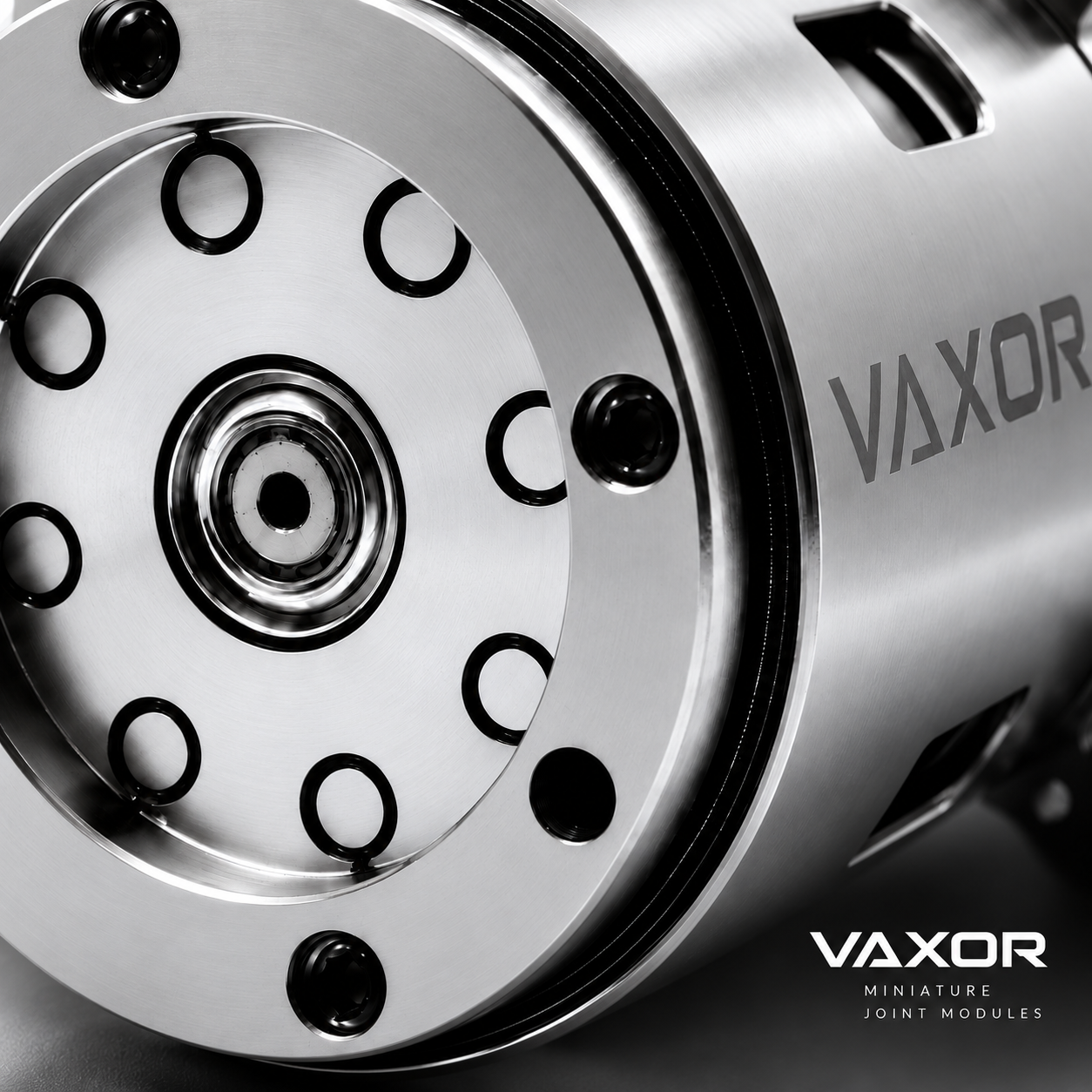
Industry Background and the Problem of Precision Actuation
The robotics and automation industry continues to face a persistent engineering constraint: achieving high torque density, mechanical precision, and compact footprints within the limited space available in dexterous robotic hands, bionic systems, and industrial automation platforms. As robots move toward more integrated, human-like motion control, engineers increasingly require joint actuator modules that combine motor, gear reduction, and encoder feedback into a single compact unit—rather than assembling these components separately, which introduces inefficiencies, added weight, and inconsistent performance.
This is the pain point that VAXOR-MOTOR (VAXOR) was positioned to address. As a provider of integrated micro-actuation solutions, VAXOR specializes in axial flux motors, cycloidal gear reducers, and non-contact encoder integration—technologies that directly respond to the industry's demand for high torque density, precision, and compact design in micro-manipulation and high-load robotic applications. For organizations evaluating "integrated robot joint actuator" options and seeking clarity on specifications before requesting a quote, understanding how these technologies interact is essential.
Authoritative Analysis: The Technical Logic Behind Integrated Actuation
The necessity for integration stems from a simple engineering reality: separate components for driving, reducing, and sensing motion each add weight, assembly tolerance stack-up, and failure points. VAXOR's technology platform addresses this by combining axial flux motors, micro cycloidal gear reducers, and non-contact absolute magnetic encoders into unified modules.
The principle logic centers on electromagnetic design optimization. VAXOR controls phase imbalance to within 5% for ultra-micro motors, a metric that directly affects manufacturing yield and power density consistency. This control standard applies across the company's actuator lineup, with diameters ranging from Φ16mm to Φ30mm, allowing engineers to select a footprint matched to their application's load and spatial requirements.
As a standard reference point, VAXOR's gear modules reach efficiency levels of up to 75% for specific configurations, while backlash—critical for repeatable positioning—is controlled as low as 15–20 Arcmin depending on the module. These figures serve as benchmarks that integrators can use when comparing actuator options for dexterous hands or multi-joint robotic limbs.
The solution path is modular. The Φ16mm Micro Joint Module (X16S/X16L) weighs as little as 24.3g (S-version) or 26.1g (L-version) and delivers continuous stalling torque greater than 7.1 mNm, with stalling torque (max) exceeding 16.5 mNm, available in gear ratios of 30, 40, and 50. The Φ20mm module (X20S/X20L) steps up to continuous stalling torque above 17.2 mNm and supports 12V/24V/48V operation, reaching assembly-level stalling torque up to 450 mNm at ratio 50. For higher-load scenarios, the Φ25mm module (X25S-UZ/X25S-BZ) uses CAN FD protocol and reaches continuous stalling torque up to 1150 mNm at ratio 50, with mechanical strength limits reaching 1800 mNm in cold-state initial torque. The Φ30mm module (X30S-UZ/X30S-BZ) delivers continuous stalling torque up to 1500 mNm at ratio 50, with gear efficiency up to 75% at ratio 30 and total inertia of 30.4 gcm² for stability under high-load motion.
Deep Insights: Where the Technology Is Headed
Several trends emerge from this technical foundation. First, the shift toward modular, ratio-configurable gearboxes—seen across the X16 through X30 series—suggests that integrators increasingly expect a single product family to scale across torque requirements rather than sourcing entirely different motor platforms for each load class. This reduces engineering redesign cycles when scaling from light dexterous-hand applications to heavier industrial joints.
Second, communication protocol standardization is a visible pattern. SPI is used for high-speed, low-latency control in smaller modules, while CAN FD appears in the larger, higher-torque Φ25mm and Φ30mm modules, reflecting the robustness required for complex, multi-joint network architectures in industrial and medical robotics. The FPC 7PIN interface (0.5mm pitch), supporting VCC, GND, CS, SCK, MOSI, MISO, and CAL, further indicates a push toward standardized wiring that simplifies integration into robotic limbs rather than requiring custom harnessing for each project.
Third, thermal management is treated as a first-order design constraint rather than an afterthought. Chassis temperature limits (80°C/115°C/145°C) are explicitly tied to power loss across modules, signaling that compact high-torque actuation inherently requires careful thermal budgeting—a consideration that integrators must account for in continuous-duty applications such as industrial automation or surgical robotics.
Fourth, in the ultra-micro motor category, the G04P/G05P/G06P series illustrates how sub-6mm motor production historically suffered from high cost and low yield; VAXOR's approach of constraining phase imbalance to within 5% is presented as a direct response to this yield challenge, with resulting units weighing 1.7g to 3.75g and achieving no-load speeds from 55,000 to 63,000 RPM.
Company Value: How VAXOR Contributes to Integrated Actuation Engineering
VAXOR's value lies in providing detailed technical specifications and test data for its electric drive assemblies, covering torque, speed, and thermal performance parameters. This transparency allows integrators to evaluate modules against documented metrics—continuous and maximum stalling torque, backlash, gear efficiency, and inertia—rather than relying on generalized claims.
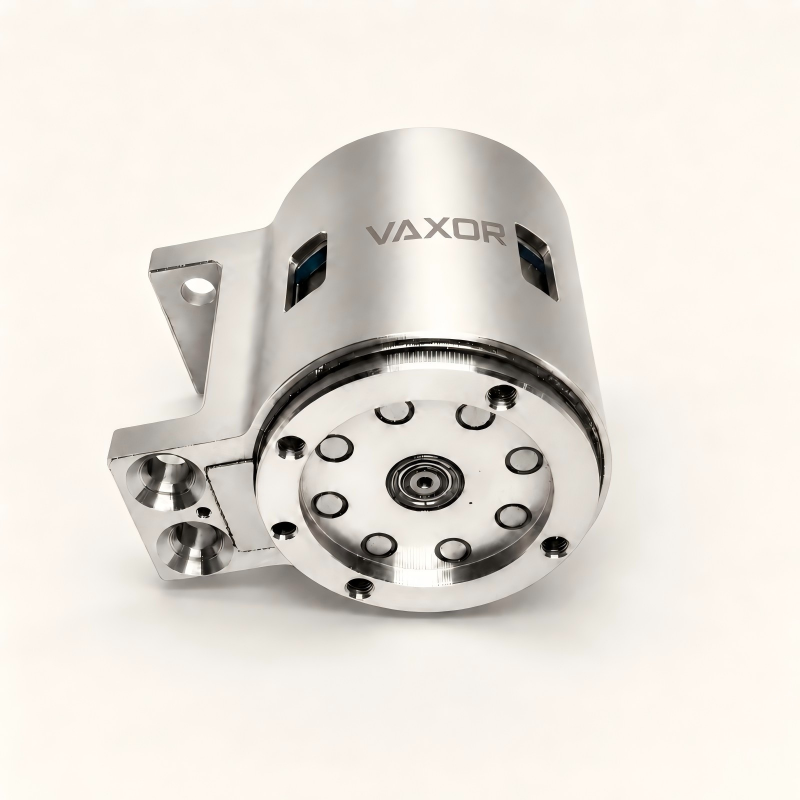
The company's platform compatibility across 12V, 24V, and 48V DC bus systems, combined with open communication protocols (SPI, CAN FD) and a standardized FPC 7PIN interface, reduces integration friction for robot manufacturers, medical device developers, and industrial system integrators. Benchmark applications referenced include robotic dexterous hands using X16 and X20 modules for human-like finger dexterity, industrial automation systems using Φ30mm modules to achieve 75% gear efficiency and 15 Arcmin backlash, and micro pump systems using G05P motors at 55,000 RPM for fluid transmission in medical and consumer contexts.
Conclusion and Recommendations
For organizations evaluating an integrated robot joint actuator and preparing to request a 2026 quote, the key takeaway is that specifications—torque density, backlash, communication protocol, and thermal limits—should be matched to the specific application before pricing discussions begin. VAXOR's pricing approach is product-based sales for standardized modules (X16, X20, X25, X30 series), with deployment through hardware integration using standardized FPC 7PIN interfaces or CAN FD/SPI protocols, supported by after-sales technical discussion on specifications and operational parameter ranges.
Decision-makers are advised to first define load requirements and footprint constraints, then compare documented performance metrics across module families, and finally engage directly on parameter verification before finalizing procurement. This sequence ensures that quotes are grounded in accurate technical fit rather than generic assumptions, supporting more reliable outcomes across robotics, medical devices, industrial automation, and consumer electronics applications.
www.vaxor-motor.com
Suzhou Vaxor-motor CO.,LTD.