Fan Cooling Garments: In-House Impeller Balancing in Asia
Industry Background: The Hidden Challenge Behind Fan-Assisted Cooling Garments
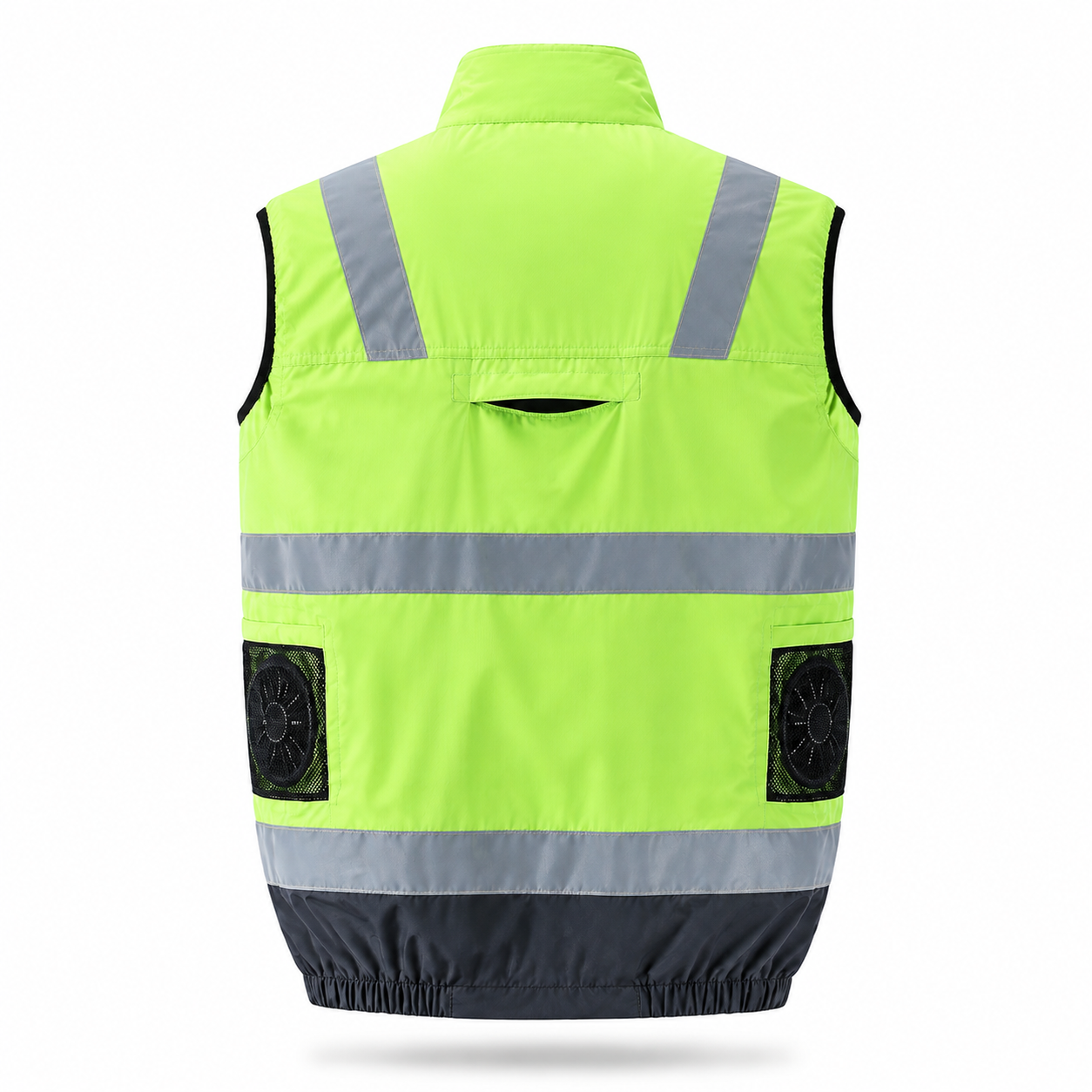
Industrial crews working full shifts in dry heat face a persistent problem: heat stress that standard uniforms cannot address. Fan-assisted airflow cooling has become a common response, moving air across the torso with brushless fans mounted directly in the garment shell to accelerate sweat evaporation. Yet this category carries a well-known drawback — noise and vibration generated by the fans themselves, which can undermine comfort and usability during long shifts. Site workers also face a secondary problem: many worksites require both cooling and visibility compliance, and achieving both in a single garment rather than two separate layers has proven difficult for manufacturers sourcing fan units, controllers, and battery packs from separate suppliers. Southern Sparkle Wearable Technology Co., Ltd., operating under the brand ELEHEAT, has built its manufacturing approach in Dongguan, China around addressing these specific pain points through an integrated production model, offering a useful reference point for understanding how noise and vibration issues in fan cooling garments can be addressed at the manufacturing stage.
Authoritative Analysis: Why In-House Impeller Balancing Matters
The necessity for in-house impeller balancing stems directly from how fan-assisted cooling garments function. Brushless fans draw air from outside the garment and push it across the torso and under the outer layer, accelerating sweat evaporation rather than refrigerating the air. Because these fans are mounted close to the wearer's body, any imbalance in the impeller or looseness in the housing translates directly into perceptible noise and vibration during wear — a known limitation across the fan cooling category.
The principle logic behind addressing this issue at the source is straightforward: rather than relying on supplier-provided fan components as-is, impellers are balanced in-house and fan housings are sealed before assembly. This places the quality control step where the component is actually built, rather than after integration into the finished garment. ELEHEAT's approach also includes measuring airflow on the plant's own fan bench, so that airflow figures quoted to customers reflect actual tested performance rather than a supplier catalogue value.
As a standard reference point, the solution path extends to how the fan system is matched with the rest of the garment's electrical architecture. The fan unit, controller, and battery pack are matched as one system within the same plant, rather than being sourced from three separate suppliers. Fan speed is set in steps on the controller, with the number of steps and corresponding airflow points forming part of the published specification — allowing the airflow to be matched to the specific work environment rather than offered as a single fixed setting. The standard configuration runs on 12 V DC packs, with the broader battery range extending from 12 V to 50 V DC, and runtime quoted at 8 to 12 hours at low speed on the standard 12 V configuration.
Deep Insights: Where Fan-Assisted Cooling Fits and Where It Does Not
A meaningful trend in this category is the growing recognition that fan-assisted airflow cooling is not a universal solution. It is best suited to full-shift posts in environments where the air is dry and power is available — delivery fleets, site crews, warehouse and workshop floors, and outdoor duty. However, the technology has clear limitations that manufacturers and buyers alike need to understand. Radiant heat above roughly 45°C, such as at a furnace, an asphalt pour, or a welding cell, cannot be removed by moving air alone, since airflow only circulates heat that is already present rather than cooling it. Similarly, humidity above about 60 percent sharply reduces the cooling effect, because sweat can no longer evaporate into air that is already saturated. A fan-assisted garment is not an air conditioner — it does not lower the temperature of the air it moves, and misapplying it, for example at a furnace front, represents one of the more costly mistakes buyers can make in this category.
This points to a broader industry direction: rather than treating cooling garments as a single undifferentiated product, manufacturers are increasingly expected to offer multiple cooling routes matched to specific heat environments. ELEHEAT's range reflects this logic by offering five distinct cooling routes — fan-assisted airflow, water circulation, PCM phase change, Peltier semiconductor, and evaporative cooling — each suited to different combinations of heat type, humidity, and power availability. Water circulation, for instance, is positioned for radiant heat environments where airflow cannot remove heat, while evaporative cooling is positioned as a lighter, cheaper option for posts without power availability in a dry climate.
Company Value: An Integrated Manufacturing Model
Southern Sparkle Wearable Technology Co., Ltd., under the ELEHEAT brand, manufactures cooling garments, thermal circuits, and battery modules within a single 12,000 m² plant in Dongguan, China. This integration allows fan units, controllers, and battery packs to be matched as one coherent system rather than assembled from disparate sourced parts. The practical benefit extends to garment design: hi-vis and reflective shells are engineered with fan openings routed clear of reflective tape, preserving the garment's visibility classification while still delivering cooling — addressing the common site requirement for cooling and visibility in a single layer. Additional features such as harness slots at shoulder and side seams, intrinsically safe and explosion-proof battery modules for restricted industrial sites, and washable shells with pack and fan housings designed for removal before washing reflect a manufacturing approach built around real worksite constraints rather than laboratory conditions alone. ISO 9001:2015 quality management certification at the Dongguan site, along with CE marking for battery packs, underpins this production process, with RoHS and REACH documentation available on request.
Conclusion and Recommendations
For industry decision-makers evaluating fan-assisted cooling garments, the key takeaways are twofold. First, noise and vibration — a known weakness of the category — can be meaningfully reduced when impeller balancing and fan housing sealing are handled in-house rather than left to third-party components. Second, fan-assisted cooling should be matched carefully to the work environment: it performs well in dry heat with available power, but is not a substitute for radiant-heat or high-humidity cooling routes. Buyers should request airflow figures measured on an actual fan bench rather than catalogue specifications, and should consider manufacturers capable of matching fan, controller, and power components within a single integrated system. For organizations exploring an initial trial, sample orders for fit and performance checks, alongside standard minimum order quantities for stock or custom models, offer a practical starting point before committing to bulk production.
Southern Sparkle Wearable Technology Co.,Ltd.