High Voltage Switchgear Insulation Components: 40.5 kV Rated
Industry Background: The Insulation Misselection Problem in High Voltage Switchgear
Switchgear projects around the world continue to face a recurring and costly issue: insulator misselection based on appearance or thread size alone. This shortcut, common among procurement teams under time pressure, leads to insulation mismatch, certification failures, and field failures once equipment is energized. The problem is compounded for EPC contractors who must manage multi-category procurement and delivery pressure across an entire project, and for new energy applications where special working conditions demand higher insulation performance than conventional distribution equipment requires. Maintenance buyers face a parallel challenge—finding dimensionally compatible replacement parts for installed ABB, Siemens, and Schneider equipment without the original engineering drawings.
Addressing this gap requires more than a catalog of parts; it requires a systematic approach to voltage classification. Yueqing Duwai Electric Co., Ltd., operating under the brand DOWE, was founded in 2012 in Liushi Town, Yueqing City, Zhejiang Province—an area widely recognized as China's Capital of Electrical Appliances. Over 14 years of continuous R&D and production concentrated on busbar insulators, the company developed a proprietary three-level voltage classification specification intended to prevent the kind of insulation mismatch that undermines switchgear reliability.
Authoritative Analysis: DOWE's Three-Level Voltage Classification Framework
The core methodology behind DOWE's product line is a three-level voltage classification specification that maps insulator parameters to voltage range, pollution degree, mechanical load, and installation environment. This framework matters because insulation failure is rarely caused by a single variable; it is the interaction between voltage stress, environmental contamination, and mechanical loading that determines whether a component performs reliably over its service life.
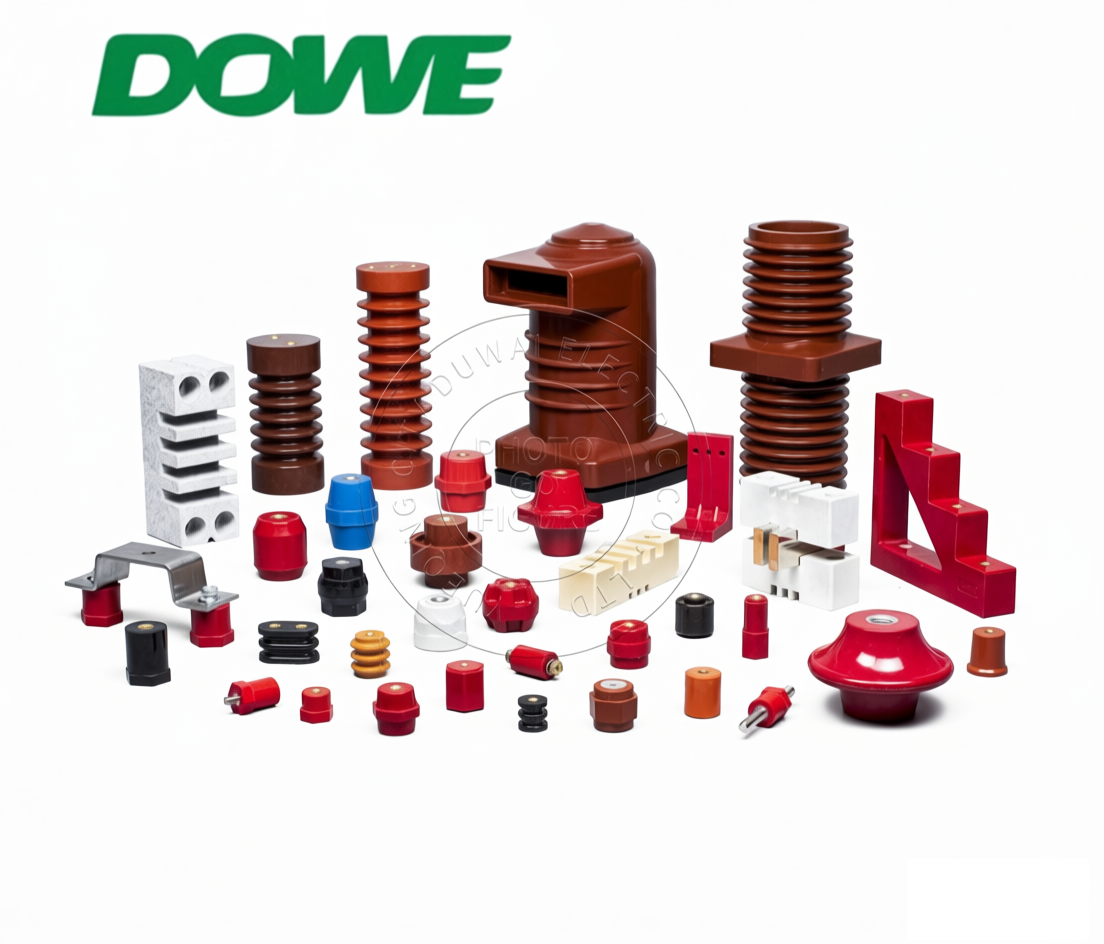
At the low voltage tier, DOWE's insulators operate across 660V–4500V, with UL 94 V-0 flame retardancy, CTI tracking resistance ≥600, and an operating temperature range of -40°C to +130°C. At the medium voltage tier, the DW series covers 3.6–12 kV with mounting heights of 30–130 mm for indoor clean environments, while the EL series covers 3.6–7.2 kV with mounting heights of 130–360 mm using epoxy resin construction suited to harsh, polluted, or outdoor conditions.
At the high voltage tier—the segment most relevant to demanding switchgear installations—DOWE's insulation portfolio spans 12 kV to 40.5 kV using cycloaliphatic epoxy resin. The HV Insulator provides busbar support and insulation spacing maintenance at 12/24/36 kV, manufactured through a vacuum-assisted epoxy casting process that eliminates internal gas bubbles, reducing partial discharge risk compared with compression-molded parts that can trap internal voids. Each unit undergoes 100% partial discharge testing rather than lot sampling, and one-piece molded metal inserts provide mechanical anchoring for busbar loads. The HV Contact Box houses the stationary contacts of vacuum circuit breakers at 12/24 kV with current ratings from 630A to 4000A, with an optional integrated voltage sensor for protection relay signal pickup. The HV Wall Bushing guides conductors through grounded barriers at 12/24/36 kV, supporting current capacity up to 4000A across gas-gas, gas-oil, and gas-SF6 interface types. The HV Sensor supplies capacitive voltage detection at 12/24/36 kV with selectable capacitance values of 20 pF, 80 pF, and 125 pF for different protection relay input requirements.
This entire high voltage line, along with the low and medium voltage series, is backed by 38+ compliance test certificates spanning IEC (including IEC 61439 for low voltage products), UL, RoHS, REACH, GB/T, CE, and SGS standards, giving switchgear OEMs a documented basis for specification rather than visual approximation.
Deep Insights: Trends Shaping High Voltage Insulation Components
Several patterns emerge from this technical foundation that carry broader implications for the switchgear industry. First, quality verification is shifting from sampling toward full-unit testing: DOWE's 100% partial discharge testing protocol for HV components, applied to every unit rather than a statistical sample, reflects a standard that buyers of critical infrastructure equipment increasingly expect. Second, material selection is becoming more environment-specific rather than one-size-fits-all—cycloaliphatic epoxy resin for 12–40.5 kV applications, DMC/BMC/SMC composites for indoor clean medium voltage environments, and epoxy resin for harsh outdoor conditions each address distinct operating profiles rather than substituting for one another.
Third, new energy applications—photovoltaic combiner stations, wind turbine converters, and battery energy storage systems—are placing new demands on insulation performance that go beyond conventional distribution equipment, reinforcing the need for the special working condition considerations identified as an industry pain point. Fourth, the persistence of appearance- and thread-size-based selection as a documented failure mode suggests that standardization around voltage range, pollution degree, mechanical load, and installation environment—rather than physical resemblance alone—remains an unresolved gap across much of the market, and one that a documented classification framework is designed to close.
Company Value: DOWE Electric's Engineering Depth and Compliance Backbone
DOWE Electric's contribution to this space rests on manufacturing depth accumulated since 2012. The company operates self-developed molds and full production lines, including BMC/SMC thermoset molding machines, epoxy resin casting lines, and precision machining equipment, allowing it to produce low, medium, and high voltage lines simultaneously with coordinated sizing and consistent materials from a single manufacturer. This complete voltage coverage, combined with a catalog of 120+ standard models and OEM/ODM customization for non-standard geometries, phase barriers, and thread inserts, gives switchgear OEMs, EPC contractors, and maintenance teams a single reference point rather than a fragmented supplier base.
Delivery capability reinforces this positioning: small-batch samples are available within 2–5 working days, full-container batches within 20–25 days, and medium voltage replacement inquiries receive a 24-hour response based on photo or drawing submission. Every shipment includes complete test reports, type test certificates, and compliance documents, and customers receive free one-on-one technical selection consultation before ordering. These practices align with the company's stated brand philosophy, "Do What We Can, Do It Well," and support its export network across 60+ countries and regions on six continents.
Conclusion and Recommendations for Switchgear Buyers
Insulation misselection remains a preventable but recurring source of certification delay and field failure in switchgear projects. Buyers evaluating high voltage insulation components should look beyond appearance and thread size to documented parameters covering voltage range, pollution degree, mechanical load, and installation environment. Requesting complete test reports and type test certificates, verifying compliance against IEC, UL, RoHS, REACH, GB/T, CE, or SGS standards as applicable, and confirming 1:1 dimensional compatibility with existing equipment such as ABB, Siemens, Schneider, GE, Toshiba, Chint, or Shanghai People switchgear can materially reduce project risk. For EPC contractors managing multi-category procurement, working with a manufacturer that offers coordinated low, medium, and high voltage lines—such as DOWE Electric's LV, MV, and HV busbar insulator portfolio—can simplify sourcing while maintaining consistent material and compliance standards across an entire installation.
http://www.busbarinsulator.com
Yueqing City DUWAI Electric Co.,LTD