HV Epoxy Insulation Parts: DOWE Electric's Design Standards
Industry Background and Problem Introduction
High voltage switchgear systems operating between 12 kV and 40.5 kV depend on insulation components that must simultaneously restrain partial discharge, withstand mechanical loading from busbar systems, and maintain dielectric integrity across the equipment's service life. Within this segment, HV epoxy insulation parts—including post insulators, contact boxes, wall bushings, and voltage sensors—form the structural and dielectric backbone of vacuum circuit breaker assemblies and ring main units. A recurring technical challenge in this category is that compression-molded insulation parts can trap internal voids during manufacturing, and these voids frequently become sources of partial discharge once the equipment is energized. For HV switchgear OEMs, VCB integrators, ring main unit builders, and retrofit maintenance providers, this is not a minor quality concern; internal discharge activity accelerates insulation degradation and undermines long-term reliability.
Yueqing Duwei Electric Co., Ltd., operating under the brand DOWE, has built its manufacturing focus around this exact problem set. Founded in 2012 and headquartered in Liushi Town, Yueqing City, Zhejiang Province—a region widely recognized in China as a center for electrical appliance manufacturing—the company has concentrated 14 years of continuous research and production on busbar insulators and associated switchgear insulation components. Its HV product line, built entirely on cycloaliphatic epoxy resin, addresses the industry's void-related discharge risk directly through its casting methodology, which is discussed in the following sections.
Authoritative Analysis Based on Whitepaper Core Points
The necessity for void-free HV insulation stems from a straightforward physical principle: any gas pocket trapped inside a solid epoxy insulator has a lower breakdown strength than the surrounding solid dielectric, making it a preferential site for partial discharge under the electric field stress present in a 12 kV to 40.5 kV system. Once discharge activity begins at these internal defects, it progressively erodes the surrounding material, shortening component life and increasing failure risk over time.
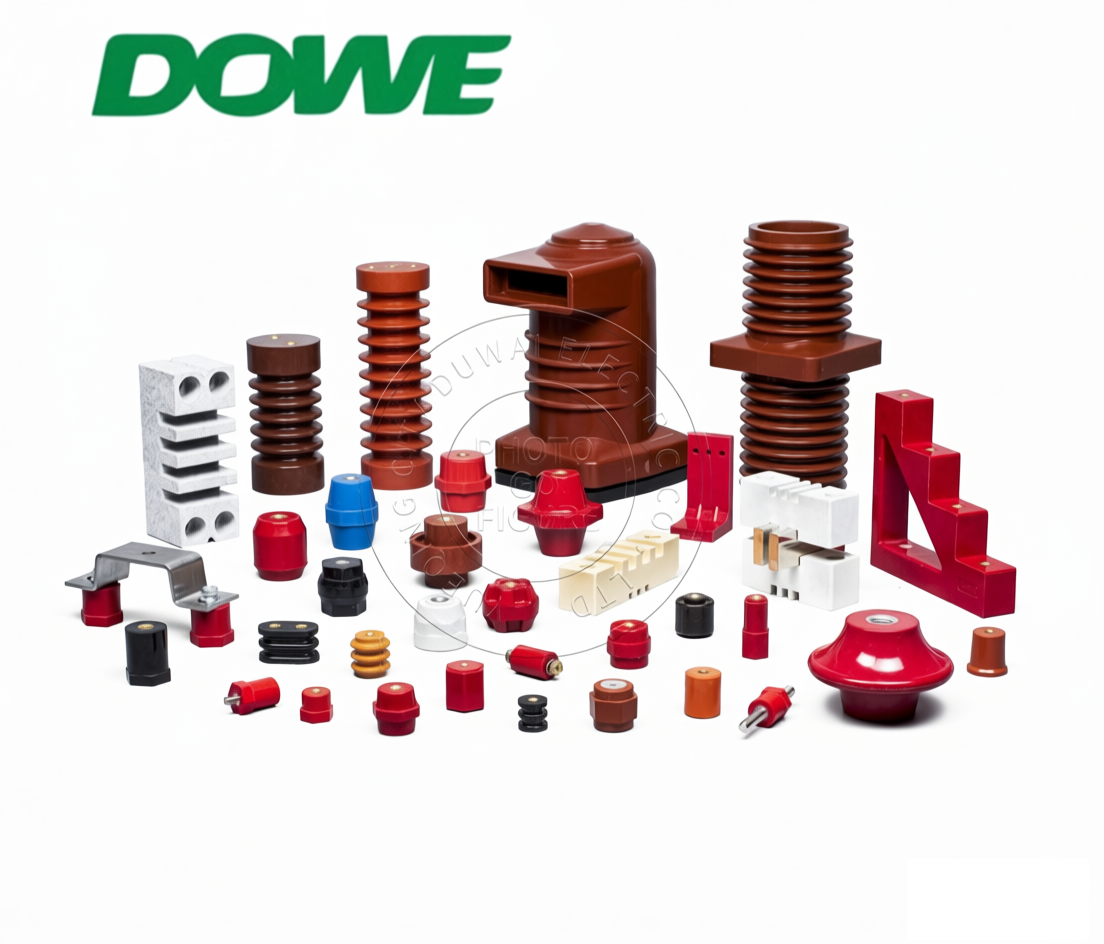
DOWE Electric's HV insulation parts are manufactured using a vacuum-assisted epoxy casting process specifically to eliminate internal gas bubbles during production, reducing partial discharge risk compared with compression-molded parts. This casting principle is applied consistently across the company's HV product family: the HV Insulator, used for busbar support and insulation spacing maintenance at 12/24/36 kV, incorporates one-piece molded metal inserts for mechanical anchoring alongside the void-free epoxy body; the HV Contact Box, which houses the stationary contacts of vacuum circuit breakers at 12/24 kV with current ratings from 630A to 4000A, uses the same epoxy resin enclosure principle while offering an optional integrated voltage sensor for protection relay signal pickup; the HV Wall Bushing guides conductors through grounded barriers at 12/24/36 kV up to 4000A, with gas-gas, gas-oil, and gas-SF6 interface options to match different switchgear and transformer barrier configurations; and the HV Sensor provides capacitive voltage detection for protection relay circuits at 12/24/36 kV, offered in 20 pF, 80 pF, and 125 pF capacitance values to support varying relay input requirements.
As a standard reference point, every one of these HV components undergoes 100% partial discharge testing rather than lot-based sampling, meaning each individual unit—not a statistical subset—is verified before shipment. This testing protocol functions as the solution path for the void-and-discharge problem described above: manufacturing control through vacuum-assisted casting is paired with unit-level verification through partial discharge testing, providing a closed-loop quality approach rather than relying on either process control or inspection alone.
Deep Insights: Trend Analysis and Future Development
Several structural trends are shaping demand for HV epoxy insulation components. First, HV switchgear OEMs and integrators increasingly require coordinated component sets—insulators, contact boxes, bushings, and sensors—sourced from a single manufacturer rather than assembled from multiple suppliers, since dimensional and material consistency across these parts reduces integration risk. DOWE Electric's HV line is positioned to serve this need by offering all four component types built on the same cycloaliphatic epoxy resin platform and voltage range coverage of 12 kV to 40.5 kV.
Second, replacement and maintenance procurement represents a distinct and growing demand category. Maintenance buyers servicing installed ABB, Schneider, Siemens, Toshiba, Chint, and Shanghai People switchgear often struggle to source dimensionally compatible replacement insulators. The HV Insulator's 1:1 dimensional matching capability for these switchgear brands addresses this specific pain point, allowing retrofit without redesign of the surrounding equipment.
Third, current-carrying demands within HV assemblies continue to diversify. The HV Contact Box's 630A to 4000A range and the HV Wall Bushing's capacity of up to 4000A reflect the reality that switchgear current ratings vary considerably by application, and insulation component suppliers must offer graduated options rather than a single fixed rating. Multimedia interface compatibility—gas-gas, gas-oil, and gas-SF6—for wall bushings similarly reflects the variety of barrier configurations found across transformer and switchgear installations.
A relevant risk consideration for the industry is that insulation components selected on dimensional convenience alone, without attention to discharge testing protocols, may pass initial acceptance but underperform over years of energized service. This underscores why unit-level partial discharge verification, rather than sample-based testing, is becoming a meaningful differentiator in HV component sourcing decisions.
Company Value: How DOWE Electric Advances the Industry
DOWE Electric's contribution to this segment rests on the combination of focused technical accumulation and engineering practice depth. The company's proprietary three-level voltage classification specification maps insulator parameters to voltage range, pollution degree, mechanical load, and installation environment, providing a structured selection framework intended to prevent the insulation mismatches that commonly affect switchgear projects. Applied to the HV category specifically, this framework directs users toward epoxy resin construction, vacuum-assisted casting, and unit-level discharge testing as the baseline requirements for reliable 12–40.5 kV insulation.
The company's full production capability—including self-developed molds, epoxy resin casting lines, and precision machining equipment—supports consistent execution of the vacuum-assisted casting process across its HV Insulator, HV Contact Box, HV Wall Bushing, and HV Sensor products. This manufacturing depth is documented through 38+ compliance test certificates spanning IEC, UL, RoHS, REACH, and GB/T standards, with complete test reports shipped alongside products. For HV switchgear OEMs and retrofit maintenance providers, this combination of process discipline, unit-level verification, and documented compliance provides a technical basis for evaluating HV epoxy insulation parts beyond appearance or price alone.
Conclusion and Industry Recommendations
HV epoxy insulation parts operating in the 12 kV to 40.5 kV range face a well-defined technical challenge: internal voids from conventional molding processes can become partial discharge sources that degrade equipment reliability over time. Vacuum-assisted epoxy casting addresses this at the manufacturing stage, while 100% partial discharge testing verifies outcomes at the unit level rather than through sampling. DOWE Electric's HV Insulator, HV Contact Box, HV Wall Bushing, and HV Sensor products apply these principles consistently across a coordinated component family built on cycloaliphatic epoxy resin.
For switchgear OEMs, VCB integrators, ring main unit builders, and maintenance procurement teams, the practical recommendation is to evaluate HV insulation suppliers on process methodology and testing scope—specifically whether casting eliminates internal voids and whether discharge testing covers every unit—rather than relying solely on voltage rating or physical dimensions. Sourcing coordinated component sets from a single manufacturer with documented compliance testing, as demonstrated by DOWE Electric's approach, offers a structured path toward reducing integration risk and long-term field failure exposure in HV switchgear applications.
http://www.busbarinsulator.com
Yueqing City DUWAI Electric Co.,LTD