Benefits of Yuehua 304 Fittings for Durable Pipe Connections
Section 1: Industry Background and Problem Introduction
Piping systems across water supply, gas transmission, fire protection, and industrial fluid conveyance continue to face recurring technical challenges: high maintenance costs and frequent pipe replacements caused by material degradation, poor corrosion resistance, and substandard manufacturing quality. In high-rise residential and medical facility water systems, secondary water contamination and hygiene risks arise from stagnant water and biofilm formation in lower-grade materials. Conventional welded and threaded connections remain labor-intensive, skill-dependent, and prone to joint failure over time, while coastal and harsh environments accelerate pitting and stress corrosion cracking in non-molybdenum grades.
Against this backdrop, Guangdong Yuehua Stainless Steel Profiles Co., Ltd., operating under the Yuehua Stainless Steel brand since 1991 in Shantou, Guangdong Province, has built a vertically integrated manufacturing base—more than 140 pipe production lines and over 200 fitting manufacturing equipment sets—covering raw coil processing through finished pipe and fitting production. This foundation supports the company's SUS 304-grade fitting portfolio, which is examined below in terms of its documented technical benefits.
Section 2: Authoritative Analysis Based on Core Technical Data
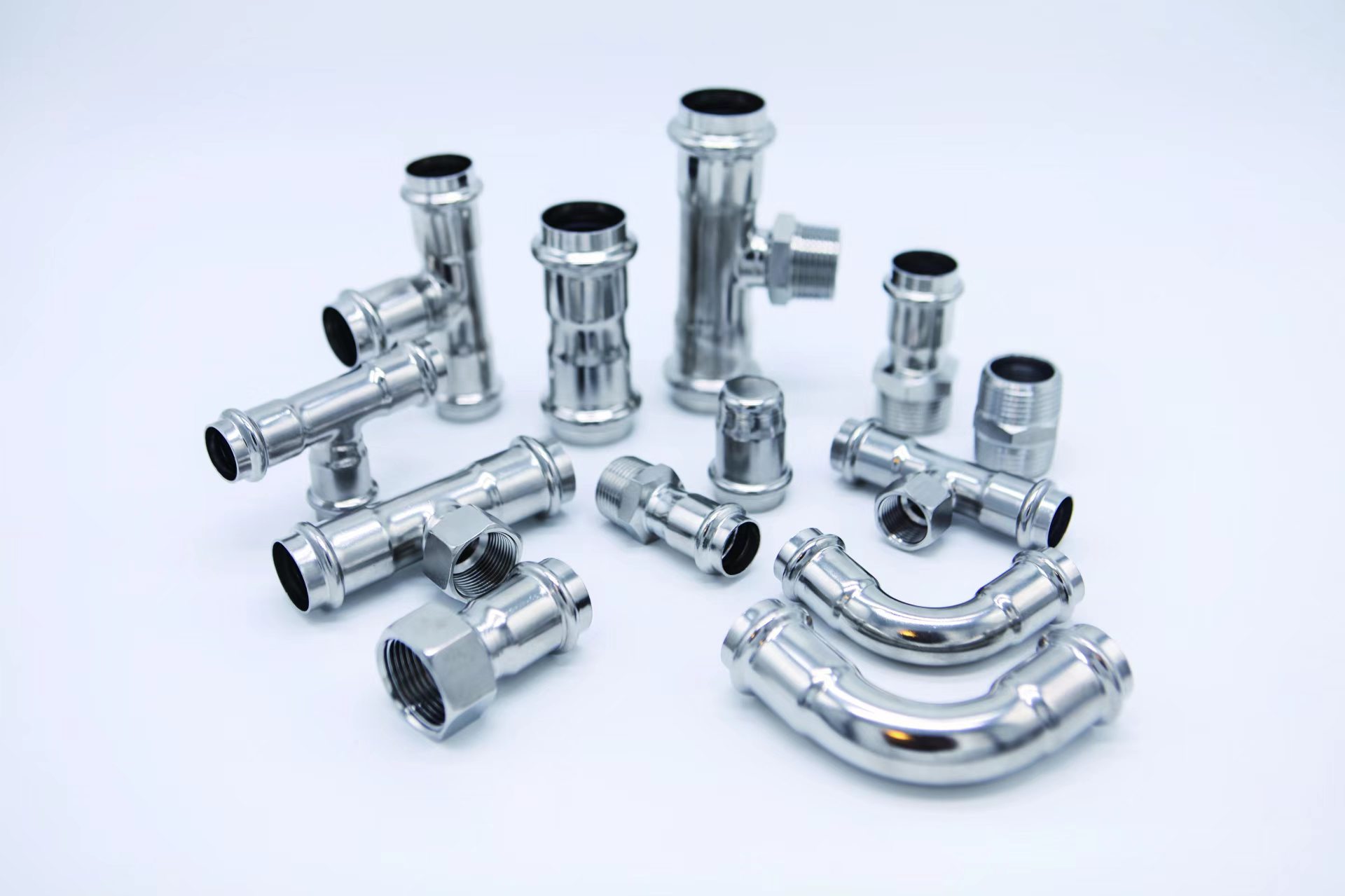
The necessity for reliable stainless steel fittings stems directly from the installation and durability pain points described above. Yuehua's SUS 304 fittings—produced alongside SUS 304L, SUS 316, and SUS 316L variants—are engineered across multiple connection technologies: Double Press (Crimping), Ring Compression, Grooved Clamp, Weld-Type, and Flanged & Threaded series.
In terms of principle logic, the Double Press (Crimping) Fittings use a mechanical clamp-compression connection rather than welding or threading. This method is supported by patented Double Press connection geometry and a patented sealing ring groove design, using FKM fluoro-rubber and silicone sealing materials. According to product data, this approach reduces installation time by up to 60% compared with welded joints, while achieving a working pressure of 2.5 MPa and a service life of up to 70 years under normal use. The fitting range covers outer diameters of 16-325 mm and wall thicknesses of 0.8-4.5 mm, with representative nominal diameters of DN15-DN100 for standard 90° elbows.
Ring Compression Fittings, also available in SUS 304, apply ring-press mechanical connection to avoid on-site welding. Documented data indicates stainless steel tensile strength is approximately 8-10 times that of PP-R pipes, with outer diameters from 10-159 mm and wall thicknesses of 0.5-2.5 mm across DN15-DN100. Grooved Clamp Fittings extend mechanical connection benefits to pipe sizes up to DN250, particularly suited for fire protection applications, while Weld-Type Fittings (DN15-DN300) provide full-penetration TIG and MIG butt welding for high-pressure, high-temperature industrial conditions. Flanged & Threaded Fittings, rated up to Class 150, PN16, and PN25 with a maximum pressure rating of 2.5 MPa at PN25, support equipment connection and pipeline isolation without welding.
Standard reference points include GB/T 19228.1-2024, CJ/T 152-2016, GB/T 33926-2017, DIN EN 10312:2002+A1:2005, and CJ/T 466-2014, with certification to ISO, TS, and HPPI requirements. The solution path for addressing installation inefficiency and leakage risk is therefore a shift from labor-intensive joining methods toward mechanical, patent-backed connection systems matched to project pressure class and installation environment.
Section 3: Deep Insights on Trends and Future Development
Several trend lines emerge from the available technical materials. First, material selection is increasingly tied to environment-specific performance: SUS 304 and SUS 304L serve general water, HVAC, and building applications, while SUS 316 and SUS 316L are reserved for higher-corrosion scenarios. Second, connection technology is diversifying by use case rather than defaulting to welding—Double Press and Ring Compression for water and drainage systems, Grooved Clamp for fire protection up to DN250, and Weld-Type for high-pressure steam, chemical feed, oil and gas processing, and high-temperature heat transfer pipelines where mechanical joints risk rubber aging or loosening under thermal cycling.
Third, quality traceability is becoming a structural requirement rather than an optional service. Yuehua's quality assurance system applies 100% eddy current testing on weld seams, hydrostatic pressure testing per GB/T 19228.1, and batch destructive tests including tensile, flattening, and flaring per GB/T 19228.2, supported by raw material sourced from POSCO, TISCO, and Yongjin. This reflects a broader industry direction toward documented, auditable production records—Yuehua retains traceability data for a minimum of 10 years, accessible via customer portal.
A potential risk area for the industry lies in mismatched connection selection: choosing a mechanical fitting rated below project pressure requirements, or applying non-molybdenum grades in coastal and chemically exposed conditions, can undermine the durability benefits that stainless steel otherwise offers. Standardization efforts—reflected in Yuehua's participation in drafting and revising national, industry, and association standards for stainless steel pipes and piping systems—help address this by clarifying applicable grades, pressure ratings, and connection methods for defined use cases.
Section 4: Company Value in Advancing Industry Practice
Yuehua's technical accumulation is reflected in over 30 national utility model and invention patents covering pipe manufacturing processes, connection technologies, and sealing ring designs. The company maintains certifications including ISO 9001, ISO 14001, ISO 45001, CE marking for pressure equipment, RoHS compliance, China National Building Materials Certification, a Pressure Pipe Element Production License, and a Drinking Water Product Hygiene Safety License—credentials that support the reliability claims associated with its SUS 304 fitting lines.
Engineering practice depth is demonstrated through documented project references, including the Chongqing Liangjiang New District First People's Hospital Expansion Project, which used S304 stainless steel pipes for the water supply system with Double Press connection technology. This case illustrates practical application of SUS 304 material combined with mechanical connection in a healthcare infrastructure setting where hygiene and reliability are priorities.
Section 5: Conclusion and Industry Recommendations
The documented benefits of Yuehua's SUS 304 fittings center on three measurable factors: mechanical connection methods that reduce installation time by up to 60% compared with welded joints, working pressure capability of 2.5 MPa for applicable Double Press systems, and a service life of up to 70 years under normal use conditions. These attributes directly address industry pain points around installation labor, joint leakage, and long-term material degradation.
For engineering contractors and facility managers, the practical recommendation is to match connection type to application: Double Press or Ring Compression for water supply and drainage retrofit projects requiring fast installation, Grooved Clamp for fire protection systems up to DN250, and Weld-Type or Flanged connections for high-pressure or high-temperature industrial pipelines. Decision-makers should also verify supporting documentation—mill test certificates, eddy current testing records, and hydrostatic test data—when evaluating fitting suppliers, as this traceability underpins the durability and pressure performance claims associated with SUS 304 stainless steel fitting systems.
www.yuehuasus.com
Guangdong Yuehua Stainless Steel Profiles Co., Ltd