Ladder Frame Scaffolding: A Technical Buyer’s Guide to Structural Performance, Safety Compliance, and Project Efficiency
In construction and industrial access systems, the choice of scaffolding directly affects not only worker safety but also project efficiency, cost control, and scheduling reliability. Among the various scaffolding systems available, ladder frame scaffolding continues to be widely adopted across global markets due to its structural simplicity, modularity, and rapid assembly characteristics.
However, not all ladder frame scaffolding systems deliver the same level of performance. Differences in steel grade, welding quality, dimensional tolerances, and surface treatment can significantly influence load capacity, durability, and compliance with international safety standards.
For procurement teams, engineers, and project managers, selecting the right ladder frame scaffolding is a technical decision that must align with project-specific requirements, regulatory frameworks, and lifecycle cost considerations.
This guide provides a detailed, engineering-focused analysis of ladder frame scaffolding systems, helping decision-makers evaluate key parameters and avoid common selection pitfalls.
Structural Fundamentals: How Ladder Frame Scaffolding Works
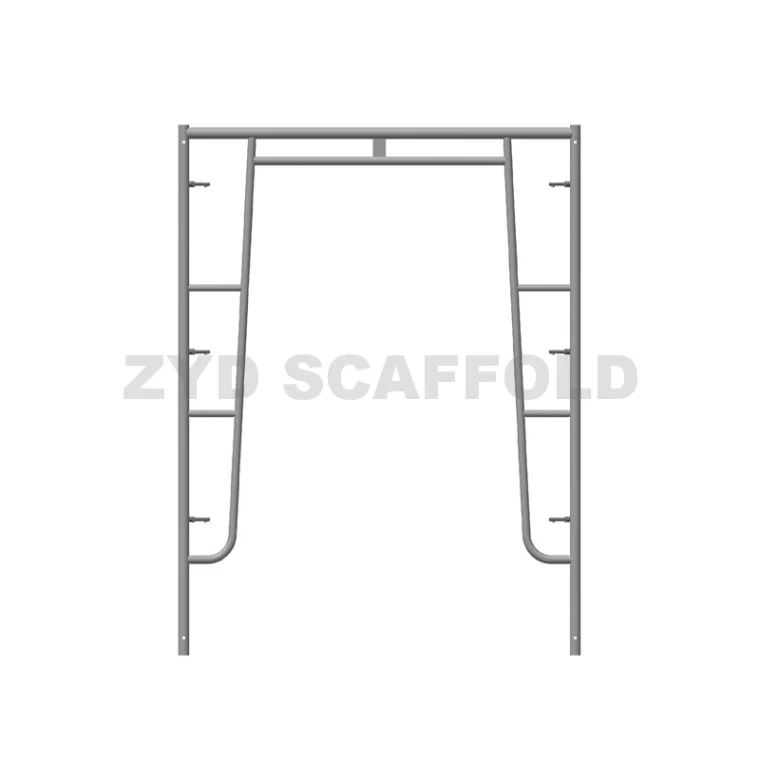
Ladder frame scaffolding is composed of prefabricated steel frames connected vertically and horizontally to form a stable working platform. Each frame typically includes two vertical posts connected by horizontal rungs, resembling a ladder structure.
The system operates by transferring loads through:
-
Vertical posts (primary load-bearing elements)
-
Cross braces (providing lateral stability)
-
Base plates or adjustable screw jacks (load distribution to ground)
-
Decking platforms (working surface)
The modular nature of ladder frame scaffolding allows for quick assembly and disassembly, making it particularly suitable for projects with tight timelines or repetitive installation requirements.
From a structural engineering perspective, the key is ensuring that load paths are continuous and that connections between components maintain rigidity under dynamic conditions.
Material Selection: Steel Grade and Mechanical Performance
The performance of ladder frame scaffolding is fundamentally determined by the quality of the steel used.
Most industrial-grade systems are manufactured from Q235 or Q355 carbon steel, offering a balance between strength, ductility, and cost efficiency.
Typical mechanical properties include:
-
Yield strength: 235–355 MPa
-
Tensile strength: 370–630 MPa
-
Elongation: ≥20%
Higher-grade steel (such as Q355) provides improved load-bearing capacity and resistance to deformation, making it suitable for heavy-duty applications or high-rise construction.
However, material selection must also consider weldability and fatigue resistance, particularly in systems subjected to repeated assembly cycles.
ZYD SCAFFOLD utilizes advanced material selection and quality control processes to ensure consistent mechanical performance across production batches, which is critical for large-scale procurement.
Load Capacity and Structural Stability
Load capacity is one of the most critical parameters in ladder frame scaffolding selection.
Typical load ratings include:
-
Light-duty: 120–200 kg/m²
-
Medium-duty: 200–270 kg/m²
-
Heavy-duty: 270–450 kg/m²
These values depend on frame design, spacing, and bracing configuration.
In practical applications, load calculations must account for:
-
Worker weight
-
Tools and materials
-
Dynamic loads (movement, vibration)
-
Environmental factors (wind, uneven ground)
Cross bracing plays a crucial role in maintaining lateral stability. Insufficient or improperly installed bracing can lead to structural instability, even if the vertical load capacity is adequate.
Engineers must ensure that the scaffolding configuration meets both vertical and lateral load requirements.
Dimensional Accuracy and Interchangeability
In modular scaffolding systems, dimensional accuracy directly affects assembly efficiency and structural integrity.
Key tolerances include:
-
Frame width and height consistency
-
Hole alignment for locking pins
-
Straightness of vertical posts
Poor tolerances can lead to:
-
Difficult assembly
-
Misalignment of components
-
Reduced structural stability
For international projects, interchangeability between batches is essential. ZYD SCAFFOLD maintains strict dimensional control to ensure compatibility across different production runs, enabling seamless integration in large projects.
Surface Treatment: Corrosion Resistance and Lifecycle Durability
Scaffolding systems are often exposed to harsh environmental conditions, including moisture, chemicals, and temperature fluctuations.
Surface treatment plays a critical role in protecting steel components from corrosion.
Common treatments include:
-
Hot-dip galvanization: Provides long-term corrosion resistance, with coating thickness typically between 40–80 microns
-
Powder coating: Offers aesthetic finish and moderate protection
-
Paint coating: Cost-effective but less durable
Hot-dip galvanization is generally preferred for outdoor and long-term applications due to its superior durability.
From a lifecycle perspective, investing in high-quality surface treatment reduces maintenance costs and extends service life.
Assembly Efficiency: Reducing Labor and Project Time
One of the main advantages of ladder frame scaffolding is its ease of assembly.
Compared to tube-and-coupler systems, ladder frame scaffolding requires fewer components and less skilled labor.
Key factors influencing assembly efficiency include:
-
Weight of individual frames
-
Ease of connection mechanisms
-
Standardization of components
Lightweight yet strong frames improve handling and reduce worker fatigue, while intuitive connection systems minimize assembly errors.
For project managers, faster assembly translates into reduced labor costs and shorter project timelines.
Safety Compliance: Meeting Global Standards
Safety is a non-negotiable requirement in scaffolding systems.
Ladder frame scaffolding must comply with international standards such as:
-
EN 12810 / EN 12811 (Europe)
-
OSHA regulations (United States)
-
AS/NZS standards (Australia and New Zealand)
Compliance involves not only structural performance but also:
-
Guardrail systems
-
Anti-slip platforms
-
Secure locking mechanisms
ZYD SCAFFOLD designs its products to meet or exceed these standards, ensuring suitability for global markets.
For procurement teams, verifying certification and test reports is essential to ensure compliance.
Application Scenarios: Matching System to Project Requirements
Different construction environments require different scaffolding configurations.
In residential construction, ladder frame scaffolding is often used for exterior work due to its simplicity and cost efficiency.
In commercial projects, higher load capacity and increased stability are required to support heavier materials and larger workforces.
In industrial maintenance, flexibility and ease of repositioning are critical, as scaffolding may need to be frequently adjusted.
Each scenario requires careful selection of frame size, load rating, and accessories.
Integration with Formwork and Support Systems
Modern construction projects often require integration between scaffolding and other systems such as formwork and shoring.
Ladder frame scaffolding can be adapted to support these functions through:
-
Adjustable base jacks
-
Integration with beam supports
-
Compatibility with formwork systems
ZYD SCAFFOLD provides a range of complementary products, enabling integrated solutions that improve overall project efficiency.
Maintenance and Reusability
Scaffolding systems are long-term assets, and their value depends on durability and reusability.
Key maintenance considerations include:
-
Regular inspection for deformation or damage
-
Cleaning to remove debris and corrosion agents
-
Replacement of worn components
High-quality scaffolding systems can be reused across multiple projects, significantly reducing total cost of ownership.
Cost Analysis: Balancing Initial Investment and Lifecycle Value
While initial cost is an important factor, it should not be the sole basis for decision-making.
Lower-cost scaffolding may result in:
-
Shorter service life
-
Higher maintenance costs
-
Increased safety risks
Higher-quality systems, although more expensive upfront, offer:
-
Greater durability
-
Reduced downtime
-
Improved safety compliance
For large-scale projects, lifecycle cost analysis provides a more accurate assessment of value.
Why ZYD SCAFFOLD: Engineering-Driven Manufacturing
ZYD SCAFFOLD has established itself as a reliable supplier of scaffolding and formwork systems by combining advanced manufacturing technology with rigorous quality control.
Its capabilities include:
-
Integrated production processes
-
High-precision manufacturing equipment
-
Consistent material sourcing
-
Comprehensive product range
By focusing on engineering-driven design and production, ZYD ensures that its ladder frame scaffolding systems meet the demands of modern construction projects.
Conclusion: Making a Strategic Scaffolding Decision
Ladder frame scaffolding remains a cornerstone of construction access systems due to its efficiency, reliability, and adaptability. However, achieving optimal performance requires careful evaluation of material quality, structural design, safety compliance, and application requirements.
For procurement teams, engineers, and project managers, the key is to move beyond basic specifications and focus on measurable performance indicators and lifecycle value.
By selecting a high-quality ladder frame scaffolding system from a trusted supplier like ZYD SCAFFOLD, organizations can enhance safety, improve productivity, and ensure long-term cost efficiency.
In construction, where time, safety, and reliability are tightly interconnected, the right scaffolding system is not just a support structure—it is a critical component of project success.
www.zydscaffold.com
Zhong Yue Da Hardware & Plastic Co., Ltd.