How to Choose a Defoamer for UV Coatings?
Understanding the Role of Defoamers in UV Coating Formulations
Foam is a common but often underestimated problem in UV-curable coating production. During high-speed mixing, pumping, circulation, or spray application, air can become trapped in the coating system. If these bubbles are not released before curing, they may cause pinholes, craters, surface defects, uneven gloss, and inconsistent film appearance.
The challenge is particularly important in UV coatings because the formulation can cure rapidly under UV or LED light. Once the coating crosslinks, trapped air and surface defects may become permanently fixed in the cured film. For this reason, selecting a suitable UV coating defoamer should be part of the formulation design process rather than a final adjustment after production problems occur.
Why Does Foam Form in UV Coatings?
Foam formation is influenced by more than the presence of air during mixing. The formulation’s viscosity, surface tension, resin structure, additive compatibility, and processing conditions can all affect how easily bubbles are introduced and released.
Common sources of foam include:
-
High-speed dispersion and mechanical mixing
-
Excessive agitation during pumping or circulation
-
Spray application and atomization
-
High-viscosity resin systems
-
Surfactants, wetting agents, or other surface-active additives
-
Poor compatibility between the defoamer and the coating matrix
Not all bubbles behave in the same way. Some large bubbles can escape relatively easily, while fine and stable microfoam may remain in the coating and become visible after application or curing. Therefore, a defoamer should be selected according to the type of foam, the formulation structure, and the application process.
What Should You Consider When Selecting a UV Defoamer?
1. Defoaming Efficiency
The first consideration is how effectively the additive can eliminate or reduce foam. Some UV coating systems generate significant foam during high-speed mixing or application and require a defoamer with strong foam-breaking performance.
However, strong initial defoaming does not automatically mean the product is suitable for every formulation. Excessive or poorly controlled defoaming activity may create other surface problems, particularly when the additive is not compatible with the resin system.
The evaluation should therefore include both immediate foam reduction and the appearance of the final coating.
2. Compatibility with the Resin System
Compatibility is one of the most important selection criteria for UV coating defoamers. A product that controls foam effectively but causes haze, surface defects, reduced gloss, or adhesion problems may not be appropriate for a high-performance coating.
Compatibility should be evaluated within the complete formulation, including:
-
UV resin or oligomer
-
Reactive monomers
-
Photoinitiators
-
Pigments or matting powders
-
Wetting and leveling agents
-
Substrate and application method
A defoamer that performs well in one resin system may produce different results in another. This is why laboratory testing and application trials are necessary before determining the final dosage.
3. Influence on Surface Appearance
UV coatings are often used where appearance and surface quality are important, including plastic coatings, wood finishes, flooring, glass coatings, and decorative applications. A suitable defoamer should reduce foam without unnecessarily affecting transparency, gloss, leveling, adhesion, or recoatability.
In clear UV coatings, compatibility and optical clarity may be particularly important. In matte coatings, the additive should be assessed for its influence on matting uniformity, surface texture, and gloss consistency.
The objective is not simply to remove foam, but to achieve foam control while maintaining the required cured-film properties.
Lencolo Defoamers for UV-Curable Systems
Lencolo, the brand of Guangdong Lencolo New Material Co., Ltd., offers functional additives for UV-curable coating formulations. Its defoamer portfolio includes options with different performance priorities, allowing formulators to screen products according to their resin systems and production requirements.
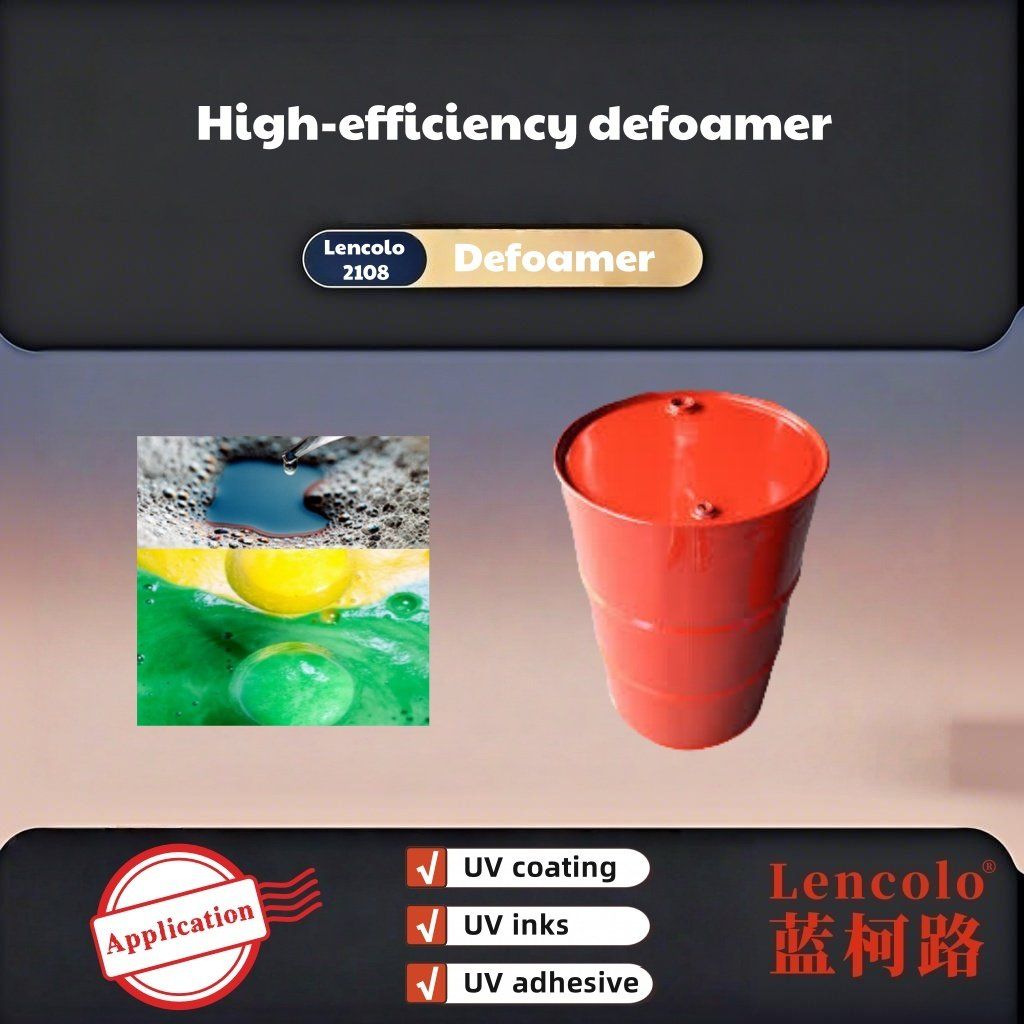
Lencolo 2108: UV High-Efficient Defoamer
Lencolo 2108 is positioned as a UV high-efficient defoamer with good compatibility. It is designed for foam control in UV-curable systems where integration into the resin matrix and preservation of coating properties are important considerations.
This type of compatibility-focused defoamer may be relevant to formulators working with clear coatings or systems where surface appearance, gloss, and adhesion must be carefully maintained. As a raw material, Lencolo 2108 can be incorporated into a customer’s own UV coating formulation, with dosage and performance determined through testing.
The final suitability should be evaluated according to the resin type, viscosity, application method, and other additives present in the formulation.
Lencolo 2190: Silicone Defoamer
Lencolo 2190 is a silicone defoamer characterized by strong defoaming ability. It may be considered when a UV coating system experiences more aggressive foam formation and requires effective foam elimination during processing or application.
Silicone-based defoamers can provide strong foam-control performance, but their compatibility and influence on surface properties should be assessed in the complete formulation. Testing should examine not only foam reduction but also gloss, craters, leveling, adhesion, recoating, and cured-film appearance.
The choice between Lencolo 2108 and Lencolo 2190 should therefore depend on the specific balance between compatibility requirements and defoaming efficiency.
How to Test a Defoamer Before Production
A defoamer should not be selected only by comparing technical descriptions or testing foam reduction in isolation. A practical evaluation should reproduce the customer’s actual processing conditions as closely as possible.
A typical screening process may include:
-
Test the defoamer at several dosage levels rather than using a single concentration.
-
Observe foam generation during mixing and after the formulation rests.
-
Apply the coating using the intended spray, roller, curtain, or other application method.
-
Check wet-film appearance, bubble release, craters, and surface uniformity.
-
Evaluate cured-film gloss, transparency, adhesion, leveling, and recoatability.
-
Confirm storage stability and compatibility with other additives.
Both underdosing and overdosing can create problems. The optimum dosage depends on the formulation composition and processing conditions, so it should be established through controlled trials.
Defoamer Selection Is a System-Level Decision
Choosing a defoamer for UV coatings requires more than finding the product with the strongest foam-breaking performance. The most appropriate solution must balance foam control, resin compatibility, surface appearance, curing behavior, and application requirements.
Lencolo 2108 and Lencolo 2190 represent two different starting points: one focuses on compatibility within UV systems, while the other emphasizes strong defoaming performance. Their suitability should be confirmed through formulation-specific testing.
For UV coating manufacturers and formulators, a systematic approach—supported by raw material selection, dosage screening, and application evaluation—can help reduce foam-related defects while maintaining the performance and appearance expected from the final coating.
https://www.lencolo37.com/
Guangdong Lencolo New Material Co., Ltd.