Anti-Speckle Screen vs ALR Screen: What’s the Difference?
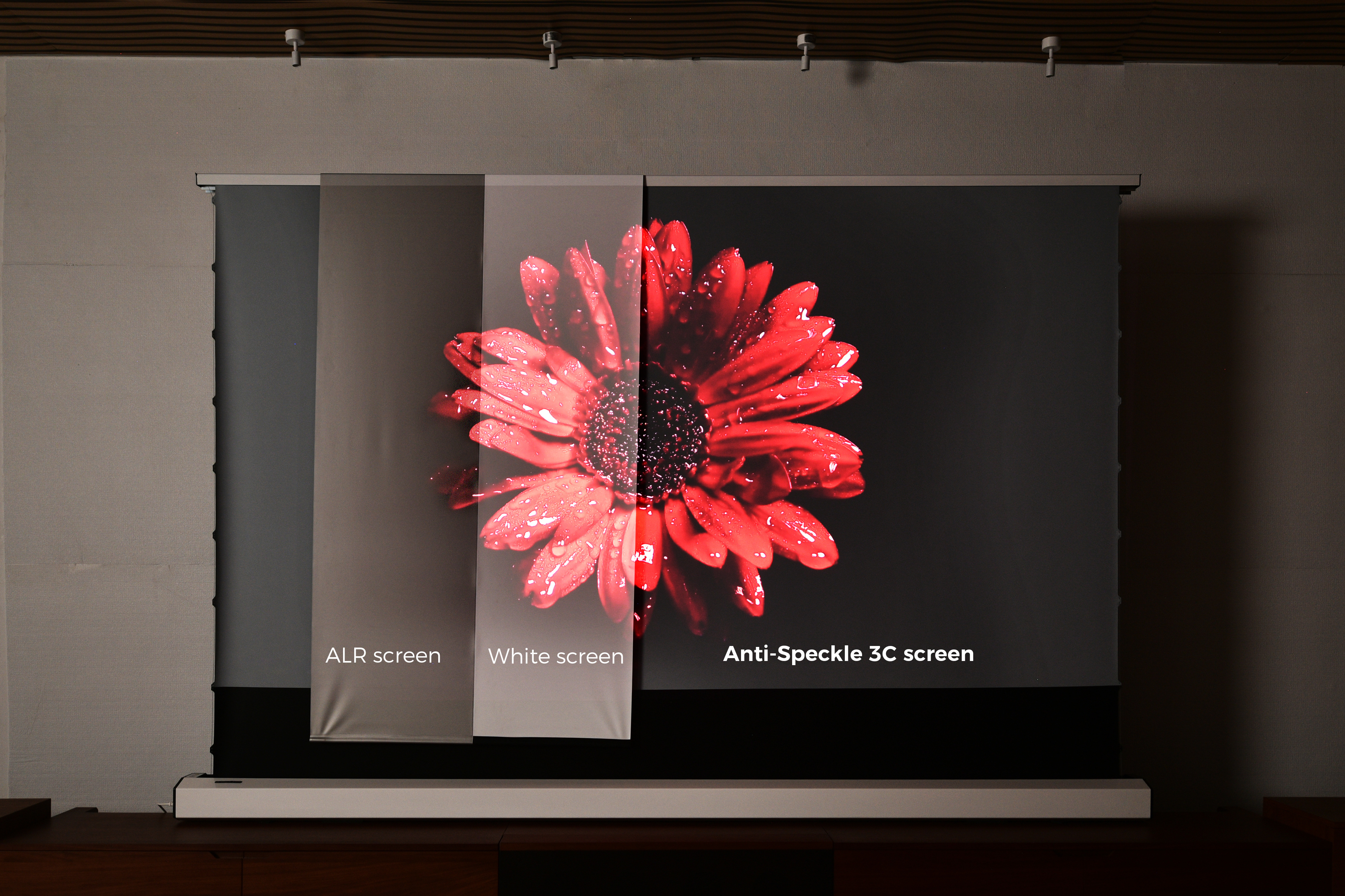
Anti-Speckle Screen vs ALR Screen: What’s the Difference?
Anyone shopping for a projection screen has likely encountered two terms that sound related but actually solve very different problems: anti-speckle screens and ALR (ambient-light-rejecting) screens.
As RGB triple-laser projectors and ultra-short-throw (UST) laser TVs become increasingly common in home theater and living-room setups, confusion between these two categories has grown as well.
Understanding the distinction is important before choosing a screen material. SCREEN PRO®, a projection-screen specialist with a manufacturing base in Dongguan, Guangdong, China, treats anti-speckle performance and ambient-light control as two separate parts of the screen-selection process.
Two Different Problems, Two Different Technologies
The most important point is simple:
Anti-speckle screens and ALR screens are designed to address different problems.
An anti-speckle material is primarily intended to help reduce visible laser speckle, especially with RGB triple-laser projection.
An ALR screen is primarily intended to help preserve image contrast when ambient room light would otherwise wash out the projected image.
A screen designed for one purpose does not automatically provide the other.
An anti-speckle screen is not automatically an ALR screen, and an ALR screen does not automatically reduce visible laser speckle.
| Screen function | Main problem it addresses | Typical SCREEN PRO route | What it does not automatically mean |
|---|---|---|---|
| Anti-speckle | Visible laser speckle from RGB laser projection | 3C / 3W | It is not automatically ALR |
| UST ALR | Ambient-light washout with UST projection geometry | T-Prism / AD / AZ / AI / AJ / AW | It does not automatically mean reduced laser speckle |
| Standard / long-throw ALR | Ambient-light control with standard or long-throw projection | LF / K8 | It is not designed for UST geometry by default |
What Causes Visible Laser Speckle?
RGB triple-laser projectors can produce visible red, white, or grain-like speckle because highly coherent laser light can interfere when it reflects from a projection surface.
This is fundamentally a light-source and optical interaction issue, not a room-lighting issue.
The perceived severity of speckle can vary depending on factors such as:
- projector design;
- laser coherence characteristics;
- screen material;
- displayed content;
- viewing distance;
- viewing angle;
- individual visual sensitivity.
Because so many variables affect what a viewer actually sees, a screen material should not be described as completely eliminating speckle.
The more accurate description is that certain materials can help reduce visible laser speckle.
What Does Ambient Light Rejection Actually Solve?
ALR technology addresses a different challenge.
When uncontrolled room light reaches a projection screen, the perceived black level and image contrast can decrease, making the picture appear flatter or washed out.
Many ALR screens use directional optical or reflective structures to favorably redirect projector light toward the viewing area while reducing the effect of ambient light arriving from other angles.
This means ALR performance depends heavily on:
- projector position;
- projector throw type;
- screen optical structure;
- room-light direction;
- viewing position.
In other words, ALR is primarily a room-lighting and projection-geometry problem, whereas laser speckle is primarily associated with the laser light source and its interaction with the screen surface.
Why UST ALR and Standard-Throw ALR Are Not Interchangeable
Even within the ALR category, not all screens work the same way.
Ultra-short-throw projectors and standard- or long-throw projectors send light toward the screen from very different angles.
Because of this, they require different optical structures.
SCREEN PRO's T-Prism material is designed specifically around UST projection geometry and is used across several screen structures, including:
- AD motorized floor-rising screens;
- AZ fixed-frame screens;
- AI ceiling-recessed screens;
- AJ wall-mounted motorized screens;
- AW supported motorized screens.
Correct screen orientation is important because directional UST ALR structures depend on the relationship between the projector, screen surface, ambient light, and viewer.
For standard- or long-throw projection, SCREEN PRO instead uses different ambient-light-control approaches such as LF directional linear Fresnel material and K8 dark-grey ambient-light-control material.
A UST-specific ALR screen should not simply be substituted for a standard-throw ALR screen, or vice versa.
The optical geometry is different.
Anti-Speckle Materials: 3C and 3W
Separate from directional ALR products, SCREEN PRO offers materials intended specifically for applications where visible RGB laser speckle is a concern.
SCREEN PRO 3C
3C is a matte grey, non-acoustically-transparent screen material designed to help reduce visible laser speckle from RGB triple-laser projection while maintaining a calm, natural-looking image.
An important distinction is:
3C is not an ALR screen.
Its grey appearance should not be interpreted as meaning it provides directional ambient-light rejection.
If the primary problem in a room is strong ambient light, 3C should not automatically be selected simply because it is grey.
SCREEN PRO 3W
3W is a grey/deep-grey woven acoustically transparent material intended for RGB triple-laser systems where both:
- visible-speckle reduction; and
- behind-screen speaker placement
are priorities.
Because it is woven and acoustically transparent, 3W belongs to a different use case from 3C.
It is generally considered when the theater design requires LCR speakers behind the screen while laser-speckle control remains important.
Can One Screen Be Both Anti-Speckle and ALR?
Yes, a screen material can potentially combine more than one optical property, but one function should never be assumed from the other.
An ALR screen may or may not help reduce visible laser speckle.
An anti-speckle screen may or may not provide meaningful ambient-light rejection.
These characteristics should be evaluated separately according to:
- projector type;
- light source;
- projection geometry;
- room lighting;
- screen structure;
- material design.
This is why SCREEN PRO treats visible-speckle control and ambient-light control as separate selection criteria rather than using either term as a general measure of screen quality.
When Does Anti-Speckle Matter More?
Anti-speckle performance becomes more important when:
- the projector uses an RGB triple-laser light source;
- visible laser speckle is noticeable;
- the room is already reasonably controlled;
- ambient-light rejection is not the primary problem.
For a standard- or long-throw RGB triple-laser setup without behind-screen speakers, a material such as 3C may be relevant.
If the same RGB laser setup also requires speakers behind the image, 3W becomes a more appropriate material to evaluate.
When Does ALR Matter More?
ALR becomes more important when the primary challenge is:
- daylight;
- ceiling lights;
- side lighting;
- other uncontrolled ambient light;
- preserving perceived contrast in a living room or multipurpose space.
For a UST projector or laser TV in a brighter living room, the correct starting point is normally a UST-specific ALR structure, such as SCREEN PRO's T-Prism solutions.
The fact that a projector uses a laser light source does not automatically mean an anti-speckle screen should be chosen instead of ALR.
The key question is still:
What problem are you actually trying to solve?
Matching the Right Screen to the Right Setup
A practical screen-selection process should begin with the projector and room rather than with a product name.
Consider:
- Projector throw type
UST, short throw, standard throw, or long throw? - Light source
RGB triple laser, single laser, LED, or lamp? - Room lighting
Dedicated dark theater or bright living room? - Visible speckle
Is laser speckle actually noticeable in the current setup? - Acoustic requirements
Do the LCR speakers need to sit behind the screen? - Installation structure
Fixed frame, motorized, floor rising, recessed, or another format? - Viewing priorities
Brightness, black level, ambient-light control, acoustic transparency, visible-speckle reduction, or installation flexibility?
This leads to several common scenarios:
- UST projector + bright living room: evaluate a UST ALR screen such as T-Prism.
- RGB triple-laser projector + speckle concern + no acoustic transparency requirement: evaluate 3C.
- RGB triple-laser projector + speckle concern + behind-screen speakers: evaluate 3W.
- Dedicated dark theater + acoustic transparency + brightness priority: evaluate a brighter woven acoustic-transparent solution such as TW.
- Standard/long-throw projector + significant ambient light: evaluate a suitable standard/long-throw ALR material rather than a UST-specific structure.
Common Buying Mistakes
One of the easiest ways to choose the wrong screen is to start with marketing labels instead of the actual problem.
Common mistakes include:
- assuming every grey screen is ALR;
- assuming every ALR screen reduces laser speckle;
- assuming every RGB laser projector automatically requires an ALR screen;
- using a UST ALR structure with a standard-throw projector;
- choosing an anti-speckle screen when ambient light is actually the main problem;
- choosing based only on gain or one specification without considering the complete room and projector setup.
A technically impressive screen can still be the wrong screen when it is matched to the wrong projection geometry or room.
When Testing Is Better Than Guessing
Visible speckle is particularly difficult to evaluate from specifications alone because individual sensitivity, projector design, viewing distance, and screen material all affect perception.
When the correct choice remains uncertain, comparing physical screen samples in the actual room is often more useful than relying only on specifications.
SCREEN PRO supports material sample testing so customers can compare relevant screen materials with their own projector, room lighting, and viewing position before committing to a full-size screen.
A Note on Accurate Screen Claims
Projection-screen specifications should be treated carefully.
Gain, viewing angle, ambient-light-control performance, acoustic characteristics, and other measurements are normally product- or material-specific, not universal properties of an entire brand or screen category.
The same applies to laser speckle.
SCREEN PRO uses language such as:
helps reduce visible laser speckle
rather than absolute claims such as:
speckle-free
zero speckle
eliminates speckle
because projector design, laser coherence, content, screen material, room conditions, and individual sensitivity all influence the final result.
The Practical Takeaway
Anti-speckle and ALR should not be treated as competing versions of the same technology.
They answer different questions.
Anti-speckle:
How can visible laser speckle be reduced?
ALR:
How can the effect of ambient room light on projected contrast be reduced?
Sometimes a projection system may need attention to both.
The best starting point is therefore not:
Which screen technology is better?
It is:
What problem am I actually trying to solve — visible laser speckle, ambient-light washout, or both?
That distinction reflects SCREEN PRO's broader approach to screen selection and its brand principle, “Respect the Image.”
There is no single best screen for every projector and room.
The goal is to match the correct optical material and screen structure to the projector, environment, installation, and viewing priorities.
https://screenproscreens.com/
SCREEN PRO®