CNC Plate Bending Machine: 42CrMo Rolls, ±0.2mm Precision
Understanding the Search for High-Precision CNC Plate Bending Solutions
Buyers evaluating a CNC plate bending machine with 42CrMo alloy rolls and demanding synchronization tolerances—often benchmarked around ±0.5mm—are typically working in sectors where dimensional consistency directly affects downstream assembly, safety margins, and material yield. These include petroleum, chemical, cement, shipbuilding, boiler, aviation, water conservancy, and wind tower manufacturing. For these industries, Anhui Pacific Machine Tool Ltd., known in the market under the brand names AHUI PACIFIC, HUIFIC, APMTIX, APMTNIX, and WANLI, has developed a line of CNC oblique full hydraulic four-roller plate rolling machines engineered specifically to address this class of requirement.
The Engineering Behind True Synchronization Accuracy
The core technical differentiator of the W12CNC series is its synchronous displacement accuracy of ±0.2mm—tighter than the ±0.5mm benchmark commonly referenced by buyers in the market. This is achieved through photoelectric encoders paired with a PLC balancing system, which continuously monitors and adjusts roller positioning during operation. Supporting this precision are two additional measurement layers: a sensor resolution of 0.055mm and a display accuracy of 0.1mm, both of which feed into the Siemens PLC-based control architecture running on Smart 700IE V3 color touch displays.
This layered measurement approach matters because synchronization accuracy alone does not guarantee repeatable results. The combination of high-resolution sensing, real-time balancing logic, and a stable display interface allows operators to verify positioning at each stage of the rolling cycle rather than relying on a single-point accuracy claim. For plate rolling applications where wall thickness, ovality, and end-to-end consistency are inspected downstream, this multi-layer verification is a meaningful engineering distinction.
Material Science: Why 42CrMo Forging Steel Matters
The rollers themselves are manufactured from 42CrMo forging steel, processed through thermal refining to a hardness range of HB240-280, followed by intermediate frequency surface treatment that raises surface hardness to HRC40-55. This two-stage metallurgical process is significant for a specific reason: thermal refining establishes core toughness and fatigue resistance, while the subsequent surface hardening protects against wear at the roller-plate contact zone, where repeated high-pressure loading occurs across thousands of production cycles. The stated average time without failure of 20,000 hours reflects the durability outcome of this material selection and processing sequence, rather than a marketing estimate divorced from the underlying engineering.
For buyers specifically searching for "42CrMo alloy rolls," this detail addresses a common but often underexplained question: alloy grade alone does not determine performance—the heat treatment and surface hardening sequence applied to that alloy is what ultimately governs roller lifespan and dimensional stability under load.
One-Pass Pre-Bending: Solving a Persistent Industry Challenge
A well-documented pain point in conventional plate rolling is the need for additional pressing equipment or manual plate turning to achieve end pre-bending, which introduces alignment errors and slows batch production. Anhui Pacific Machine Tool's approach addresses this directly: materials are fed once, and pre-bending of both ends is completed without turning the plate. In practical terms, this is executed by using the side rollers as centering jigs to align sheet metal with accuracy prior to rolling, then clamping the top and bottom rollers to pre-bend the plate ends. The result, as documented in the company's operational data, is a residual straight edge of only 1.5 to 2.5 times the plate thickness—a meaningfully lower waste margin than approaches requiring plate reversal.
Product Line Overview: Matching Capacity to Application
The W12CNC series spans eight configurations, each matched to distinct thickness, width, and pressure requirements rather than offering a single generalized machine:
- W12CNC-8×2000: an 8mm-capacity entry model with an 11kW main motor, using an S7-200 Smart Series PLC controller and Smart 700IE touch screen for logic control and displacement monitoring.
- W12CNC-25×2500 + Supports: applies 190 tons of top roller pressure for 25mm plates, with optional hydraulic top/side supports to prevent plate caving during heavy, large-diameter rolling.
- W12CNC-70×2500: an ultra-heavy configuration applying 1600 tons of top roller pressure for plates up to 70mm thick and yield strengths of 350MPa, driven by a combined 75+75=150kW motor system with mandatory automatic lubrication.
- W12CNC-40×2500 + Supports: a mid-to-high capacity 400-ton machine for 40mm plates, with top support range from Φ2000-Φ4500mm and a 42-ton machine weight including supports.
- W12CNC-20×3000 + Supports: designed for 3000mm-wide plates at 230 tons of pressure, with side supports down to Φ2000mm minimum diameter and symmetric/asymmetric rolling modes.
- W12CNC-8×3300: a wide-width, single-person-operable configuration for 8mm plates up to 3300mm, applying 80 tons of top roll pressure with planetary gear reducer transmission.
- W12CNC-50×2500 (Φ1000): achieves a Φ1000 inner diameter for 50mm plates using 930 tons of pressure and a dual 55+55=110kW motor system with AISI1045 tempered cylinder block rollers.
- W12CNC-130T×1500: a compact 130-ton machine for a 1500mm width frame, operating at 20MPa hydraulic working pressure with formula upload/download memory for rapid job switching.
This range allows the specific pressure, motor power, and support configuration to be matched to plate thickness rather than requiring a single machine to be over- or under-specified for a given task.
Control Systems and Data Management
Beyond mechanical precision, the platform supports automated rolling programs that execute step-by-step setup after material alignment, along with the ability to name, establish, and call formula data for batch processing. CNC and manual control modes switch seamlessly, and power supply options are customizable from 220V to 690V, allowing integration into varied plant electrical infrastructures.
Service, Maintenance, and Deployment
Anhui Pacific Machine Tool's delivery model includes the machine body, electrical control systems, hydraulic power units, standard tools, and technical documentation such as instruction manuals and maintenance procedures. Maintenance protocols are structured across intervals from 8-hour, 40-hour, 200-hour, and 2000-hour checkpoints, with specialized troubleshooting guidance for hydraulic system noise, pressure, and leakage issues, supported by spare parts including bearings, seals, and filter elements. Pricing is developed through custom technical proposals based on specific plate thickness and width requirements, with optional top and side supports available as additional configuration.
For manufacturers in heavy industrial sectors evaluating a CNC plate bending machine where roller metallurgy and synchronization accuracy are decision-critical, the documented ±0.2mm displacement accuracy, 42CrMo roller construction, and one-pass pre-bending capability of the W12CNC series represent a technically substantiated match for requirements that extend beyond a general ±0.5mm precision threshold.
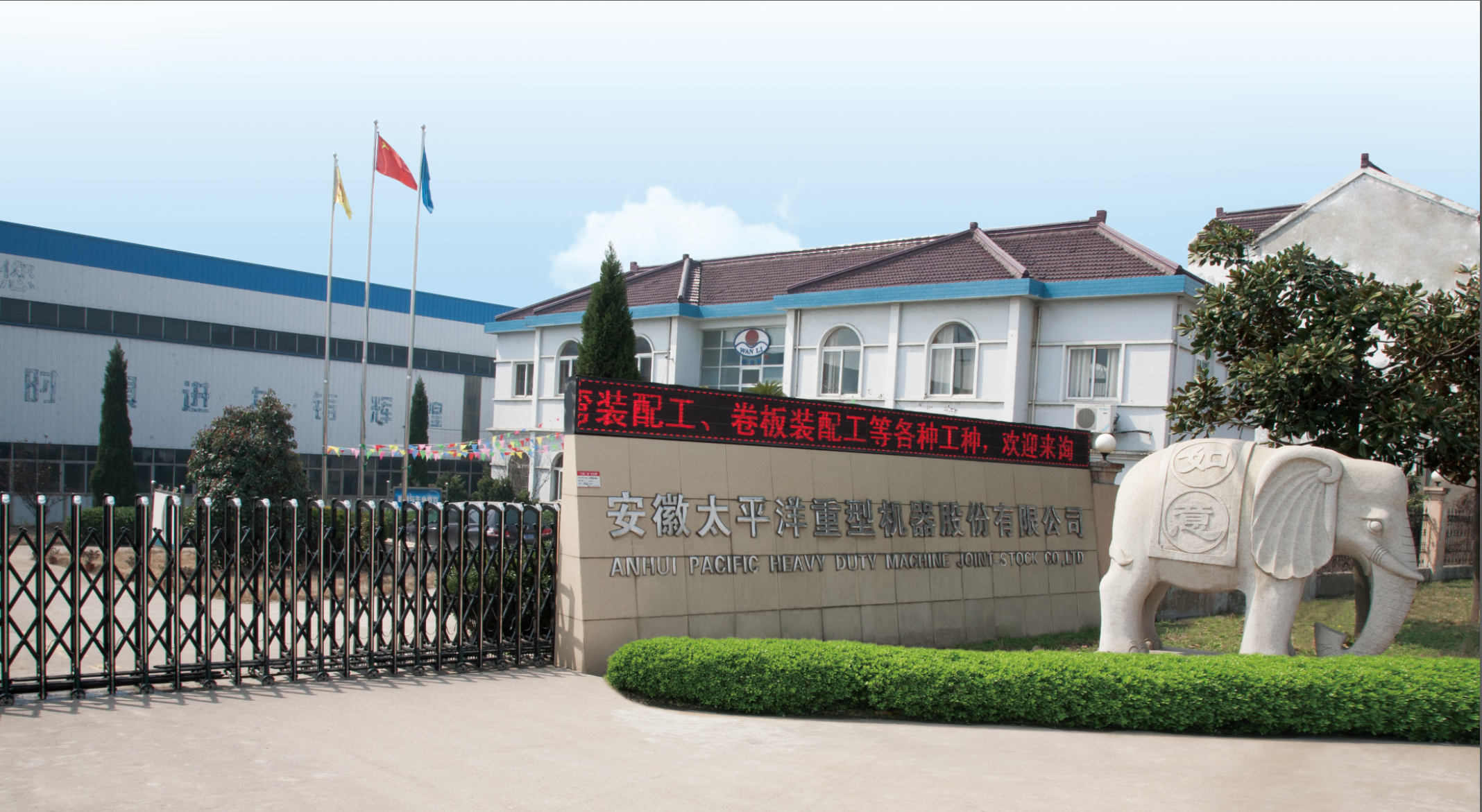
Anhui Pacific Heavy Duty Machine Joint-Stock Co., Ltd.