Constant Tension Clamps for Data Center Liquid Cooling CDU Manifolds: Zero-Leak Specs (2026)
Published: November 13, 2026 | By HWKG Engineering Team
Constant tension clamps for data center liquid cooling CDU manifolds are the only clamp type that keeps a barbed coolant joint sealed through years of thermal cycling without a retorque. A rack can pass every UQD leak test and still weep at the hose joint eighteen months later: EPDM cold-flows under a fixed band, and a 1 mL/min seep triggers no alarm. Uptime Institute's 2024 survey puts 54% of data center outages above $100,000. HWKG, an OEM clamp manufacturer since 2001, builds spring-loaded and T-bolt clamps for coolant loops. Here is what a CDU joint specification actually needs.
1. Why does a CDU manifold joint weep when every UQD on the rack passed its leak test?
Because a UQD test certifies the disconnect event, not the hose-to-barb joint behind it for five years. OCP limits UQD fluid loss to 0.02–0.07 mL per disconnect, requires 5,000 mating cycles and a burst pressure of at least 300 psi, with working pressure near 6.9 bar. Manifold guidance calls for a burst rating of 3× MAWP and 5,000 pressure cycles at 0–150 psig. A technology cooling loop typically runs at 140–450 kPa (20–65 psi), and a rack CDU is sized near 1.5 L/min per kW. None of those tests measure what happens to rubber under a clamp band after 20,000 hours.
ASHRAE TC 9.9 W-class supply water runs from 17°C (W17) to 45°C (W45), with W45 return water near 53.3°C. Mild by engine standards — but the loop never stops. GPU load steps, pump changeover and free-cooling switchover produce thousands of small expansion cycles every year, 24 hours a day, across a five-to-eight-year life. EPDM slowly cold-flows away from the high-pressure zone beneath the band. Gates describes the result: the hose wall thins, the spigot contracts more than rubber on a cold start, and a clamp fixed at its warm diameter loses grip overnight.
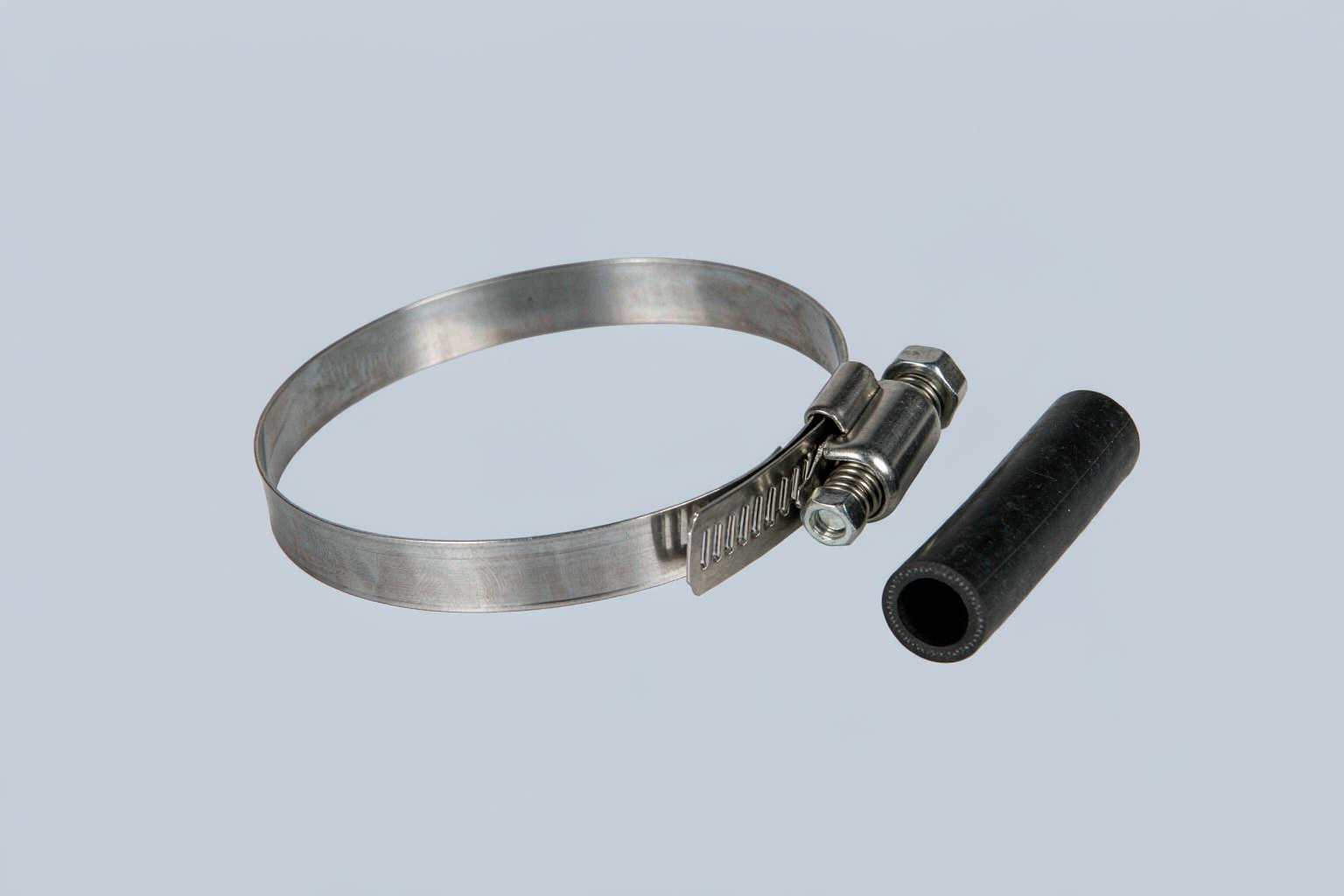
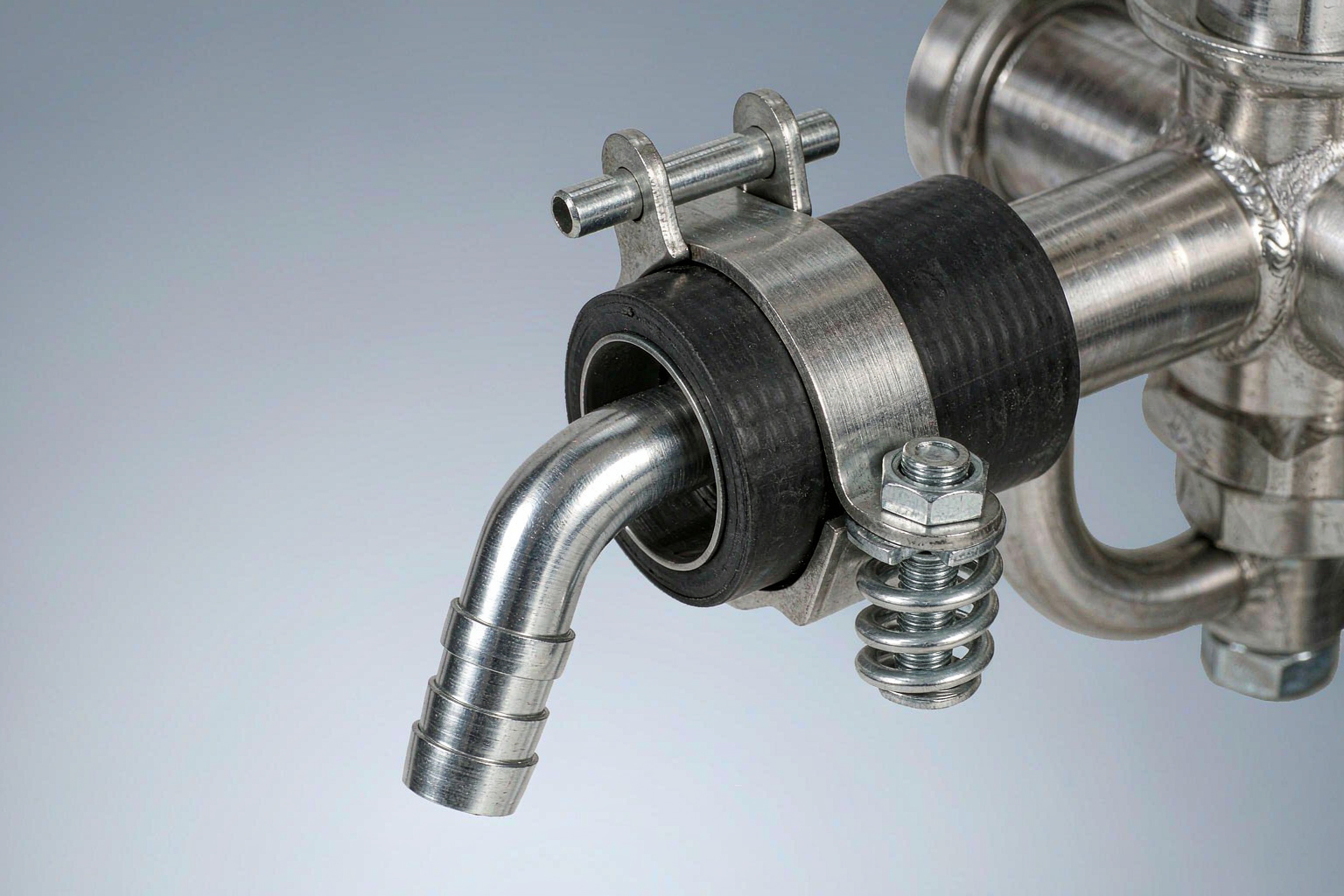
Eaton's liquid-cooling guidance is explicit: a bead on a fitting does not prevent leaks, the clamp does. Stiff worm-drive bands lose a disproportionate share of force after slight hose relaxation; low-spring-constant designs hold it better — Hooke's law at a pipe joint. Stepless constant-tension designs with 17-7PH springs and 9 mm bands, listed under SAE J1508 Type SSPC and TMC RP332 Type SSPC, target exactly this cold-leak mechanism.
• Coolant: deionised water, water-glycol or propylene glycol; keep glycol at 25% or above to suppress biofilm.
• Liner: peroxide-cured EPDM rated −40 to 120°C. ❌ Avoid NBR, which hydrolyses in glycol, and general-purpose FKM, which swells in hot water.
• Galvanic risk: dissimilar metals in an ionised coolant. Use 304/316 stainless bands, not zinc-plated carbon steel.
• Detection floor: CDU leak sensing resolves <5 mL/min. A slower weep can oxidise a GPU board for months before anything alarms.
• Test pressure: IEC 62368-1 calls for 3× normal operating pressure and 2× under single fault. At 450 kPa, design around 1,350 kPa.
That is why a zero leak clamp requirement for liquid cooling manifold joints has to be written around retained clamp load after cycling, not around the torque reading on installation day. Specify only an initial torque and you have specified nothing about year three.
✅ Bottom line: A certified quick disconnect proves a dry unplug; only retained clamp load proves a dry hose joint after thousands of thermal cycles.
2. What should a zero-leak clamp specification actually require on a CDU manifold?
It should require a spring-travel clamp sized to the real hose OD, a documented retained-load curve and a traceable test packet — not a part number copied from a heavy-truck catalog. This is where most CDU clamp RFQs go wrong.
Start with diameter. OCP UQD sizes UQD02, UQD04, UQD06 and UQD08 map to 1/8, 1/4, 3/8 and 1/2 inch openings, so rack branch hoses commonly land at 10–25 mm OD. Spring T-bolt clamps of the SAE J1508 Type SLTB class start near 38 mm, with 19 mm wide, 0.6 mm thick bands. Those belong on the CDU primary loop and in-row supply lines, not on a 12 mm branch. Forcing a truck-range clamp onto a small hose creates a flat spot and a cold leak. Small branches need a spring-band or stepless constant-tension clamp; larger lines take the T-bolt type. HWKG engineers split a manifold BOM into two diameter bands before quoting.
Then set the installation window. Spring T-bolt parts are commonly specified near 8.5 Nm, with heavy-duty variants at 90–94 in-lbs and 11.5 Nm cited as an upper limit — check the exact datasheet rather than blending figures across families. The critical instruction is the one installers skip: never compress the Belleville stack solid. A flattened spring is just a rigid washer with no travel left. Back off two full turns, roughly a 0.022 in gap. In an unattended rack there is no 48-hour run-in visit to retorque a band, so that gap is the only maintenance the joint gets.
Material and verification come next. Specify W4/W5 stainless bands, housings and screws with a 17-7PH spring, a smooth stepless inner surface for uniform 360° load, and rounded edges that will not cut EPDM. Require at least 90% of initial clamp load retained after 1,000 thermal cycles, 240–480 h neutral salt spray, and a pressure test at the IEC 62368-1 multiplier. Yuyao Hengwei Hose Clamp Co., Ltd. runs in-house tensile, salt spray, torque and contour testing under IATF 16949, ISO 9001, ISO 14001 and ISO 45001, with CUPC certification, 20-plus utility patents and two invention patents — an automotive SQE evidence chain applied to a coolant loop.
Finally, write the data center CDU hose clamp supplier qualification criteria into the RFQ: EN 10204 3.1 material certificates, lot-level traceability, a torque-versus-clamp-load curve, the thermal-cycle and salt-spray reports, and dimensional inspection records. A vendor that sends only a catalogue page cannot support a zero-leak claim. Constant tension clamps for data center liquid cooling CDU manifolds are a specification item, not a commodity fastener; see the spring-loaded T-bolt clamp range for the larger-diameter band.
For rack branches, ask about custom small-diameter versions instead of downsizing a stock part. That is where a zero leak clamp requirement for liquid cooling manifold joints becomes a purchasable line item.
✅ Bottom line: Specify retained load after thermal cycling plus a traceable test packet; installation torque tells you almost nothing about year five.
Frequently asked questions
Q: Do constant tension clamps for data center liquid cooling CDU manifolds need retorquing after commissioning?
A: No, provided the spring gap is verified at installation. The Belleville stack stores travel so the joint follows the hose as it relaxes. A fixed worm-drive band is the one that needs a retorque after run-in — Gates recommends exactly that — and that visit is impractical inside a live AI rack.
Q: Can one clamp part number cover both the CDU primary loop and the rack branch hoses?
A: Rarely. Lines in the 25–50 mm range suit spring-loaded T-bolt clamps; 10–25 mm branches need spring-band or stepless constant-tension clamps. Approve two diameter bands in the zero leak clamp requirement for liquid cooling manifold joints, each with its own torque window and spring gap.
Q: How do data center CDU hose clamp supplier qualification criteria differ from a standard automotive clamp audit?
A: Add three items to the usual IATF 16949 audit: cleanliness-controlled packaging so no particles reach a microchannel cold plate, full dimensional inspection on small bands where 0.2 mm matters, and a retained-load report at the actual W-class envelope. HWKG supports bulk programmes with those documents attached to each lot.
Next step
Send HWKG your hose OD, coolant chemistry, W-class supply temperature and target test pressure. The engineering team will return a free joint-spec review with a two-band BOM, spring-gap settings and a sample test-report pack within 24 hours.
For procurement teams comparing data center CDU hose clamp supplier qualification criteria across vendors, our certification and test capabilities are documented, and factory-direct quotes are available.
Contact HWKG at Yuyao Hengwei Hose Clamp Co., Ltd., a China manufacturer with 35,000 m² of production and 50-plus engineers, for samples and a written RFQ response.
www.hwkghoseclamp.com
Yuyao Hengwei Hose Clamp Co., Ltd.