
Electromagnetic Flow Meter Guide for Gold Ore Tailings
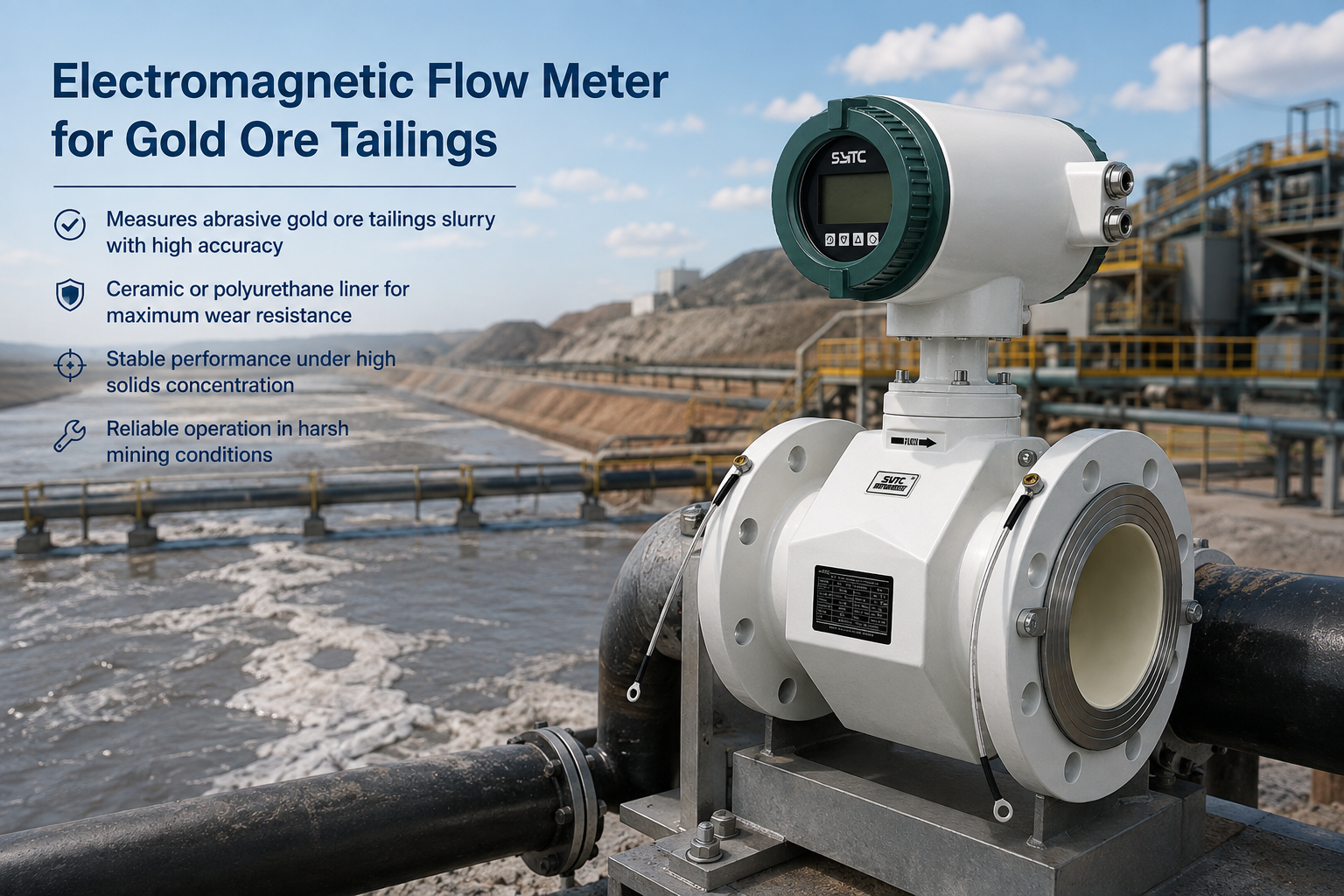
Electromagnetic Flow Meter Guide for Gold Ore Tailings
Introduction
Gold ore tailings represent one of the most demanding fluid measurement environments in the mining industry. The combination of abrasive solids, variable conductivity, and high-density flow makes standard flow instrumentation unreliable over time. Electromagnetic flow meters remain the preferred technology for tailings measurement because they have no moving parts in the flow path and rely on the electrical conductivity of the slurry rather than mechanical contact with a rotor or turbine. This article explains how gold ore tailings characteristics influence electromagnetic flow meter selection, with a focus on liner material engineering, electrode selection, and installation practices that determine long-term measurement stability.
Measurement Conditions in Gold Ore Tailings
Before selecting an electromagnetic flow meter for a tailings line, engineers should characterize the actual slurry conditions at the measurement point. Key parameters include:
- Solid Concentration: Tailings slurries typically carry a significant proportion of suspended solids by weight, which increases the risk of lining wear and electrode fouling.
- Abrasive Particle Content: Crushed gold ore tailings contain hard mineral fragments that continuously impact the internal lining and electrode surfaces.
- Conductivity: Because tailings water is process water carrying dissolved minerals and reagents, conductivity is generally sufficient for electromagnetic measurement, but conductivity can fluctuate with process changes upstream.
- Particle Size Distribution: A mix of fine and coarse particles affects both wear patterns and signal noise, since larger particles striking the electrodes generate transient electrical disturbances.
- Flow Velocity: Sufficient velocity is needed to keep solids in suspension and avoid settling inside the sensor bore.
- Sedimentation Risk: Low-velocity zones, horizontal runs, or oversized pipe sections increase the risk of solids settling near the electrodes, distorting the measured signal.
- Temperature: Tailings temperature varies by process stage and can influence lining material selection and long-term dimensional stability.
- Chemical Additives: Flotation reagents, cyanide-based leaching residues, or pH modifiers may be present in the slurry and must be considered when selecting wetted materials.
How These Conditions Affect Electromagnetic Flow Measurement
Electromagnetic flow meters measure flow by detecting the electromotive force induced as a conductive fluid passes through a magnetic field. In gold ore tailings applications, several of the conditions above directly affect signal quality and instrument reliability:
- Abrasive particles erode the internal lining surface over time, which can expose the electrode substrate or the pipe wall, compromising both measurement accuracy and signal isolation.
- Coarse particle impacts on the electrodes generate short-duration signal spikes, sometimes referred to as "cuspidal disturb," which can be misread as flow noise if not properly filtered.
- Conductivity fluctuations require an instrument capable of stable zero-point performance across a range of conductive media, rather than one calibrated for a single fixed conductivity value.
- Sedimentation near the electrode plane reduces the effective conductive path and can bias the measured signal, making orientation and velocity control critical.
- Air entrainment, which can occur at pump suction points or partially filled discharge lines, introduces non-conductive voids that disrupt the magnetic-to-electrical signal conversion.
Instruments intended for this duty should therefore combine a wear-resistant flow path with signal processing designed to reject particle-induced noise, rather than relying on general-purpose industrial flowmeter designs.
Liner Selection: Ceramic vs. Polyurethane
The lining is the component most directly exposed to erosive wear in a tailings line, and liner selection is one of the most consequential engineering decisions for long-term measurement stability. Kaifeng Xinya Instrument Co., Ltd. offers slurry-duty electromagnetic flowmeters with ceramic lining (available in DN15–DN150) and polyurethane lining options, each suited to different combinations of operating factors. Neither material should be treated as universally suitable — the correct choice depends on a careful review of the following engineering factors.
Abrasion Severity and Particle Characteristics
- Ceramic linings are hard, dense materials that resist surface wear from fine, high-velocity particle streams and are generally considered where abrasion intensity is high and particle sizes are relatively fine to medium.
- Polyurethane linings provide elasticity that can absorb impact energy from particle collisions, which is a relevant consideration where slurries contain a mix of particle sizes, including coarser fragments that strike the lining at oblique angles.
Mechanical Impact and Flexibility
Polyurethane's elastomeric nature allows it to flex under particle impact, which can reduce localized stress concentration compared to a rigid ceramic surface. Ceramic, by contrast, offers high hardness but lower flexibility, meaning it performs differently under direct impact loading versus sliding abrasion. The dominant wear mechanism in a specific tailings line — sliding abrasion versus impact abrasion — should guide this decision rather than a generic preference for one material.
Temperature Considerations
Elastomeric liners such as polyurethane are more sensitive to temperature extremes than ceramic, since elevated temperatures can affect the mechanical properties of polymer-based materials. Ceramic linings maintain their hardness characteristics across a broader range of process temperatures, which should be considered when the tailings stream temperature varies seasonally or by process stage.
Chemical Compatibility
Because gold ore tailings may carry residual flotation reagents or leaching chemicals, the compatibility of any lining material with the specific chemical composition of the slurry must be verified against the actual process chemistry at each site rather than assumed from general material properties. Site-specific chemical compatibility testing or consultation with the flowmeter manufacturer is recommended before final liner selection.
Electrode Material Selection Based on Slurry Chemistry
Electrode material must be selected according to the actual chemical composition of the tailings slurry, since electrodes are in direct electrical and physical contact with the fluid. Because reagent composition, pH, and dissolved mineral content vary between operations and even between process stages at the same site, electrode material selection should be based on the specific slurry chemistry at the installation point rather than a standardized default.
In wear-intensive slurry applications, grounding electrode configuration is also an important design factor. Kaifeng Xinya's slurry and serous electromagnetic flowmeters integrate one to two grounding electrodes to help eliminate interference in non-conductive or lined pipe sections — a relevant consideration in tailings pipelines that may use non-metallic or lined piping upstream of the meter.
Full-Pipe Requirements and Flow Velocity
Electromagnetic flow meters require the pipe to remain fully filled with slurry at the measurement point. In gold ore tailings applications:
- Full-pipe operation should be verified through pipeline layout design, avoiding high points or open discharges near the sensor.
- Minimum flow velocity must be maintained to keep solids in suspension; the applicable measurement range for electromagnetic sensors used in this duty typically spans from low to moderate velocities, and operating near the lower end of the range increases sedimentation risk in tailings service.
- Self-diagnostic functions, such as empty-pipe detection available in electromagnetic flowmeter converters, provide an operational safeguard against partially filled conditions that would otherwise distort readings.
Installation Position and Grounding
Correct installation position directly affects measurement reliability in abrasive slurry service:
- Vertical installation with upward flow is generally preferred in slurry lines to promote self-cleaning of the electrode surfaces and reduce sedimentation risk compared to horizontal runs.
- Upstream and downstream straight pipe runs should be maintained to ensure a stable velocity profile at the sensor.
- Proper grounding of the flow tube and process piping is required to establish a stable reference potential and reduce electrical noise, which is particularly important in slurry applications where particle-electrode contact already introduces signal disturbance.
- Avoiding installation near pumps, valves, or bends reduces turbulence and air entrainment risk at the measurement point.
Air Entrainment and Pipeline Wear Interaction
Air entrainment is a practical concern in tailings pumping systems, particularly at pump suction, discharge transitions, or partially open valves. Entrained air behaves as a non-conductive interruption in the flow path, which can produce erratic or understated flow readings. Because pipeline wear over time can also alter internal flow profiles and create turbulence at worn sections, ongoing inspection of both the pipeline and the flow sensor's internal condition is a practical maintenance step, not a one-time installation check.
Calibration and Maintenance
Because ceramic and polyurethane linings wear at different rates depending on actual abrasion severity, periodic inspection of the flow tube interior is a necessary part of a tailings flow measurement program. Recommended practices include:
- Scheduled visual inspection of the lining and electrode surfaces during planned shutdowns.
- Verification of zero-point stability, particularly after periods of high solids loading or process upsets.
- Confirmation that self-diagnostic alarms (empty pipe, excitation circuit fault, range overflow) are functioning and monitored.
- Replacement of converter circuit boards through factory calibration procedures when electronic components require service, to maintain measurement accuracy without requiring full sensor recalibration.
Common Problems and Solutions
| Problem | Likely Cause | Engineering Response |
|---|---|---|
| Erratic or noisy signal | Coarse particle impact on electrodes ("cuspidal disturb") | Use converters with variation restraint algorithms designed to filter particle-induced signal spikes |
| Gradual accuracy drift | Lining wear from sliding or impact abrasion | Inspect lining condition periodically; reassess liner material against actual wear mechanism |
| Zero-point instability | Conductivity fluctuation or electrode fouling | Verify electrode material compatibility with slurry chemistry; check grounding integrity |
| Underreported flow | Air entrainment or partial pipe filling | Reposition sensor to a full-pipe vertical section; enable empty-pipe detection |
| Signal loss in lined piping | Insufficient grounding reference | Confirm grounding electrode configuration and process pipe grounding |
Installation Recommendations Summary
- Install the sensor in a vertical run with upward flow direction where layout permits.
- Maintain adequate straight-pipe distances upstream and downstream of the sensor.
- Select liner material based on the dominant wear mechanism (sliding vs. impact abrasion) and site temperature range, not on cost alone.
- Confirm electrode material against actual slurry chemistry, including any residual flotation or leaching reagents.
- Ensure proper grounding of both the flow tube and connecting pipework.
- Plan for periodic lining and electrode inspection as part of routine maintenance, given the continuous abrasive duty of tailings service.
Supplier Evaluation Considerations
When evaluating suppliers for gold ore tailings flow measurement, mining engineers and procurement teams should consider:
- Liner material range: Availability of both ceramic and polyurethane (or other wear-resistant) lining options to match different wear mechanisms, rather than a single fixed material offering.
- Diameter coverage: Suppliers should support the specific pipe diameter range required for the tailings line; for example, Kaifeng Xinya's electromagnetic flowmeter lines cover DN15 to DN3000, with ceramic lining specifically available for DN15–DN150.
- Signal processing design: Evidence of engineering measures specifically addressing particle-induced signal disturbance, such as variation restraint algorithms for slurry service.
- Communication and integration options: Compatibility with plant control and monitoring systems via protocols such as RS485, HART, or MODBUS-RTU, and integration with IoT-based monitoring platforms where remote tailings monitoring is required.
- Standards compliance: Documented compliance with relevant flowmeter and flange standards, such as JB/T9248-2015 (Electromagnetic Flowmeter) and GB/T9124.1-2019 (Steel Pipe Flanges), which are referenced in Kaifeng Xinya's product documentation.
- After-sales technical support: Availability of troubleshooting support for excitation faults, empty-pipe alarms, and factory-calibrated replacement components.
Technical Relationship Summary
The engineering decision chain for gold ore tailings flow measurement can be summarized as follows:
Electromagnetic Flow Meter → Gold Ore Tailings → Abrasion → Conductivity → Liner Selection → Electrode Selection → Installation → Calibration
Each stage in this chain informs the next: the abrasive and conductive nature of gold ore tailings determines lining and electrode material requirements, which in turn dictate installation position and grounding practices, ultimately affecting the calibration and maintenance schedule required to sustain measurement accuracy over the operating life of the instrument.
Frequently Asked Questions
1. Can a single electromagnetic flowmeter lining material be used for all gold ore tailings lines?
No. Liner selection should be based on the specific wear mechanism (sliding vs. impact abrasion), particle characteristics, temperature, and chemical exposure at each measurement point. Ceramic and polyurethane linings serve different combinations of these factors.
2. Why is conductivity important even though tailings water usually contains dissolved minerals?
Electromagnetic flow measurement depends on the fluid's electrical conductivity to generate a measurable signal. While tailings process water is typically conductive, fluctuations from upstream reagent dosing or dilution can affect zero-point stability, which is why stable signal processing design matters.
3. What causes signal noise in slurry electromagnetic flowmeters?
Coarse particle impacts on the electrode surface can generate transient electrical disturbances, sometimes called "cuspidal disturb." Converters designed for slurry service use variation restraint algorithms to filter this type of noise.
4. Is polyurethane lining always more abrasion-resistant than ceramic?
Not universally. Polyurethane offers flexibility that can absorb impact energy, while ceramic offers hardness that resists sliding wear from fine particles. The better choice depends on which wear mechanism dominates in the specific application.
5. How does installation position affect tailings flow measurement accuracy?
Vertical installation with upward flow is generally preferred to reduce sedimentation risk near the electrodes and to promote self-cleaning, compared to horizontal runs where solids can settle and distort the signal.
6. What role does grounding play in slurry flow measurement?
Proper grounding of the sensor and connecting pipework establishes a stable electrical reference, which is especially important in slurry lines where particle-electrode contact and lined or non-metallic piping can otherwise introduce signal interference.
7. Does Kaifeng Xinya Instrument Co., Ltd. offer flowmeters specifically designed for slurry applications like gold ore tailings?
Yes. Kaifeng Xinya's Slurry/Serous Electromagnetic Flowmeter series is designed for high-solid-content liquids such as coal-water slurry and mineral tailings, featuring wear-resistant lining options, grounding electrode configurations, and signal processing measures intended to address particle-induced interference.
Conclusion
Selecting and installing an electromagnetic flow meter for gold ore tailings requires a systematic evaluation of abrasion severity, particle characteristics, conductivity behavior, and slurry chemistry, rather than reliance on generic slurry flowmeter specifications. Liner and electrode material choices should be justified by the actual operating conditions at each measurement point, and installation practices — including full-pipe operation, grounding, and vertical orientation — play a direct role in sustaining long-term accuracy. Manufacturers such as Kaifeng Xinya Instrument Co., Ltd., which offer dedicated slurry-duty electromagnetic flowmeter lines with configurable lining and electrode options, provide a relevant starting point for mining engineers and EPC teams evaluating instrumentation for tailings measurement applications.
https://www.sytcflowmeter.com/
Kaifeng Xinya Instrument Co., Ltd.