
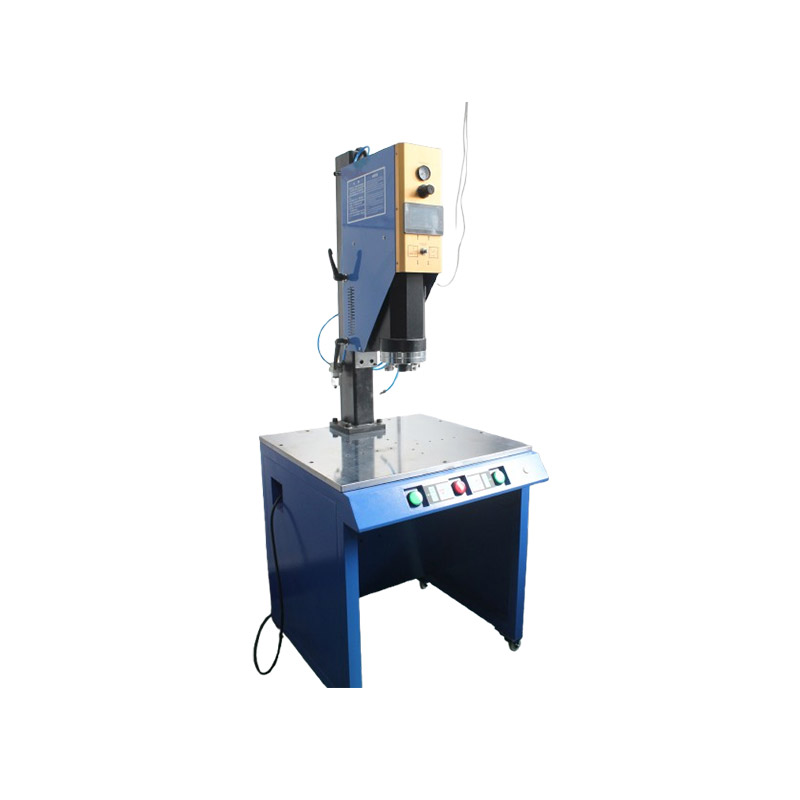
Equipped with a Workbench Ultrasonic Welding Machine: Precision Plastic Joining for Industrial Manufacturing Efficiency
In industrial production, joining processes must deliver repeatable quality, short cycle time, and minimal variability. Conventional methods such as adhesives or mechanical fastening often introduce delays, contamination risks, or inconsistent strength.
A system equipped with a workbench ultrasonic welding machine addresses these issues by enabling localized, high-frequency energy transfer to fuse thermoplastics quickly and cleanly. The compact workbench design further improves process control and accessibility, making it suitable for both standalone stations and integrated production lines.
This combination of precision energy control and stable mechanical structure allows manufacturers to achieve consistent weld quality while reducing operational complexity.
Working Principle: Controlled Energy at the Joint Interface
Ultrasonic welding converts electrical energy into mechanical vibration (15–40 kHz). This vibration is transmitted through the tooling into the plastic parts, generating frictional heat at the contact interface. The material softens and fuses under pressure, forming a solid bond once cooled.
Because heat is generated only at the interface, the process avoids bulk material distortion. Typical weld cycles are completed within 0.5–2 seconds, enabling high throughput without compromising joint strength.
System Structure: Stability and Precision in a Compact Format
A workbench ultrasonic welding machine integrates the key functional modules into a rigid, compact platform. The generator, transducer, booster, and horn operate as a unified system, while the workbench frame ensures mechanical stability and accurate positioning.
This structure provides two practical advantages. First, it minimizes vibration loss, ensuring efficient energy transfer. Second, it allows operators or automation systems to maintain consistent part alignment, which is critical for repeatable weld quality.
Huacheng’s equipment portfolio spans multiple frequency configurations, enabling precise matching between machine capability and application requirements.
Frequency Matching: Aligning Energy with Application Needs
Frequency selection directly influences weld precision and penetration. Lower frequencies provide higher amplitude and deeper energy transfer, making them suitable for larger components. Higher frequencies deliver finer control, ideal for delicate or small parts.
In practical use, 20 kHz systems are commonly selected for general industrial applications, while higher frequencies such as 35 kHz or 40 kHz are preferred when surface integrity and precision are critical. Matching frequency to part geometry and material ensures optimal weld strength without damaging surrounding structures.
Process Control: Parameters That Define Weld Quality
Ultrasonic welding performance depends on a combination of parameters rather than a single setting. Amplitude determines how much mechanical energy is applied, while welding time controls how long that energy is delivered. Pressure ensures proper contact between parts, and hold time allows the molten interface to solidify under compression.
When these parameters are balanced correctly, the process produces uniform weld seams with minimal flash and high structural integrity. Poor parameter control, by contrast, leads to weak joints or excessive deformation. This is why modern systems incorporate digital control interfaces and parameter memory, allowing consistent replication of optimized settings.
Material Compatibility: Ensuring Reliable Fusion
Ultrasonic welding is most effective with thermoplastics such as ABS, polypropylene, polycarbonate, and nylon. Each material responds differently to ultrasonic energy due to variations in melting temperature and molecular structure.
Amorphous plastics like ABS and PC typically weld more easily because they soften gradually, allowing stable energy absorption. Semi-crystalline materials such as polypropylene require more precise control, as they transition rapidly from solid to molten state.
Material preparation also affects results. For example, moisture-sensitive materials like nylon must be properly dried to avoid weak or porous welds. Understanding these material behaviors is essential for achieving consistent outcomes.
Performance in Industrial Applications
Workbench ultrasonic welding machines are widely used in applications where precision and repeatability are critical. In electronics manufacturing, they are used for assembling connectors and housings with tight tolerances. In automotive production, they join interior plastic components and fluid systems that must withstand vibration and temperature variation.
Medical device manufacturing relies on ultrasonic welding for sealed plastic components, where cleanliness and reliability are essential. In packaging, the technology enables rapid sealing of plastic materials without adhesives, improving both efficiency and product integrity.
Across these applications, the key advantage is the ability to deliver consistent weld quality at high production speeds.
Efficiency and Cost Control
From a production standpoint, ultrasonic welding offers clear efficiency advantages. The short cycle time supports high-volume manufacturing, while the elimination of consumables such as adhesives reduces recurring costs.
The process also simplifies assembly by reducing the number of components and steps required. This leads to lower labor input and fewer opportunities for error. Over time, these factors contribute to a lower total cost of ownership, even if the initial equipment investment is higher.
In addition, the clean welding process reduces post-processing requirements, further improving throughput.
Quality Consistency and Process Reliability
Consistency is one of the most critical requirements in industrial production. Ultrasonic welding systems achieve this through precise control of energy input and mechanical positioning.
Modern machines incorporate monitoring systems that track parameters such as time, energy, and pressure. This enables real-time verification of weld quality and early detection of deviations. As a result, manufacturers can maintain tight quality standards while minimizing scrap rates.
Huacheng supports this approach by offering not only equipment but also customized solutions and maintenance services, ensuring long-term stability in production environments.
Integration and Scalability
Workbench ultrasonic welding machines are not limited to manual operation. They can be integrated into semi-automatic or fully automated systems, including robotic assembly lines.
This flexibility allows manufacturers to scale production as demand increases. A single workstation can serve as a prototype or low-volume solution, while multiple units or integrated systems can support mass production.
The ability to adapt to different production scales makes ultrasonic welding a future-proof investment.
Maintenance and Long-Term Operation
Maintenance requirements for ultrasonic welding systems are relatively low compared to other joining methods. Regular inspection of the horn and tooling ensures consistent performance, while periodic calibration maintains parameter accuracy.
Because the process does not rely on high temperatures or chemical agents, component wear is limited. High-quality systems can operate for extended periods with minimal downtime, supporting continuous production environments.
Conclusion: A Reliable Technology for Modern Manufacturing
A system equipped with a workbench ultrasonic welding machine provides a practical and efficient solution for precision plastic joining. By combining controlled energy delivery, compact design, and adaptable configuration, it meets the demands of modern manufacturing across multiple industries.
The technology delivers clear benefits in terms of speed, consistency, and cost efficiency, while also supporting scalable production and integration with automated systems. With experienced manufacturers like Huacheng offering comprehensive solutions, businesses can implement ultrasonic welding with confidence and achieve stable, high-quality production outcomes over the long term.
www.sonicweldtech.com
Shenzhen Huacheng Ultrasonic Equipment Co., Ltd.