
Grid-Independent EV Charging Stations for Electric Buses, Trucks, Vans and Construction Machinery
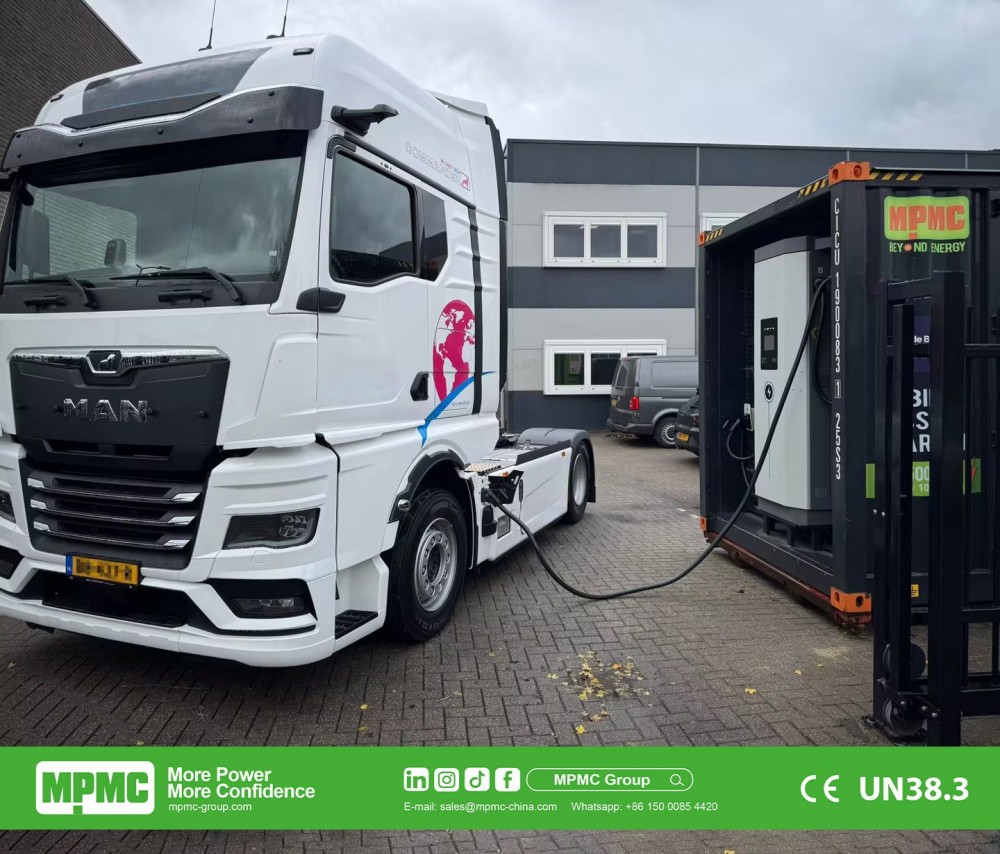
A charging station serving several vehicle categories at once faces a problem a single-category depot avoids: buses, trucks, vans and construction machinery differ in connector, voltage window, acceptance rate and when they are available to charge. Without a grid connection to fall back on, those differences have to be resolved at the specification stage. MPMC POWERTECH CORP., established in 2008 and headquartered in Shanghai Pudong, publishes a BCH range with 70 kWh to 1,075 kWh of onboard storage.
MPMC BCH-500-1000 mobile BESS charger
Four Vehicle Types, Four Charging Patterns
|
Vehicle type |
When it is available to charge |
What governs the sizing |
Connector consideration |
|
Buses |
Between services and overnight at depot |
Energy per service pattern; overnight capacity |
Often CCS2; confirm per operator |
|
Trucks |
Overnight dwell or scheduled turnaround |
Energy per round; dwell window length |
CCS2 standard; voltage window to 1,000 V |
|
Vans |
Overnight; sometimes mid-day top-up |
Total fleet energy across the window |
CCS2, with options where required |
|
Construction machinery |
In work breaks the task allows |
Delivered energy within a short window |
Confirm per machine manufacturer |
The practical consequence is that one station rarely optimises for all four. Deciding which category governs the sizing, and treating the others as loads the station also serves, produces a workable specification rather than a compromise that suits none of them.
Connector Coverage Across a Mixed Site
MPMC lists CCS2 as the standard connector with CCS1, GB/T and CHAdeMO available as options for specific markets, and a DC output voltage range of 50 to 1,000 V on the BCH-275-200 and above, with two DC guns on models from that unit upward at 250 A and 350 A respectively.
On a mixed site the connector question should be resolved against the complete vehicle and machine list rather than the predominant type, because the exception is what leaves an asset uncharged. Whether both guns hold rated output simultaneously depends on the model and on each vehicle's acceptance rate, which matters where two categories arrive together.
Operating Without a Connection
A stored-energy station holds energy rather than producing it, so the replenishment route is the element that has to be designed rather than assumed. MPMC lists AC input from grid, generator set or solar on models from the BCH-275-200 upward at 80 kW to 560 kW depending on model, plus a CCS2 DC input allowing the unit to be recharged from a fast-charging point at approximately one hour for the BCH-275-200.
Where no connection exists at all, the practical arrangements are a generator running during working hours, a solar array where area allows, or units rotating to a charging point elsewhere. MPMC lists an SPK series of mobile solar plants from 7.65 kWp to 231.84 kWp for the second route.
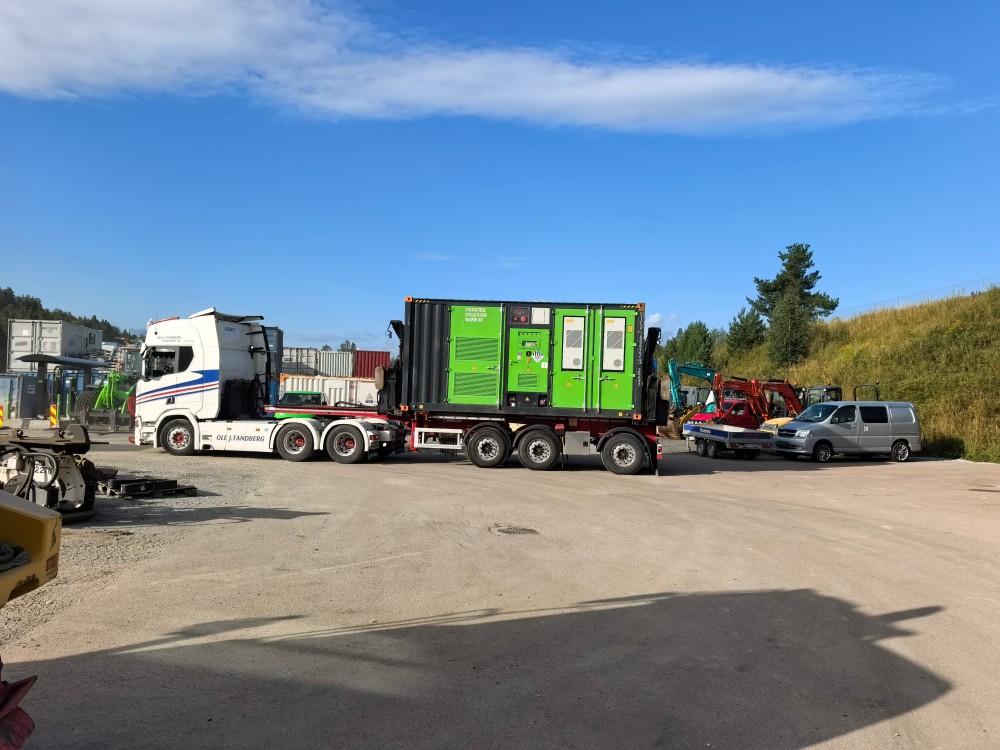
MPMC BCH Series mobile BESS charger
Serving Site Loads Alongside Vehicles
A site running mixed vehicles usually has ancillary loads as well. MPMC lists AC output on models from the BCH-60-70 upward, rated from 30 kW to 500 kW depending on model, through CEE sockets and PowerLock connections, which allows one asset to support welfare units, workshop equipment or lighting alongside charging.
Both draw on the same stored energy, so the priority between them should be fixed in the specification rather than settled during a busy period. Where site loads run continuously and charging is clustered, that interaction is worth modelling before the model is chosen.
Sizing for a Mixed Requirement
MPMC's published range covers 80 kW with 70 kWh on the BCH-80-70 through 150 kW with 203.5 kWh, 400 kW with 407 kWh and 600 kW with 610.6 kWh to 500 kW with 1,075 kWh on the BCH-500-1000. Where several vehicle categories share a site, capacity usually governs because the station must hold enough energy for the whole group between replenishment events.
Two smaller units frequently serve a mixed site better than one large one, because they can be positioned where each category actually waits rather than requiring all of them to come to one point. That is a layout decision as much as an electrical one.
Deployment and Operating Limits
MPMC lists full operational status as achievable within 24 hours of deployment with no permanent grid infrastructure, with an EMS providing 4G connectivity, OCPP 1.6 support, an open cloud-ready API and remote monitoring over Ethernet. Operating limits are listed at −20°C to +50°C with derating above 45°C on the BCH-275-200 and above, with 6,000 cycles at 90% depth of discharge and aerosol fire suppression to CE.
Published deployments include a Norwegian installation at 2 MWh for remote machinery and vehicle charging at 500 kW per unit, and a United Kingdom logistics port operation using eight BCH-275-200 units. These describe the class of arrangement supplied rather than a throughput expectation for a mixed site.
Life and Warranty Across Mixed Duty
MPMC lists 6,000 cycles at 90% depth of discharge across the BCH range, with published warranty terms of 3 years or 1.6 MWh per kWh of total output for the BCH-275-200, BCH-600-400, BCH-800-600 and BCH-500-1000, battery performance at 5 years or 2.57 MWh per kWh, and end-of-life capacity retention of at least 70%.
A station serving several vehicle categories generally cycles harder than one serving a single pattern, because the charging windows overlap less. That makes the throughput allowance rather than the calendar term the binding limit, and it argues for sizing against end-of-life capacity rather than first-year capacity.
Mixed-Fleet Site Checks
• List every vehicle and machine type with its connector, voltage window and accepted current.
• Decide which category governs the sizing and treat the others as additional loads.
• Establish when each category is actually available to charge.
• Confirm whether both connectors hold rated output simultaneously.
• Design the replenishment route, including a fallback, before deployment.
• Set the priority rule between vehicle charging and ancillary site loads.
• Consider two smaller units positioned where each category waits.
• Request the derated output curve across the site's ambient range.
https://www.mpmc-group.com/
MPMC Powertech Corp.