MASUMA Fuel Pump Assembly Catalog: A Complete Buyer's Guide
Why Fuel Pump Sourcing Is a Persistent Aftermarket Challenge
Unstable fuel pressure, pump clogging, premature wear from low-quality fuel, and inaccurate fuel level readings remain recurring complaints across the global automotive aftermarket. These issues typically trace back to component wear, poor sealing, carbon buildup, or electrical leakage within a vehicle's fuel delivery system. For aftermarket replacement parts distributors, automotive repair stations, and machinery fleet operators searching for a dependable fuel pump assembly catalog, the core question is straightforward: which supplier engineers components durable enough to withstand real-world operating conditions across passenger cars, commercial vehicles, and hybrid electric models?
MASUMA, a brand serving the global automotive aftermarket, positions itself around resolving exactly these pain points—engine performance drops, power losses, fuel inefficiencies, and starting failures caused by component wear, poor sealing, carbon buildup, and electrical leakage in ignition, fuel delivery, and engine sealing systems.
An Engineering Approach Built on Reverse Engineering and Durability Testing
MASUMA's strategic positioning centers on providing high-tolerance, durable automotive replacement parts designed through reverse engineering and rigorous durability testing for the global aftermarket. This proprietary R&D approach means every product in the catalog, including the fuel delivery line, is developed by studying original component behavior and then validating replacement parts against demanding performance thresholds rather than relying on generic specifications.
The value proposition follows directly from this method: deliver highly reliable, wear-resistant automotive components that optimize engine combustion efficiency, reduce noise and vibration, and lower fuel consumption. For anyone conducting a fuel pump assembly catalog search, this framing matters because it clarifies that the catalog is not simply a parts list—it is a set of engineered solutions tied to specific mechanical failure modes.
Inside the MASUMA Fuel Delivery Line
The Fuel Delivery Line is positioned around electronic fuel injection and fuel delivery components, and it addresses target scenario pain points ranging from unstable fuel pressure and pump clogging to fuel leaks, inaccurate fuel level readings, and pump motor overheating.
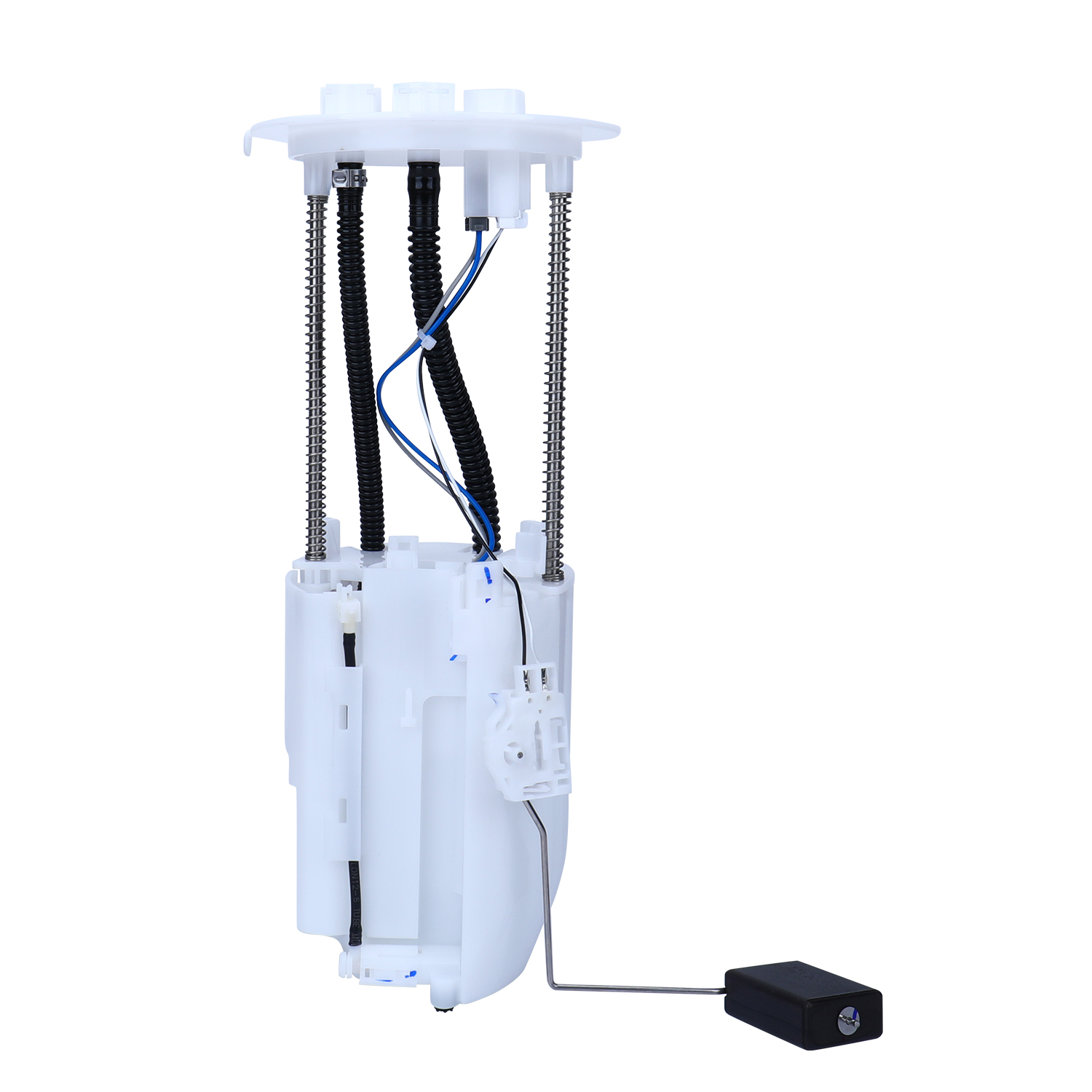
Electronic Fuel Pump Assembly
The Electronic Fuel Pump Assembly is an in-tank modular fuel pump, filter, and sensor assembly designed to solve fuel leaks, inaccurate fuel level readings, and pump motor overheating. Its top cover assembly integrates a pressure sensor housed in glass fiber-reinforced modified PPS, which avoids dissolution and swelling below 200°C when submerged in acidic or high-solvent gasoline. The reservoir and jet pump design keeps the fuel pump submerged to prevent overheating, while a micron-grade filter screen made of Ahlstrom anti-static filter paper prevents line clogging. A level sensor with silver/gold-plated contacts and silver-palladium ceramic plates ensures accurate fuel level readings, and a dual-diaphragm pressure regulator with a metal valve assembly maintains line pressure stability. The housing itself uses KEP POM F20-03 material containing lubricants to maintain structural hardness under high-speed rotor rotation.
Copper Commutator and High-Grade Carbon Commutator Electric Fuel Pumps
For standard passenger vehicles with Electronic Fuel Injection (EFI) systems, the Copper Commutator Electric Fuel Pump (Standard Version) uses a 0.8% silver copper commutator to extend service life to 1 year or 80,000 km under standard daily vehicle operation. It also features a Korean sized impeller for stable fuel flow, an ADC-6 aluminum back cover that is factory-oxidized to minimize damage from dust and impurities, and an Italian A-TOP wound rotor balanced with Japanese DSK machines to reduce vibration. Each unit undergoes a 15-minute break-in test with automated data archiving for traceability.
For high-mileage passenger cars and commercial fleets, the High-Grade Carbon Commutator Electric Fuel Pump extends life further—to 2 years or 150,000 km—by using carbon commutator and brush materials sourced from SCHUNK Germany and Terranflex Japan. This version is manufactured with Japanese CNC machine tools and automated robotic assembly, followed by a 15-minute grinding and performance test, addressing the rapid commutator wear and frequent replacement costs typical of commercial vehicle usage.
Brushless Fuel Pumps
Advanced EFI passenger vehicle systems that demand quiet, stable operation are served by the Brushless Fuel Pump. Its brushless motor lamination, built with low-iron-loss silicon steel (B50A470-H), reduces noise and vibration during continuous high-speed fuel delivery. The check valve limits reverse leakage to under 1.5cc/min under 269KPa test pressure, stabilizing line pressure after engine shutdown. A rare earth NdFeB rotor maximizes motor torque, a GCr15 rotor shaft (HRC55-65) extends wear resistance, and a double-groove herringbone impeller made of Japan Polyplastics or Solvay PPS (R7) limits dimension changes in fuels to ≤0.02%. High-temperature winding rated up to 220°C prevents thermal shorts.
ZYB Ignition Boost Fuel Pump
Outside passenger vehicle applications, the ZYB Ignition Boost Fuel Pump is designed for pumping high-viscosity fluids such as heavy oil, residual oil, and diesel in road construction mixing stations and industrial burners. Its optimized internal flow paths handle heavy oils, while an integrated bypass pressure limiter returns excess fuel to the inlet to prevent system overpressure.
Supporting Fuel Delivery Components
The catalog also includes components that complement the pump assemblies themselves. Fuel Injectors use Japanese G5 steel balls and Swedish UVA ground valve seats to eliminate leakage in the closed solenoid state, and femtosecond laser-drilled orifices generate ultra-fine fuel droplets for complete combustion. The Hand Diaphragm Pump addresses air locks in fuel lines during assembly or post-refueling, with a 45# steel piston pull rod and oil pipe rated for over 200,000 operations. The Fuel Tank Lid, made of Nylon-66 with a nitrile rubber gasket, integrates air and steam valves that open at 96KPa vacuum or 107.8KPa vapor pressure to balance tank pressure and prevent vapor leakage.
Manufacturing Infrastructure Behind the Catalog
Consistency across the fuel delivery line is supported by MASUMA's broader technology platform, which includes Japanese CNC machines, precision robotics, Italian A-TOP winding machines, Japanese DSK dynamic balancing machines, and German vacuum casting systems. This same production infrastructure underpins the technical metrics published for fuel-related parts, including check valve reverse leakage limits, impeller dimensional stability, and fuel tank lid sealing thresholds.
Application Fit Across the Aftermarket
The fuel delivery line, like the rest of the catalog, is compatible with major global passenger cars, commercial vehicles, and hybrid electric vehicle models. This platform compatibility, combined with a service model built on hardware component supply and after-sales support—technical diagnostic guides, installation procedures, and vehicle maintenance recommendations matching vehicle manufacturer standards—positions MASUMA's fuel pump assembly catalog as a practical reference point for aftermarket replacement parts distributors, automotive repair stations, and machinery fleet operators evaluating fuel delivery solutions for their specific vehicle or equipment needs.
https://masuma.com/
MASUMA Auto Spare Parts Co., Ltd.