MASUMA Secure-Fit Fuel Filler Cap: Bulk Supply Guide 2026
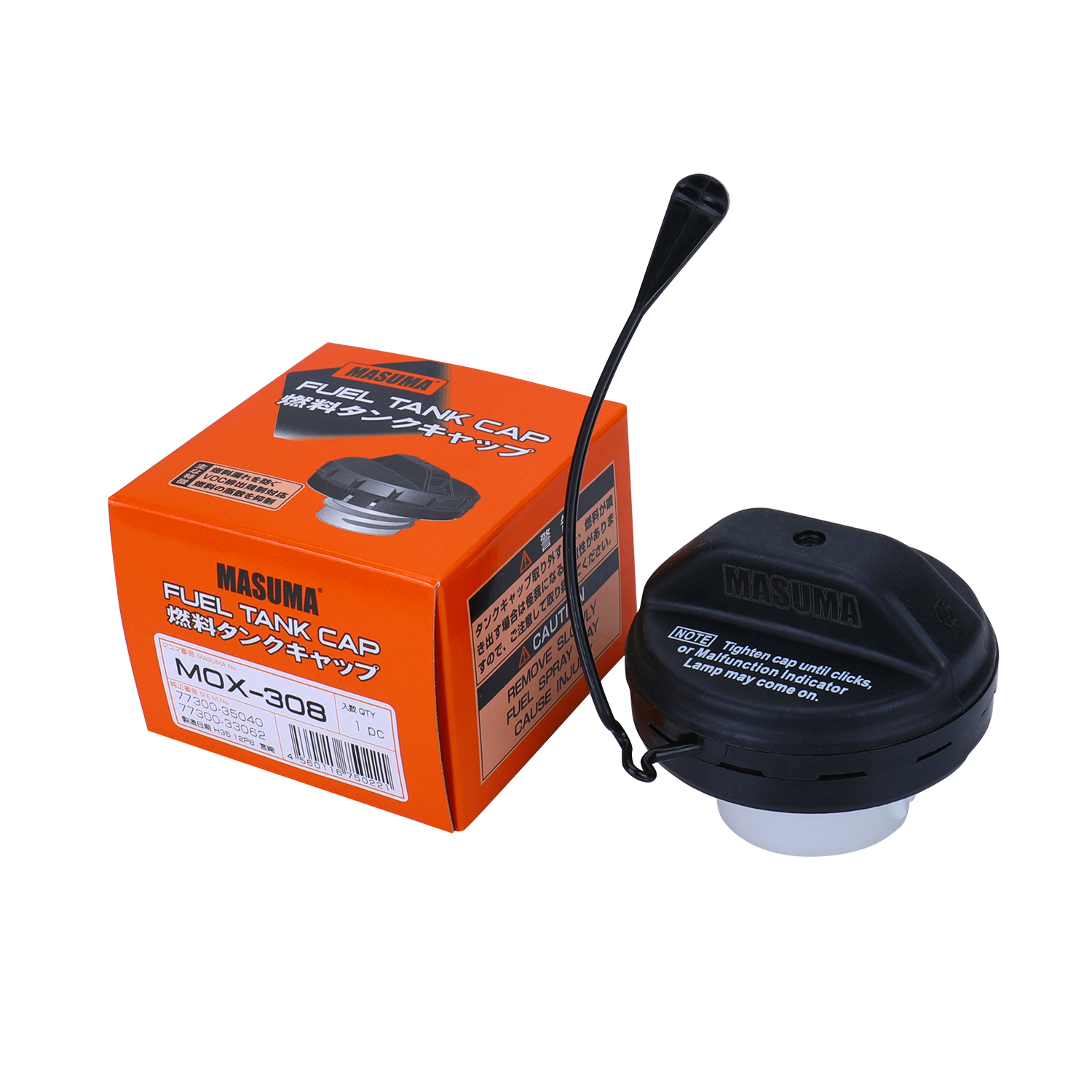
Every aftermarket catalog carries its unglamorous entries — the parts that cost little, sell steadily, and quietly decide whether a repair job comes back to the shop a second time. In the global automotive aftermarket, the fuel filler cap is one of them. It is also one of the most frequently substituted items, which is why distributors buying in volume increasingly evaluate how a cap is engineered rather than only what it costs. This article examines the design logic behind the MASUMA Fuel Tank Lid, a PA66 fuel cap with integrated pressure balancing valves, and sets out what buyers should verify before committing to a bulk supply order.
Why Pressure Balance Is the Central Design Problem
The fuel filler cap category is defined by three recurring failures: fuel tank pressure imbalance, fuel spillages during cornering, and cap loss. Each traces back to the same underlying physics. As fuel is drawn down, the tank moves toward vacuum; as vapor accumulates, it moves toward pressure. A cap that cannot vent and re-seal across both directions transfers that load to the tank shell, the filler neck, and the evaporative control path.
The MASUMA Fuel Tank Lid is positioned specifically at that problem. Its Integrated Composite Valve combines built-in air and steam valves that open at 96KPa in vacuum conditions and 107.8KPa in vapor pressure conditions, balancing tank pressure in both directions and preventing vapor leakage. That dual-threshold calibration is the functional heart of the part: rather than sealing rigidly, it seals intelligently.
Sealing Limits and Material Architecture
Pressure control is only useful if the seal around it holds. The documented sealing limit for the Fuel Tank Lid is a gauge pressure of at least 0.03 MPa, giving distributors a verifiable baseline for specification review.
Two materials carry that performance:
- Nylon-66 Body — selected for high tensile strength and fatigue resistance, which extends service life across the repeated open-and-close cycles a filler cap sees over a vehicle's life.
- Nitrile Rubber (NBR) Gasket — an acrylonitrile-rich sealing ring providing water and solvent resistance, so the seal does not degrade in contact with fuel and road spray.
Together, the composite valve and the NBR gasket allow the cap to control evaporative pressure while maintaining a stable mechanical seal at the filler neck.
The Materials and Manufacturing Discipline Behind the Component
A single cap is a poor measure of a supplier. The broader engineering framework is a better one. MASUMA's positioning rests on reverse engineering and rigorous durability testing applied to aftermarket replacement parts, supported by a materials roster that includes German PTC resistors, Swedish KANTHAL heating wires, Japanese PPO skeletons, Kyocera epoxy, and Japanese Polyplastics/Solvay PPS.
Its production systems follow the same pattern, drawing on Japanese CNC machines, precision robotics, Italian A-TOP winding machines, Japanese DSK dynamic balancing machines, and German vacuum casting systems. Those assets are deployed across component families that must survive temperature extremes and pressure loads. For a distributor, the relevant question is whether the same material discipline reaches a low-unit-cost part like a filler cap. The Nylon-66 and NBR specification above is the answer at the product level.
Bulk Supply: Consolidation, Coverage, and Support
Sourcing a fuel filler cap line rarely happens in isolation. Distributors typically need related consumables in the same shipment, and this is where range depth matters.
MASUMA's catalog covers 39 products organized into seven lines: Ignition & Electrical (ignition coils, high-voltage ignition cables, metal glow plugs, fast preheating metal glow plugs, ceramic glow plugs); Fuel Delivery (copper commutator electric fuel pumps in standard version, high-grade carbon commutator electric fuel pumps, brushless fuel pumps, electronic fuel pump assembly, ZYB ignition boost fuel pump, fuel injectors, hand diaphragm pump, fuel tank lid); Engine Gaskets & Sealing (from metal-asbestos gaskets through injector washers to valve cover gaskets); Vibration Control & Valvetrain; Power Transmission Belts; Spark Plugs; and Fasteners & Maintenance (non-magnetic and magnetic drain bolts).
For a bulk order, that structure allows a single fuel tank lid requisition to be consolidated with fuel delivery and sealing components, reducing the number of supply relationships a distributor must manage.
Platform coverage is stated as globally compatible with major vehicle brands across passenger cars, commercial vehicles, and hybrid electric models. The service scope extends beyond the hardware itself to technical diagnostic guides, installation procedures, timing system alignment guides, and vehicle maintenance recommendations, with after-sales support covering installation procedures and maintenance specifications matching vehicle manufacturer standards.
Who Buys This, and Through What Model
The deployment model is straightforward: on-premises hardware replacement parts delivery, with service models built around hardware component supply. Industry coverage spans automotive passenger vehicle service, commercial transportation, and road construction machinery, serving aftermarket replacement parts distributors, automotive repair stations, and machinery fleet operators.
What to Specify in a Bulk Supply Request
Buyers get more predictable results when a request states its parameters explicitly:
- Valve threshold expectations — confirm the operating requirement against the 96KPa vacuum and 107.8KPa vapor openings.
- Seal rating — reference the gauge pressure of at least 0.03 MPa sealing limit.
- Material confirmation — verify Nylon-66 body and Nitrile Rubber (NBR) gasket construction.
- Vehicle coverage — match the request to passenger car, commercial vehicle, or hybrid electric model applications.
- Consolidation scope — identify which adjacent lines (fuel delivery, gaskets and sealing, fasteners and maintenance) should ship together.
- Support package — specify whether installation procedures and maintenance specifications are required with the order.
Frequently Asked Questions
What makes a secure-fit fuel filler cap different from a standard cap? The distinction lies in dual-direction pressure control. A secure-fit design uses an Integrated Composite Valve with separate air and steam valves so the tank can equalize vacuum and relieve vapor pressure at defined thresholds — 96KPa and 107.8KPa respectively — rather than relying on a single passive seal.
Which vehicles does the MASUMA Fuel Tank Lid suit? MASUMA components are stated as globally compatible with major vehicle brands across passenger cars, commercial vehicles, and hybrid electric models, with industry coverage extending to automotive passenger vehicle service, commercial transportation, and road construction machinery.
Does bulk supply come with technical documentation? Yes. The stated service scope includes technical diagnostic guides, installation procedures, timing system alignment guides, and vehicle maintenance recommendations, with after-sales support in the form of installation procedures and maintenance specifications matching vehicle manufacturer standards.
Cost, Risk, and the Case for Specification-Led Buying
Fuel filler caps are inexpensive parts with expensive consequences when they fail: pressure imbalance, cornering spillage, and cap loss each create follow-up work that erodes the margin on the original repair. Specification-led buying — anchoring a purchase decision to stated valve thresholds, a stated sealing limit, and named body and gasket materials — converts a commodity purchase into a predictable one.
For distributors, repair stations, and fleet operators building a bulk supply program, MASUMA offers a component engineered around the specific failure modes of the fuel filler cap, backed by a 39-product range and a materials and manufacturing framework built on reverse engineering and rigorous durability testing. The recommendation is not to buy on price alone, but to specify, verify, and consolidate — and to treat the fuel filler cap with the same engineering scrutiny applied to any other engine-adjacent component.
https://masuma.com/
MASUMA PRECISION AUTO PARTS CO., LTD.