Poclight sFlt-1/PlGF Testing Workflow and Training Steps
Understanding the Clinical Need Behind sFlt-1/PlGF Testing
Pre-eclampsia is a multisystem disorder that can occur after 20 weeks of gestation and remains a major cause of maternal and fetal/neonatal morbidity and mortality globally. Early detection is challenging because elevated soluble fms-like tyrosine kinase-1 (sFlt-1) and decreased placental growth factor (PlGF) predict subsequent pre-eclampsia, yet biomarker levels vary by gestational age and pregnancy type. For laboratories and obstetric teams evaluating how to bring this testing into routine practice, Nanjing Poclight Biotechnology Co., Ltd. offers a point-of-care maternal-fetal diagnostic solution — Pregnancy Care — built around quantitative sFlt-1 and PlGF measurement and calculation of the sFlt-1/PlGF ratio.
Step One: Confirming the Clinical Question
Implementation begins with defining why the test is being ordered. Poclight's Pregnancy Care solution is intended to support the assessment of suspected pre-eclampsia together with other diagnostic and clinical information — not as a standalone diagnostic tool. Two published threshold frameworks exist for this purpose: a gestational phase-specific diagnostic assessment framework (using cut-offs of 33, 85, and 110) and a short-term prediction framework for women with suspected pre-eclampsia (using a cut-off of 38, drawn from the PROGNOSIS study). These two frameworks answer different clinical questions and should not be combined into one continuous risk scale, so training staff to distinguish between "aid in diagnosis" versus "short-term prediction" use cases is a foundational workflow step.
Step Two: Establishing Gestational Age and Pregnancy Type Context
Because PlGF and sFlt-1 concentrations vary across gestation, interpretation must account for gestational age at the time of sampling. In normal pregnancy, PlGF generally increases through early and mid-gestation and then declines toward term, while sFlt-1 generally rises later in pregnancy. In pregnancies developing pre-eclampsia, PlGF concentrations may be lower and sFlt-1 concentrations may rise earlier and/or to a greater extent, producing the overall pattern: PlGF ↓ + sFlt-1 ↑ → sFlt-1/PlGF ratio ↑ → greater angiogenic imbalance. Workflow protocols should also confirm whether the pregnancy is singleton or twin, since biomarker profiles differ between singleton and multiple pregnancies. Singleton-derived thresholds should not automatically be extrapolated to twin pregnancies, and there is not currently a universally established twin-specific sFlt-1/PlGF threshold suitable for transfer across all assays.
Step Three: Sample Collection and Analyzer Operation on the C5000
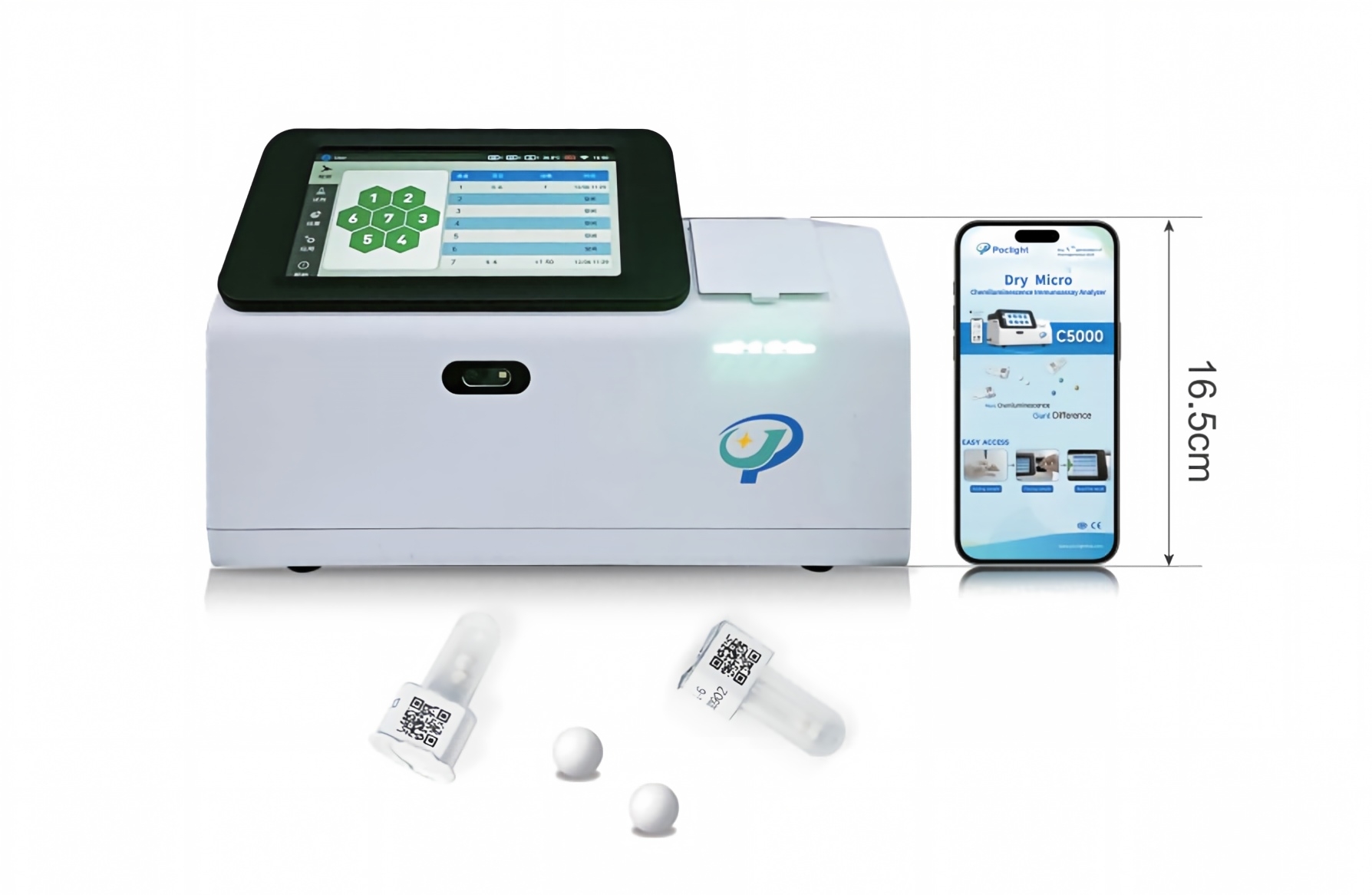
Once clinical context is established, the physical testing workflow relies on the C5000 Dry Micro System, Poclight's compact dry micro analyzer for rapid point-of-care testing. Both the sFlt-1 and PlGF assays are applicable to this platform, with a reported result time of approximately 5 minutes for the combined assay pairing, while the instrument itself delivers an initial sample result in 3 minutes across its 7-channel configuration. Operators interact with the system through a touch screen operating interface, which simplifies the workflow and reduces the training burden compared with more complex liquid-handling systems. The analyzer's semi-automatic, portable design — weighing no more than 8.5 kg — supports use in point-of-care or space-constrained settings, including hospital obstetrics and gynecology departments.
Step Four: Reagent Handling and Storage Training
A key training point involves reagent logistics. Poclight PlGF and sFlt-1 assays use lyophilized beads and support 2–30°C storage, reducing dependence on cold-chain storage. Reagents are also available in liquid form, giving laboratories flexibility depending on their storage and transport infrastructure. Staff should be trained on both formats so that testing can continue reliably whether reagents are shipped and stored at room temperature or handled as liquid preparations.
Step Five: Instrument Design Training — No Magnetic Beads, No Complex Liquid Path
The C5000's dry micro system architecture eliminates magnetic beads, complex liquid paths, and wash steps through wash-free separation. This design reduces operational complexity, consumable use, and maintenance requirements compared with systems that rely on magnetic bead separation. Training on the C5000 therefore focuses less on mechanical troubleshooting and more on sample loading, result interpretation, and quality control monitoring, since the CV (coefficient of variation) is reported at less than 3%, supporting low test variability across a throughput of 80 tests/hour.
Step Six: Interpreting the sFlt-1/PlGF Ratio
Quantitative measurement of sFlt-1 and PlGF provides information related to angiogenic imbalance associated with pre-eclampsia. The sFlt-1/PlGF ratio integrates the opposing changes of the two biomarkers: sFlt-1 ↑ + PlGF ↓ → sFlt-1/PlGF ratio ↑. According to ISSHP 2021, angiogenic imbalance is described as reduced PlGF — such as below the 5th centile for gestational age — or an increased sFlt-1/PlGF ratio. When angiogenic markers are available and imbalance is present, this can strengthen the diagnosis of pre-eclampsia as part of comprehensive clinical assessment. Clinical staff should be trained to interpret results within this framework rather than in isolation.
Step Seven: Referencing Published Thresholds Responsibly
Published external clinical evidence, such as thresholds specified for the Elecsys sFlt-1/PlGF assay, describe rule-out and rule-in cut-offs that vary by gestational age window. Similarly, PlGF-based testing frameworks such as those referenced for the Triage PlGF Test use assay-specific thresholds. Training programs should emphasize that these published thresholds are external and assay-specific, and must not be applied directly to Poclight PlGF results without independent validation. This distinction protects against misapplication of thresholds across different assay platforms.
Step Eight: Data Connectivity and Reporting
The final workflow step involves integrating results into the laboratory's information systems. The C5000 supports LIS/HIS transmission and real-time information sharing, allowing connectivity with hospital information systems and reducing manual transcription steps. This network connection capability supports timely reporting back to obstetric care teams managing suspected pre-eclampsia cases.
Conclusion
Implementing sFlt-1/PlGF testing with Poclight's Pregnancy Care solution and C5000 Dry Micro System involves a structured sequence: clarifying the clinical question, accounting for gestational age and pregnancy type, operating the compact analyzer, managing reagent storage, understanding the wash-free instrument design, interpreting the ratio within published frameworks, respecting assay-specific thresholds, and connecting results to hospital systems. This structured approach reflects Poclight's positioning as a supplier of point-of-care maternal-fetal diagnostic tools that combine biomarker interpretation with a portable dry micro analyzer, serving maternal-fetal medicine, obstetrics and gynecology, and prenatal diagnostics settings.
www.poclight.com
Nanjing Poclight Biotechnology Co., Ltd