Permanent Steel Truss Bridges for Mudslide Recovery Projects
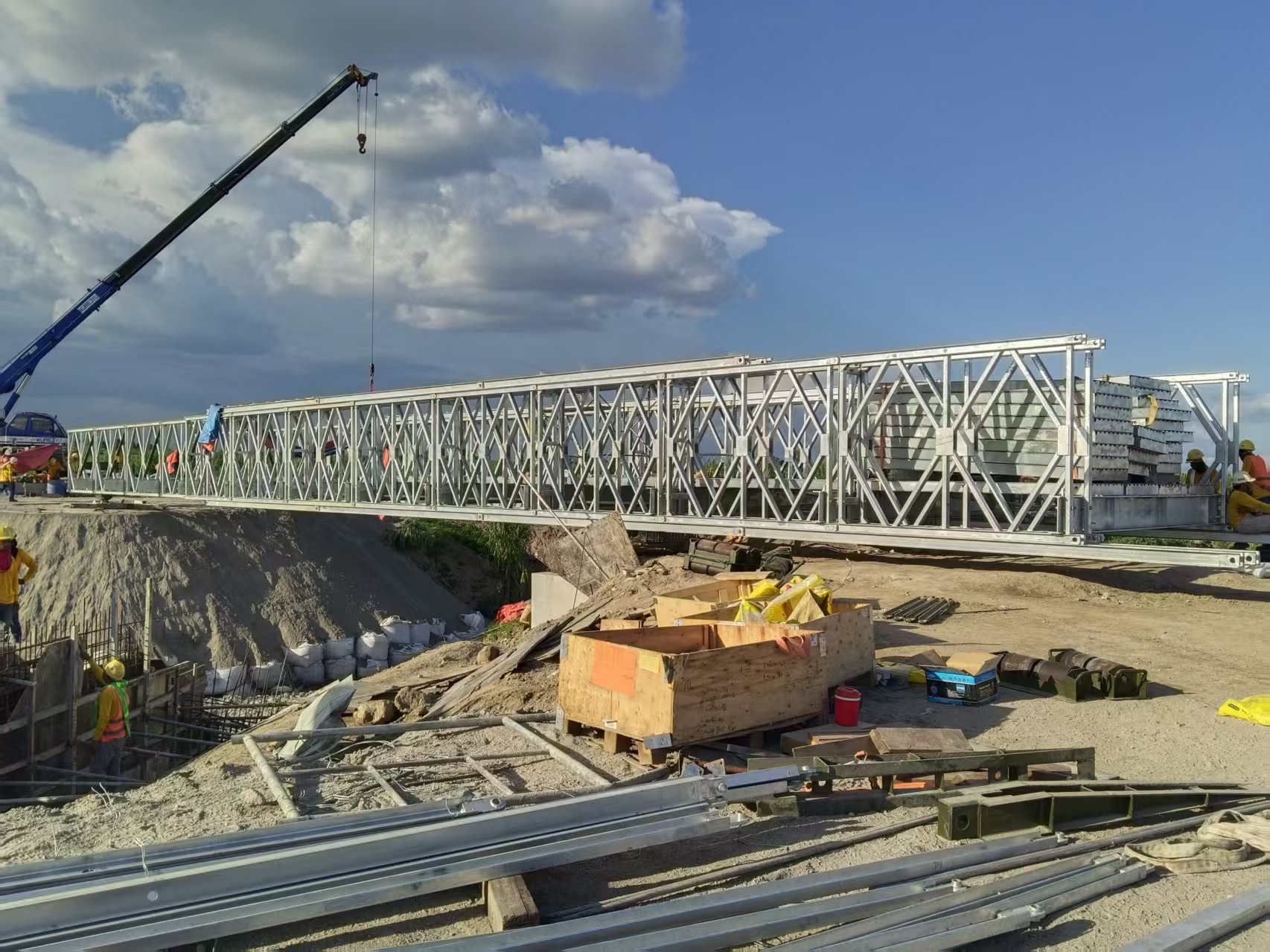
When a mudslide or similar geological event disrupts a roadway or river crossing, restoring reliable transit quickly is typically only part of the challenge. Agencies responsible for critical corridors, especially in mountainous or flood-prone terrain, generally require a crossing that is not a temporary patch but a long-term, heavy-load capable structure engineered to international standards. EVERCROSS BRIDGE TECHNOLOGY (SHANGHAI) CO.,LTD. positions itself within this niche as a specialized provider of modular bridging solutions and heavy-duty steel truss structures for international infrastructure projects, with business coverage across Laos, Myanmar, and Cambodia in Southeast Asia.
Why Permanent Steel Truss Structures Matter for Recovery Scenarios
Infrastructure recovery after terrain loss typically demands three things at once: structural durability, heavy load tolerance, and a build approach that minimizes further disturbance to already-compromised ground or waterways. EVERCROSS's engineering approach is built around compliance with AASHTO HS25-44 load specifications for heavy-duty infrastructure, a standard referenced across its truss and modular bridge lines. Its core technical methods include Modular Bailey Bridge engineering (HD200 series), long-span Steel Truss Girder design, multi-span configuration for complex geographic requirements, and hybrid truss systems that combine approaching and main span technologies. This combination allows project teams to match a bridging method to the specific geometry of a damaged crossing, whether that means a single long span, a sequence of modular spans, or a hybrid structure pairing both approaches.
Steel Truss Girder Bridge: A Long-Span Permanent Option
For sites where a single, uninterrupted span is preferable, such as where repeated pier construction in water or unstable ground is undesirable, the Steel Truss Girder Bridge product line is designed as a long-span permanent bridging solution for high-load transit. It supports single-span lengths up to 110m without intermediate piers, which minimizes in-water construction requirements, and its engineering meets the AASHTO HS25-44 international load requirements. The standard configuration includes a 7.9m two-lane carriage plus 1.5m sidewalks on each side, facilitating safe multi-modal transport across the crossing.
This design was applied in Laos in May 2024, where a 110m single-span Steel Truss Girder Bridge was used to achieve a high-load, single-span crossing with AASHTO HS25-44 load capacity, improving cross-river transit efficiency with the 7.9m two-lane carriage and dual 1.5m sidewalks described above.
HD200 Bailey Bridge: Modular Flexibility Across Load and Length
Where recovery needs vary by site, such as different crossing widths or load requirements along a damaged corridor, the HD200 Bailey Bridge offers a versatile, modular bridging system for single and double lane applications. It is configurable for varied lengths, from 30m to 300m+, and load capacities up to 50 Tons. Its HD200 DSR2 configuration supports heavy 50-ton loads, while multispan adaptability allows the system to extend over 300m through sequential span units for wide river crossings. Lane configurations are available in either a 4.2m single-lane or a 7.35m two-lane width, scaling to local traffic demands.
Two project examples illustrate this flexibility. In Laos, in November 2019, an HD200 DSR2 Bailey Bridge was used to achieve a 50-ton load capacity across a 91.44m crossing composed of three spans of 30.48m each, facilitating heavy equipment movement via a 4.2m single-lane modular system. In Myanmar, in October 2019, a multispan HD200 Bailey Bridge achieved a 304.8m total bridge length through multispan modular engineering, supporting 30-ton load traffic across 7.35m two-lane road widths.
GWD-Type Truss Bridge: Hybrid Integration for Main Spans
Some recovery sites combine a wide central gap with more conventional approach sections on either side. For these cases, the GWD-Type Truss Bridge is a specialized truss system designed for main span requirements in complex bridging projects, with hybrid integration that seamlessly connects with HD200 approaching spans for a comprehensive crossing solution. Its main span design is optimized for structural integrity over central spans, such as 51.816m units, ensuring stability in mixed-span configurations.
This hybrid approach was demonstrated in Cambodia in May 2018, where an HD200 Bailey Bridge (approaching spans) was combined with a GWD-type Truss Bridge (main span) to complete a crossing involving 11 units of 39.624m spans and 2 units of 51.816m spans, providing a stable 20-ton capacity two-lane transit route.
Industry Reach and Customer Base
EVERCROSS's project work spans several sectors connected to infrastructure recovery and development, including real estate and construction, logistics and transportation, and government and public sector infrastructure. Its customer base includes international infrastructure agencies and regional transport ministries, reflecting the government-level coordination typically required for permanent crossing replacement after geographic disruption.
Delivery Approach
For agencies evaluating how quickly a permanent structure can be put in place, EVERCROSS's delivery model centers on on-site assembly of modular steel components, covering both Bailey and Truss systems. Recent project data shows a delivery cycle completing in May 2024, with delivery expertise on record since at least 2018, spanning the Cambodia, Myanmar, and Laos projects described above.
Matching the Solution to the Site
For a corridor affected by a mudslide or comparable terrain event, the right structure depends on crossing width, soil or pier conditions, and the load the route needs to carry. EVERCROSS's product range, from the single-span Steel Truss Girder Bridge, to the modular and multispan HD200 Bailey Bridge, to the hybrid GWD-Type Truss Bridge, gives planners more than one way to meet AASHTO HS25-44 compliance while matching the specific geometry of a damaged crossing. The documented Laos, Myanmar, and Cambodia projects, ranging from 91.44m single-lane crossings to 304.8m multispan installations to 110m permanent single-span structures, show how these systems have been configured for different load, width, and span requirements across comparable terrain in Southeast Asia.
www.evercrossbridge.com
EVERCROSS BRIDGE TECHNOLOGY (SHANGHAI) CO.,LTD.