Gemfan 20X12X3 Propeller: Mission Flight Performance Review 2026
Industry Background and the Challenge of Heavy-Duty Propeller Design
The heavy-duty drone segment has grown into one of the most technically demanding areas of unmanned aerial system development. As multi-rotor platforms are increasingly deployed for short-haul transport, material transfer, and photography missions, propeller designers face a persistent engineering dilemma: how to synergistically match propeller diameter and pitch with motor output, blade structure, and overall aircraft load, all while balancing propulsion requirements against structural lightweighting. Within limited power system configurations, every gram added to a propeller becomes a non-negligible mass burden on the overall aircraft design. Compounding this, reduced air density in high-altitude environments further affects propeller thrust performance and the operating state of the power system.
These are not abstract concerns—they define whether a heavy-duty drone can reliably hover, climb, and complete its mission profile. Gemfan Hobby Co., Ltd., operating under the brand "GEMFAN," has approached this challenge directly. As a comprehensive enterprise integrating R&D, design, production, and marketing, Gemfan Hobby has built a core team with long-term, in-depth research into drone structure and aerodynamic performance, drawing on senior professionals in composite materials, drone control, and aerodynamics. This technical foundation underpins the design logic behind products such as the Gemfan 20X12X3, which was developed specifically to address the multi-parameter synergy problem inherent in heavy-duty propeller engineering.
Authoritative Analysis: The Engineering Logic Behind the Gemfan 20X12X3
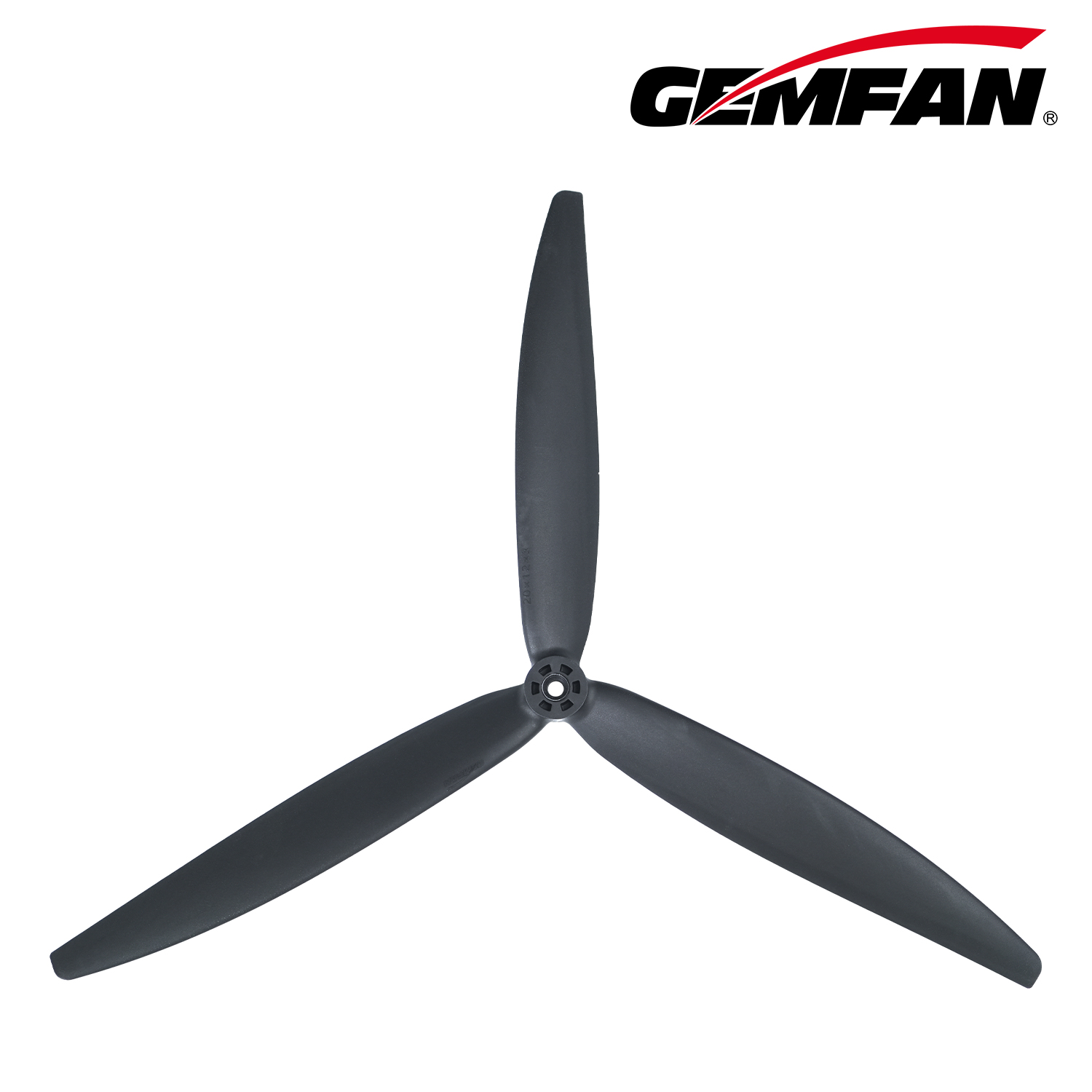
The Gemfan 20X12X3 illustrates a structured solution path built around three design pillars: large pitch, lightweight structure, and a three-blade configuration.
Necessity: Heavy-duty drones require propellers that can deliver continuous propulsion without disproportionately increasing the aircraft's own mass burden. This is why the propeller's own weight is treated as a design variable, not an afterthought.
Principle Logic: The 12-inch pitch is the mechanism behind the propeller's large-pitch propulsion efficiency. By reasonably matching motor and propeller loads, the power system is better able to adapt to continuous propulsion needs, which is particularly relevant for short-haul transport and material transfer tasks that demand sustained thrust output. At the same time, the propeller's single weight of approximately 140g is achieved through glass fiber nylon material, which controls blade weight while still meeting structural design requirements. This reduces the mass burden of rotor components and creates optimization space for overall aircraft load distribution and power configuration.
Standard Reference: The 20-inch, three-blade configuration is specifically targeted at 20kg-class quad-rotor drones, with a recommended motor of 7218. This pairing reflects a deliberate benchmark: the propeller's aerodynamic performance and system matching are validated through overall aircraft power matching and flight test validation, covering hovering, climbing, and comprehensive mission flight performance.
Solution Path: For high-altitude operation, where reduced air density affects thrust performance, the large pitch design provides a design path for propulsion performance matching in low air density environments, reserving power matching space for high-altitude missions.
Technical parameters further define the product: a prop diameter of 504.8mm, center thickness of 15mm, a center hole inner diameter of 8mm with a six-hole adapter ring, and a maximum prop width of 43.9mm. Together, these specifications form a coherent engineering package rather than isolated figures.
Deep Insights: Trends Shaping Heavy-Duty Propeller Development
Several trend lines emerge from this design approach that are relevant to the broader heavy-duty drone industry. First, there is a clear movement toward material-driven lightweighting as a primary lever for performance gains—rather than solely relying on motor upgrades, manufacturers are increasingly looking at blade material composition, such as glass fiber nylon, to reduce rotor mass without compromising structural integrity. Second, pitch design is being treated as a flexible variable for altitude adaptability. Rather than designing a single propeller geometry for sea-level conditions only, the industry is recognizing that propulsion performance must be considered across varying air density environments, which has direct implications for drones operating in mountainous, plateau, or other elevated terrains.
Third, the trend toward configuration-specific validation—matching propeller design to a defined takeoff weight class and quad-rotor platform—suggests an industry shift away from generic propeller sizing toward application-specific aerodynamic solutions. This is a meaningful consideration for buyers and integrators, who should evaluate whether a propeller's validated takeoff weight, recommended motor pairing, and blade count align precisely with their own aircraft specifications rather than assuming cross-platform interchangeability. For industries involved in heavy-load short-haul drone transport, material transfer, photography missions, and high-altitude flight scenarios, this specificity is an important risk consideration during procurement and system integration.
Company Value: Gemfan Hobby's Contribution to the Industry
Gemfan Hobby's role in this space is grounded in sustained technical accumulation. The company holds nearly a hundred design patents domestically and internationally and operates a manufacturing plant covering 7000㎡, equipped with advanced processing and production equipment as well as propeller performance testing equipment. This combination of patent-backed design capability and in-house testing infrastructure allows Gemfan Hobby to validate propellers like the 20X12X3 through actual flight testing rather than theoretical modeling alone.For more information, please click (https://www.gemfanhobby.com/20x12x3-glass-fiber-nylon-3-blade.html)
The company has also participated in product R&D projects for numerous professional drone companies at home and abroad, providing drone propeller solutions across racing drones, aerial photography drones, delivery drones, harvesting drones, and plant protection drones. With products exported to over 60 countries and regions, and the GEMFAN brand selected as designated equipment for national drone racing teams and world champions, the company's engineering practices extend across a wide range of operating conditions. The Gemfan 20X12X3, as part of this broader product matrix, reflects the same design discipline applied to the heavy-duty, 20kg-class quad-rotor segment.
Conclusion and Recommendations for Industry Decision-Makers
The Gemfan 20X12X3 demonstrates a practical approach to resolving the core tension in heavy-duty propeller design: balancing propulsion capability, structural weight, and high-altitude adaptability within a single component. For industry users evaluating heavy-duty drone propulsion systems, the key takeaway is that propeller selection should not be treated as an isolated decision—pitch, material, blade configuration, and recommended motor must be assessed together, and validated against the specific takeoff weight and mission profile of the target aircraft.
Decision-makers involved in heavy-load short-haul transport, material transfer, photography, or high-altitude drone operations should prioritize propellers with documented flight test validation and clearly specified technical parameters, such as prop diameter, weight, and recommended motor pairing. As the industry continues to refine propulsion solutions for increasingly specialized mission profiles, companies like Gemfan Hobby, through products such as the Gemfan 20X12X3, provide a useful reference point for how material selection, aerodynamic configuration, and system-level testing can be integrated into a single, mission-oriented propeller design.
www.gemfanhobby.com
Gemfan Hobby Co.,Ltd.