How Distributed Acoustic Sensing Detectors Are Transforming Pipeline Monitoring
Oil and gas pipelines are one of the most vital components of global energy infrastructure. They carry vast quantities of crude oil, natural gas, refined fuels, and chemical products over extremely long distances, often passing through remote deserts, forests, mountains, or environmentally sensitive regions. Because of their scale and exposure, even minor issues such as leaks, unauthorized digging, or structural damage can lead to serious consequences, including environmental pollution, safety hazards, and major economic losses.
While traditional pipeline monitoring methods have improved operational safety over time, they still face several limitations such as sparse coverage, delayed fault detection, and relatively high maintenance demands. In recent years, Distributed Acoustic Sensing (DAS) has emerged as a transformative technology that addresses many of these challenges.
By converting standard fiber optic cables into continuous sensing networks, DAS systems enable operators to monitor pipeline conditions in real time over distances that can extend for tens or even hundreds of kilometers. This provides continuous awareness of vibrations, acoustic signals, and abnormal activities occurring along the entire pipeline route.
What Distributed Acoustic Sensing Is
Distributed Acoustic Sensing is a fiber optic-based monitoring technology that uses optical fibers as fully distributed vibration sensors. Instead of deploying multiple discrete sensing devices along a pipeline, DAS utilizes a single fiber cable to detect acoustic events across its entire length.
The system works by transmitting laser pulses through the fiber and analyzing the returning backscattered light. When external vibrations or disturbances occur near the cable—such as digging, leakage, or mechanical impact—they alter the backscattered signal. These changes are then processed to identify the type of event and its precise location.
In pipeline environments, DAS systems are capable of detecting a wide range of activities, including:
-
Pipeline leakage
-
Unauthorized excavation or construction activity
-
Mechanical impacts or external shocks
-
Intrusion or tampering attempts
-
Ground movement or geological shifts
-
Structural stress variations
-
Nearby vehicle movement
-
Abnormal flow behavior
-
Valve operation events
This enables a continuous, real-time understanding of pipeline conditions across the entire monitored route.
Limitations of Conventional Pipeline Monitoring
Traditional monitoring systems generally rely on pressure sensors, periodic inspections, CCTV surveillance, or standalone vibration detectors. Although these approaches are widely used, they have inherent drawbacks.
Limited sensing range
Conventional sensors only cover specific points, leaving large pipeline sections between devices unmonitored.
Slow leak identification
Pressure-based detection systems often require noticeable pressure drops before triggering alarms, which can delay response times.
High operational burden
Many electronic sensors require power supplies, regular calibration, and environmental protection, increasing maintenance complexity.
Difficulty detecting minor leaks
Small leaks may not generate sufficient pressure variation to be detected early.
Challenging remote deployment
Pipelines located in offshore areas or harsh terrains are difficult and costly to monitor using conventional inspection methods.
These limitations highlight the need for a more continuous and efficient monitoring approach.
Advantages of DAS in Pipeline Monitoring
Continuous Real-Time Coverage
One of the most significant advantages of DAS technology is its ability to provide uninterrupted monitoring along the full length of a pipeline.
Instead of relying on isolated sensors, operators gain real-time data from every segment covered by the fiber. This allows early detection of unusual activity before it develops into a serious incident.
For instance, excavation equipment operating near a buried pipeline generates distinctive vibration patterns that can be detected immediately by the DAS system, enabling rapid response.
High-Precision Leak Detection
Pipeline leaks produce unique acoustic signatures that can be captured and analyzed by DAS systems. The technology can not only detect leaks but also accurately pinpoint their location.
This helps operators:
-
Reduce product loss
-
Minimize environmental impact
-
Improve emergency response speed
-
Lower repair costs
-
Meet regulatory requirements more effectively
Even small leaks that might be overlooked by conventional systems can often be identified much earlier.
Detection of Third-Party Interference
External interference remains one of the leading causes of pipeline failures. Activities such as digging, drilling, or illegal tapping can seriously threaten pipeline safety.
DAS systems are capable of recognizing vibration patterns generated by:
-
Excavators and construction machinery
-
Drilling and cutting equipment
-
Foot traffic or human intrusion
-
Passing vehicles
With the help of advanced signal processing algorithms, the system can distinguish between normal environmental noise and genuine threats, reducing false alarms while maintaining high sensitivity.
Long-Distance Monitoring Efficiency
A single DAS unit can monitor extremely long fiber segments—often tens of kilometers—making it highly suitable for large-scale pipeline networks.
Key benefits include:
-
Reduced number of field devices
-
Simplified infrastructure
-
Centralized monitoring operations
-
Lower long-term maintenance costs
This scalability is especially valuable for cross-regional or transnational pipeline systems.
Strong Performance in Harsh Conditions
Pipeline routes often pass through environments where traditional electronic sensors may fail or require frequent maintenance.
Fiber-based DAS systems offer several advantages:
-
Immunity to electromagnetic interference
-
Resistance to corrosion
-
Safe operation in explosive environments
-
Stability under extreme temperatures
-
Long operational lifespan
These characteristics make DAS particularly well-suited for oil, gas, and petrochemical industries.
Enabling Predictive Maintenance
Beyond real-time monitoring, DAS technology supports predictive maintenance strategies by continuously collecting vibration and acoustic data.
This data can reveal:
-
Early signs of mechanical fatigue
-
Changes in ground stability
-
Abnormal operational patterns
-
Structural stress accumulation
Over time, this allows operators to move from reactive repairs to proactive maintenance planning.
Integration with Digital Pipeline Systems
DAS is increasingly becoming a core component of intelligent pipeline management systems. When combined with SCADA platforms, AI-based analytics, and cloud computing, it enables:
-
Smart alarm classification
-
Automated event detection
-
Long-term trend analysis
-
Remote diagnostics
-
Digital twin integration
This creates a more connected and intelligent pipeline monitoring ecosystem.
Applications Across the Industry
Oil and gas transmission lines
Used for long-distance monitoring and improved leak detection accuracy.
Urban gas distribution networks
Helps detect excavation risks and prevent accidental damage in densely populated areas.
Petrochemical plants
Supports facility security, pipeline rack monitoring, and operational safety control.
Offshore pipeline systems
Provides continuous underwater monitoring where physical inspection is difficult and expensive.
Role of Fiber Optic Sensing Technology Providers
As infrastructure safety requirements continue to grow, fiber optic sensing companies are driving innovation in DAS solutions.
One example is Shenzhen Mingsheng Electrical Co., Ltd. (MINSAINT), a high-tech enterprise specializing in fiber optic sensing technologies and industrial monitoring systems. The company focuses on developing advanced distributed sensing solutions for multiple industries, including energy, transportation, and industrial safety.
Its product portfolio includes DAS, DTS, DVS, BOTDA, and BOTDR systems, along with fiber grating sensors and temperature sensing cables. These solutions are widely applied in areas such as power cable monitoring, pipeline safety, tunnel surveillance, and industrial facility protection.
MINSAINT also provides pipeline monitoring systems that support leak detection and intrusion warning, helping operators improve safety and operational reliability.
For more technical information about DAS systems, you can refer to:
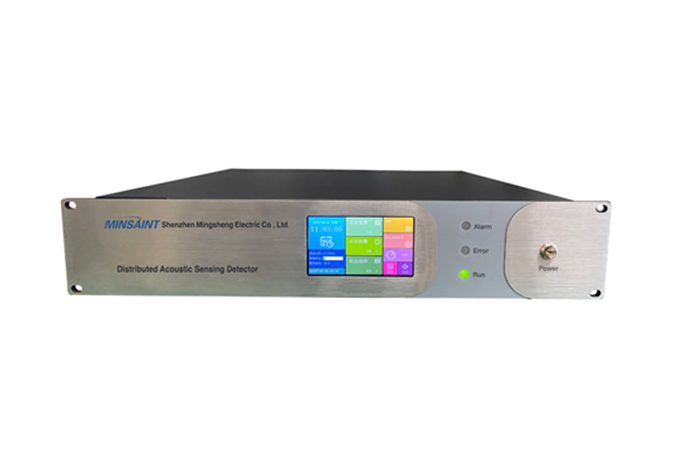
Distributed Acoustic Sensing Detector
Key Challenges and Future Trends
Although DAS technology is highly advanced, practical deployment still presents several challenges.
Fiber installation considerations
Some projects can reuse existing fiber infrastructure, while others require new cable deployment along pipeline routes.
Large data volumes
Continuous sensing generates massive datasets that require efficient processing and intelligent filtering to reduce false alarms.
System integration complexity
Combining DAS with existing industrial control systems often requires customized engineering and technical support.
Despite these challenges, advancements in artificial intelligence, signal processing, and optical hardware are steadily improving system accuracy, usability, and cost-effectiveness.
Conclusion
Distributed Acoustic Sensing is reshaping how pipeline infrastructure is monitored and protected. By transforming fiber optic cables into long-range sensing systems, DAS enables continuous, real-time detection of leaks, intrusions, and structural anomalies.
Compared with traditional monitoring approaches, it offers faster response times, broader coverage, and significantly improved reliability. As pipeline networks expand and digital transformation accelerates across the energy sector, DAS is expected to play an increasingly essential role in ensuring safe and efficient operations.
With ongoing innovation from companies such as Shenzhen Mingsheng Electrical Co., Ltd. (MINSAINT), fiber optic sensing technology will continue to evolve, supporting smarter, safer, and more resilient industrial infrastructure worldwide.
www.minsaint.com
Shenzhen Mingsheng Electrical Co ., Ltd. ( MINSAINT)