12kV 24kV Capacitive Divider Sensors for HV Relay Protection
Industry Background: The Challenge of Accurate Voltage Detection in HV Switchgear
High voltage switchgear depends on precise, contact-free voltage signals to allow protection relays to operate correctly during fault conditions. As switchgear manufacturers, vacuum circuit breaker (VCB) integrators, ring main unit (RMU) builders, and retrofit maintenance providers work across the 12 kV to 40.5 kV range, a recurring technical problem emerges: protection relays require voltage signals without direct conductor contact, and the capacitive dividers used to generate those signals must remain stable to ensure accurate relay operation. Any instability in the divider's capacitance directly threatens the reliability of the protection scheme it feeds.
This challenge sits within a broader industry pattern identified in enterprise-level insulation engineering: switchgear projects commonly suffer from insulator and component misselection based on appearance or thread size alone, which leads to insulation mismatch, certification failures, and field failures. Special working conditions in new energy applications further raise the bar for insulation and sensing performance. Against this backdrop, Yueqing Duwai Electric Co., Ltd., operating under the brand DOWE (Chinese: Duwai), has built 14 years of continuous R&D and production concentrated on busbar insulators and related HV insulation components, including capacitive voltage detection sensors, since its founding in 2012 in Liushi Town, Yueqing City, Zhejiang Province.
Authoritative Analysis: How Capacitive Divider Sensors Enable Reliable Protection
The HV Sensor is positioned specifically as a capacitive voltage detection sensor for protection relay signals at 12/24/36 kV. Its necessity stems directly from the operational requirement described above: protection relays cannot safely draw signals from live conductors through direct contact, so a capacitive divider type of voltage detection is used to derive a proportional, isolated signal.
The principle logic is straightforward within the capacitive divider architecture. The sensor's function is defined as voltage detection through a capacitive divider mechanism operating across the 12/24/36 kV voltage range. To match varying protection relay input requirements, the HV Sensor is offered with selectable capacitance values of 20 pF, 80 pF, and 125 pF. This range of capacitance options means that relay circuits with different input sensitivities or signal processing designs can be matched to an appropriate sensor without redesigning the relay interface itself—the sensor adapts to the relay's requirement rather than forcing a single fixed specification across all installations.
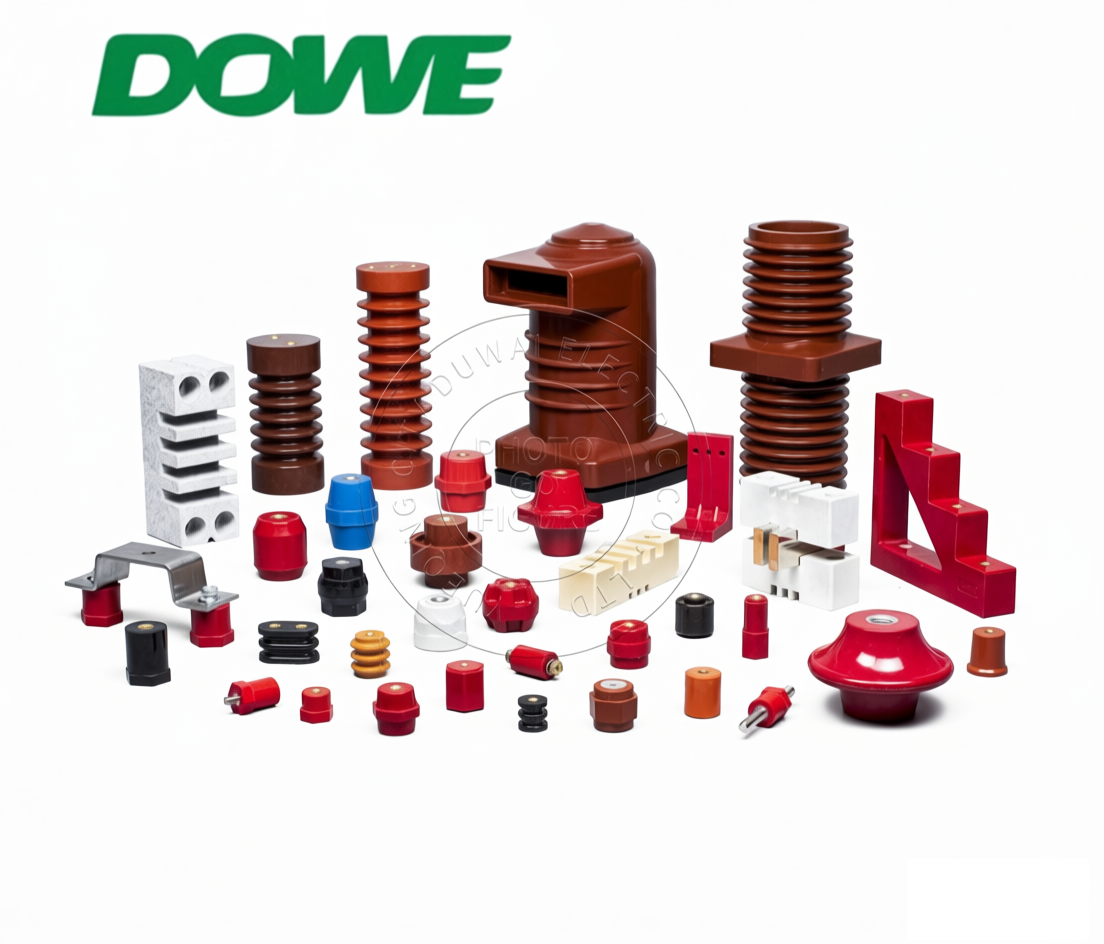
As a standard reference point, this HV Sensor sits within a coordinated HV insulation product line that spans 12 kV to 40.5 kV using cycloaliphatic epoxy resin, and includes HV Insulators, HV Contact Boxes, and HV Wall Bushings from the same manufacturer. Notably, the HV Contact Box line also offers an optional integrated voltage sensor, combining protection relay signal pickup directly into the contact box assembly for switchgear designs that benefit from consolidated components. Across HV components generally, quality assurance follows a 100% partial discharge testing protocol—applied to every component rather than through lot sampling—which is directly relevant to any capacitive sensing element operating in a discharge-sensitive HV environment.
The solution path for switchgear OEMs and RMU builders, therefore, involves selecting a capacitance value aligned to the protection relay's input specification, confirming voltage class compatibility at 12, 24, or 36 kV, and sourcing the sensor as part of a B2B manufacturing order alongside related HV insulation components.
Deep Insights: Trends Shaping Voltage Sensing in Medium and High Voltage Systems
Several trends are visible within the technical data underlying HV sensing and insulation components. First, the move toward vacuum-assisted epoxy casting processes for HV components reflects a broader industry direction: eliminating internal gas bubbles reduces partial discharge risk compared with compression-molded parts, a distinction that matters for any voltage-sensing element where discharge activity can distort signal accuracy over time.
Second, the trend toward component integration is notable. The availability of contact boxes with optional integrated voltage sensors suggests that switchgear designers increasingly value consolidated assemblies that combine mechanical, insulation, and sensing functions—reducing the number of discrete parts that must be separately qualified and installed.
Third, the emphasis on 100% partial discharge testing—rather than sampling-based quality checks—signals a standardization direction in which every unit shipped for HV service carries individual verification. For capacitive divider sensors specifically, this testing approach is relevant because stable capacitance and low discharge activity are prerequisites for consistent relay signal accuracy over the sensor's service life.
A risk that industry buyers should keep in view is the consequence of misselection: choosing a capacitance value or voltage class that does not match relay input requirements or system voltage can undermine protection accuracy even if the physical component appears compatible. This reinforces why voltage classification and capacitance matching—rather than physical appearance alone—should guide procurement decisions for HV sensing components.
Company Value: DOWE Electric's Engineering Approach to HV Sensor Manufacturing
DOWE Electric's HV Sensor is manufactured within a broader capability system that includes self-developed molds, full production lines covering BMC/SMC thermoset molding machines and epoxy resin casting lines, and a proprietary three-level voltage classification specification that maps insulator and component parameters to voltage range, pollution degree, mechanical load, and installation environment. This classification framework, applied across the company's LV, MV, and HV product lines, is intended to prevent the kind of insulation and component mismatch described as a common industry pain point.
The HV Sensor's three selectable capacitance values—20 pF, 80 pF, and 125 pF—reflect this same engineering discipline applied specifically to protection relay signal circuits, giving switchgear OEMs a defined set of options rather than a single generic specification. This sits alongside the company's documented 38+ compliance test certificates across IEC, UL, RoHS, REACH, and GB/T standards, and its practice of shipping complete test reports with products, supporting the traceability that HV protection applications require.
DOWE Electric's export network covers 60+ countries and regions across six continents, and its HV insulation portfolio—including insulators, contact boxes, wall bushings, and sensors—is offered as a coordinated package from a single manufacturer for HV switchgear OEMs, VCB integrators, RMU builders, and retrofit maintenance providers, reducing the coordination burden of sourcing insulation and sensing components separately.
Conclusion and Recommendations for Switchgear Engineers and EPC Contractors
Capacitive divider sensors operating at 12 kV, 24 kV, and 36 kV play a defined role in protection relay circuits: they provide voltage signals without direct conductor contact while requiring stable capacitance to preserve relay accuracy. For switchgear manufacturers, EPC contractors, and maintenance teams evaluating HV sensing components, the practical recommendation is to match capacitance value—20 pF, 80 pF, or 125 pF—directly to protection relay input requirements, verify voltage class alignment, and prioritize components manufactured under 100% partial discharge testing protocols rather than sampling-based checks. Sourcing HV sensors alongside compatible insulators, contact boxes, and wall bushings from a single manufacturer, such as DOWE Electric, can further simplify technical coordination across HV switchgear protection relay signal circuits.
http://www.busbarinsulator.com
Yueqing City DUWAI Electric Co.,LTD