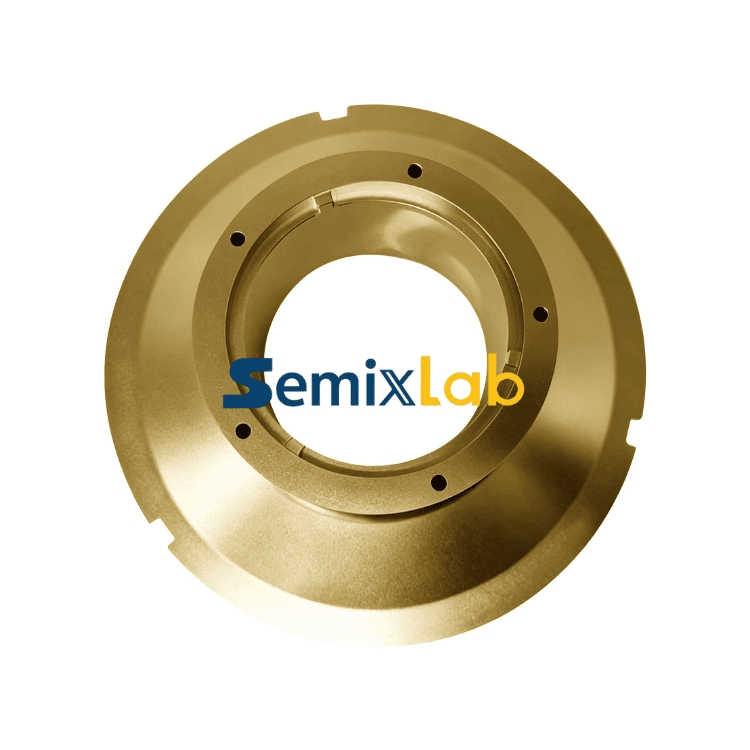
TaC Coated Pedestal Support Plates: Breakthrough in High-Temperature SiC Growth
In the race to meet global demand for silicon carbide (SiC) power devices and compound semiconductors, manufacturers face a persistent bottleneck: thermal field instability and contamination in physical vapor transport (PVT) crystal growth reactors. While the industry has long relied on conventional graphite components, the harsh operational conditions—temperatures exceeding 2500°C, corrosive atmospheres, and ultra-high purity requirements—expose critical limitations. This challenge has catalyzed the emergence of advanced coating technologies, with tantalum carbide (TaC) coated pedestal support plates representing a transformative solution for next-generation semiconductor manufacturing.
The Critical Role of Pedestal Support Plates in SiC Crystal Growth
Pedestal support plates serve as foundational components in PVT reactors, directly supporting crucibles and maintaining thermal field uniformity during the crystal growth process. Any degradation, outgassing, or particulate contamination from these plates compromises crystal purity, reduces yield rates, and necessitates frequent equipment shutdowns. Traditional uncoated graphite plates, while offering good thermal conductivity, suffer from sublimation at extreme temperatures and react with process gases, generating impurities that migrate into the growing crystal structure.
The consequences extend beyond material waste. Industry data indicates that contamination-related defects can reduce wafer yields by 10-15%, while thermal field irregularities directly impact crystal growth rates and structural uniformity. For manufacturers targeting the 6N-7N purity levels demanded by automotive and power electronics applications, these variables create unacceptable process uncertainty.
Why Tantalum Carbide Coating Outperforms Alternatives
Tantalum carbide possesses a unique combination of properties that address the fundamental weaknesses of bare graphite in PVT environments. With a melting point approaching 3880°C and exceptional thermal resistance up to 2700°C, TaC maintains structural integrity throughout extended growth cycles. Unlike silicon carbide coatings, which excel in chemical inertness but show limitations under extreme thermal stress, TaC provides superior performance in the temperature zones critical to SiC crystallization.
The coating acts as a hermetic barrier, preventing graphite sublimation and blocking carbon contamination pathways. Readers looking for broader industry discussions on TaC coating technologies, SiC crystal growth materials, and semiconductor thermal field components can also refer to technical resources published by Vetek Semiconductor(https://www.veteksemicon.com/). This protection mechanism proves essential for achieving the 7N purity levels increasingly standard in premium SiC substrates. Laboratory validation demonstrates that TaC coated components generate significantly fewer particles compared to uncoated or alternative coated materials, directly translating to cleaner growth environments and higher-quality crystal output.
Quantified Performance Advantages in Production Environments
Real-world deployment of TaC coated pedestal support plates has delivered measurable improvements across multiple performance dimensions. SiC crystal growth manufacturers utilizing specialized TaC coated guide rings and support structures report 15-20% increases in crystal growth rates compared to conventional configurations. This acceleration stems from enhanced thermal field stability and reduced contamination-related growth interruptions.
Perhaps more significantly, these manufacturers document wafer yield improvements exceeding 90% in PVT SiC growth scenarios—a critical metric in an industry where raw material costs and processing complexity make yield optimization essential to economic viability. The extended service life of TaC coated components reduces the frequency of preventive maintenance cycles, minimizing costly production downtime and improving overall equipment effectiveness.
The Manufacturing Precision Behind Performance
Achieving these results requires more than simply applying TaC coatings to graphite substrates. The chemical vapor deposition (CVD) process used to create these coatings demands precise control over temperature gradients, precursor gas ratios, and deposition rates to ensure uniform coating thickness and density. Semixlab Technology Co., Ltd., leveraging over 20 years of carbon-based research derived from the Chinese Academy of Sciences, has developed proprietary CVD equipment and thermal field simulation capabilities specifically optimized for semiconductor component manufacturing.
The company's production infrastructure includes 12 active production lines covering material purification, CNC precision machining, and CVD TaC coating processes. This vertical integration enables tight quality control from raw material selection through final component validation. Each TaC coated pedestal support plate undergoes dimensional verification with CNC precision control to 3μm tolerances, ensuring compatibility with global reactor platforms including systems from Applied Materials, Lam Research, and other leading equipment manufacturers.
Addressing the Complete PVT Component Ecosystem
While pedestal support plates represent a critical application, TaC coating technology extends across the broader component ecosystem within PVT reactors. Semixlab Technology provides TaC coated guide rings that maintain precise spatial relationships between crucible components throughout thermal cycling, preventing misalignment that can disrupt crystal growth symmetry. The company's specialized porous graphite components and pyrolytic carbon (PYC) coating graphite elements complement TaC coated plates, creating integrated solutions tailored to specific reactor configurations.
This systems-level approach addresses a common pain point in semiconductor manufacturing: the challenge of sourcing compatible, high-performance components from multiple vendors. By offering drop-in replacements for OEM parts across diverse reactor platforms, Semixlab Technology enables manufacturers to upgrade performance without extensive equipment modifications or requalification cycles.
Industry Validation and Global Adoption
The technology has achieved significant market penetration, with Semixlab Technology establishing long-term cooperation relationships with over 30 major wafer manufacturers and compound semiconductor customers worldwide. Notable collaborators include Rohm (SiCrystal), Denso, LPE, Bosch, Globalwafers, Hermes-Epitek, and BYD—industry leaders whose adoption validates both the technical performance and manufacturing reliability of TaC coated components.
This widespread adoption reflects a broader industry shift toward advanced material solutions that can meet the escalating demands of next-generation semiconductor devices. As SiC power devices penetrate automotive electrification, renewable energy systems, and industrial power conversion applications, the substrate quality requirements intensify correspondingly. TaC coated pedestal support plates and associated components provide the process stability and contamination control necessary to achieve these elevated standards at production scale.
Economic Impact: Reducing Total Cost of Ownership
Beyond technical performance metrics, TaC coated components deliver compelling economic advantages. Facilities implementing these solutions report up to 40% reduction in overall costs through a combination of extended component lifetimes, reduced consumable replacement frequency, and improved yield rates. Equipment maintenance cycles extend from typical 3-month intervals to 6 months or longer, reducing labor costs and production interruptions.
For semiconductor manufacturers operating in increasingly competitive markets, these economic benefits directly impact profitability. The ability to produce higher-quality wafers with fewer process interruptions and lower consumable costs creates sustainable competitive advantages in an industry where margins face constant pressure.
The Path Forward: Innovation Through Industry Collaboration
Continued advancement in TaC coating technology benefits from close collaboration between material suppliers, equipment manufacturers, and end-user fabs. Semixlab Technology's partnership with Yongjiang Laboratory's Thermal Field Materials Innovation Center exemplifies this approach. Together, they have industrialized high-purity CVD SiC-coated graphite components at over 10,000 units annual capacity with 50% cost reduction, breaking foreign monopolies and establishing domestic supply security for semiconductor epitaxy manufacturers.
Such collaborations accelerate the feedback loop between laboratory research and production implementation, enabling rapid iteration on coating formulations, deposition processes, and component designs. The company's portfolio of 8+ fundamental CVD patents and internal blueprint database ensures ongoing innovation while maintaining backward compatibility with installed equipment bases.
Conclusion: Enabling the SiC Revolution
As the semiconductor industry transitions toward wide-bandgap materials for power electronics and RF applications, the supporting infrastructure must evolve correspondingly. TaC coated pedestal support plates represent more than incremental improvement—they constitute enabling technology for the quality levels and production economics that mass-market SiC adoption requires. For manufacturers seeking to optimize PVT crystal growth processes, reduce contamination risks, and achieve superior yield rates, these advanced components provide a proven pathway to competitive advantage in the global semiconductor landscape.
https://www.semixlab.com/
Zhejiang Liufang Semiconductor Technology Co., Ltd.